450th Birthday of Galileo Galilei
 + Add to collection In collection ★ Wanted
 At a glance
| Country | Italy |
|---|---|
| Year | 2014 |
| Issue date | 17 June 2014 |
| Coin type | Commemorative coin |
| Mintage | 6.500.000 (37.000 / 4.000) |
| Catalogue number | IT-14 G2 |
| Designer | Claudia Momoni |
| Rarity | €€€€€ what does this mean? |
| Edge lettering |  |
| Market value (approx.) | 4 € · guide price, uncirculated Unlock · for members |
Coin description
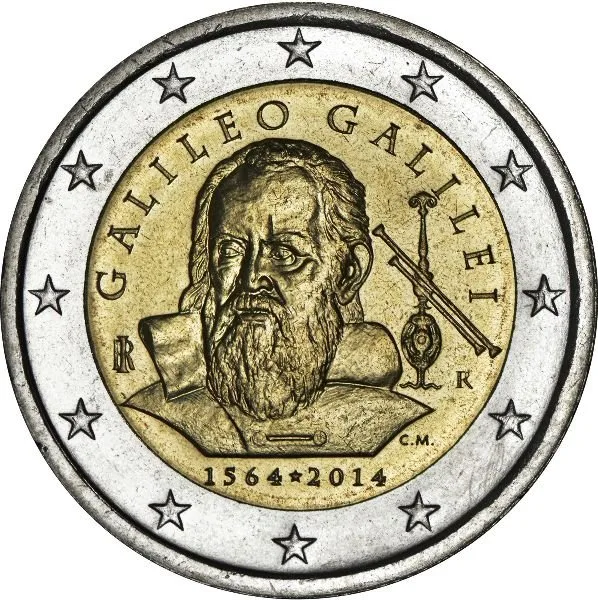
Head of Galileo Galilei after the 1636 portrait by Justus Sustermans (Florence, Uffizi Gallery). Arcing above, the name "Galileo GALILEI"; to the right, the "R" mintmark of the Rome Mint, an astronomical telescope, and the initials "C.M." (engraver Claudia Momoni); to the left, the overlapping letters of the Italian Republic monogram "RI"; in the lower portion, the dates "1564–2014".
Further information on the topic
As early as 1609, with a telescope he built himself and pointed at the night sky, Galileo Galilei made observations that permanently shook the geocentric worldview: the moons of Jupiter, the phases of Venus, the irregularities of the lunar surface. Born in Pisa in 1564, this mathematician and natural philosopher combined systematic observation with mathematical analysis — a method that makes him a founder of modern empirical science. At the University of Padua, where he taught for almost twenty years, he also developed fundamental laws of falling motion and inertia, later taken up by Newton in building classical mechanics. Galileo's Tuscan origins and his close ties to Florence — he spent the last part of his life under the protection of the Medici in Arcetri near Florence — firmly anchor him in the scholarly culture of early modern northern Italy.
The trial before the Roman Inquisition in 1633, which forced him to recant the Copernican system and ended in house arrest, made Galileo a symbol of the conflict between institutional authority and scientific knowledge. Only in 1992 did the Catholic Church officially rehabilitate him. His major work, Dialogue Concerning the Two Chief World Systems (1632), directly triggered the trial; the Discourses and Mathematical Demonstrations Relating to Two New Sciences, published in 1638 in exile in the Netherlands, laid the foundations of modern dynamics. With a commemorative coin from 2014, Italy honoured the 450th birthday of Galileo Galilei — marking a scientist whose methods and conflicts have lastingly shaped European thought.
Technical data
| Face value | 2 euro |
|---|---|
| Material | Bimetallic – outer ring: cupronickel; centre: three layers (nickel-brass / nickel / nickel-brass) |
| Weight | 8.5 g |
| Diameter | 25.75 mm |
| Thickness | 2.20 mm |