50 Years of the Treaties of Rome
 + Add to collection In collection ★ Wanted
 At a glance
| Country | Italy |
|---|---|
| Year | 2007 |
| Issue date | 25 March 2007 |
| Coin type | Commemorative coin |
| Mintage | 5.000.000 ( – / – ) |
| Catalogue number | IT-07 G1 |
| Designer | Münze Österreich, Real Casa de la Moneda, Istituto Poligrafico e Zecca dello Stato S.p.A |
| Rarity | €€€€€ what does this mean? |
| Edge lettering |  |
| Market value (approx.) | 5 € · guide price, uncirculated Unlock · for members |
Coin description
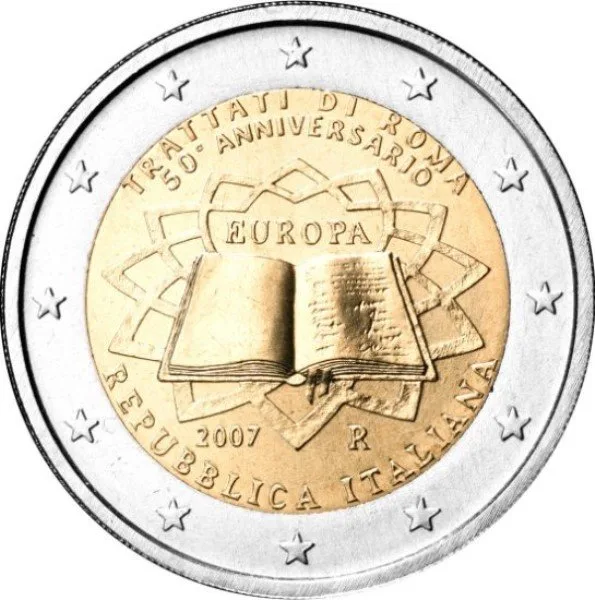
At the centre, the treaty document signed by the six founding members, set against Michelangelo's star-patterned pavement on the Piazza del Campidoglio in Rome, where the Treaty was signed on 25 March 1957. Directly above the treaty, the word "Europe" is engraved in the respective language. Above, the commemorative occasion; below, the issuing country in the relevant language version(s) and the year 2007.
Note on the coin
First joint issue of the European Union. All 13 euro-area states issued a coin with the same design on the anniversary date of 25 March 2007. The coins differ only in the inscription, which appears in each country's national language.
Further information on the topic
That the treaties establishing the European Economic Community and the European Atomic Energy Community were signed in Rome of all places was no coincidence: since the end of the Second World War, Italy had consistently positioned itself as an advocate of closer Western European cooperation. On 25 March 1957, the foreign ministers of the six founding states — Belgium, the Federal Republic of Germany, France, Italy, Luxembourg, and the Netherlands — gathered in the Palazzo dei Senatori on the Capitoline Hill to sign the treaties. The location was chosen deliberately: the square designed by Michelangelo, with its star-shaped paving pattern, symbolised both state tradition and European dignity. The Treaties of Rome created the legal framework for a common market, the dismantling of trade barriers, and the free movement of goods — foundations on which the later European Union was built.
For Italy, the treaties also marked an economic turning point: the country was in the midst of the so-called miracolo economico, the Italian economic miracle of the late 1950s and 1960s, which received an additional boost from integration into the common European market. Institutional interconnection with the other EEC states considerably accelerated industrialisation and export growth in northern Italy. From the EEC, the European Communities emerged over the decades and, finally, with the Maastricht Treaty of 1993, the European Union. To mark the 50th anniversary of the signing in 2007, all euro states — including Italy as host of the original signing — issued a joint 2-euro commemorative coin.
Technical data
| Face value | 2 euro |
|---|---|
| Material | Bimetallic – outer ring: cupronickel; centre: three layers (nickel-brass / nickel / nickel-brass) |
| Weight | 8.5 g |
| Diameter | 25.75 mm |
| Thickness | 2.20 mm |