200th Birthday of Louis Braille
 + Add to collection In collection ★ Wanted
 At a glance
| Country | Italy |
|---|---|
| Year | 2009 |
| Issue date | 15 October 2009 |
| Coin type | Commemorative coin |
| Mintage | 2.000.000 (15.000 / – ) |
| Catalogue number | IT-09 G2 |
| Designer | Maria Carmela Colaneri |
| Rarity | €€€€€ what does this mean? |
| Edge lettering |  |
| Market value (approx.) | 4 € · guide price, uncirculated Unlock · for members |
Coin description
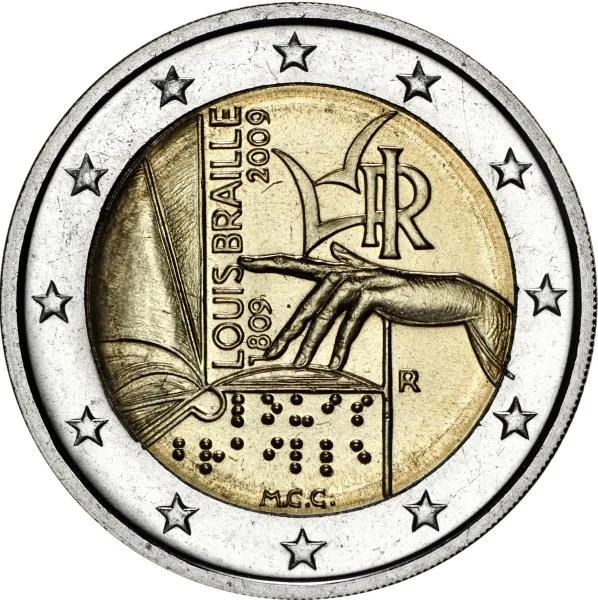
A hand reading an open book in Braille. Above the index finger, pointing to the vertical inscription "LOUIS BRAILLE 1809–2009", two birds symbolise the freedom brought by knowledge. The issuing country abbreviation "RI" appears at upper right and the engraver's "R" at lower right. Below the book, the name Braille is written in Braille script. At the very bottom, the initials "MCC" of artist Maria Carmela Colaneri.
Further information on the topic
Louis Braille was born in 1809 in Coupvray near Paris and lost his sight as a young child after an accident in his father's workshop. At the age of ten, he entered the Royal Institute for Blind Youth in Paris, where he encountered the military's tactile writing system in use at the time and developed it into a wholly new system. The Braille alphabet, which he completed in the 1820s and first published in 1829, is based on six-dot cells and, for the first time, allowed blind people both to read and to write independently. Braille himself taught at the Paris institute until his death in 1852; his invention, however, only spread worldwide after his death and is today regarded as one of the most consequential innovations for the social inclusion of people with visual impairments.
The writing system bears his name in almost every language of the world and remains to this day the international standard for tactile writing — from books and medicine packaging to elevator buttons and banknotes. UNESCO declared Braille an intangible cultural heritage of humanity in 2018. With its 2-euro commemorative coin of 2009, Italy honours the 200th birthday of Louis Braille, joining a broad international tribute that anchors Braille's life's work as a lasting part of cultural memory.
Technical data
| Face value | 2 euro |
|---|---|
| Material | Bimetallic – outer ring: cupronickel; centre: three layers (nickel-brass / nickel / nickel-brass) |
| Weight | 8.5 g |
| Diameter | 25.75 mm |
| Thickness | 2.20 mm |