30 Years of the European Flag
 + Add to collection In collection ★ Wanted
 At a glance
| Country | Lithuania |
|---|---|
| Year | 2015 |
| Issue date | 17 November 2015 |
| Coin type | Commemorative coin |
| Mintage | 750.000 (5.000 / – ) |
| Catalogue number | LT-15 G1 |
| Designer | Georgios Stamatopoulos |
| Rarity | €€€€€ what does this mean? |
| Edge lettering |  |
| Market value (approx.) | 4 € · guide price, uncirculated Unlock · for members |
Coin description
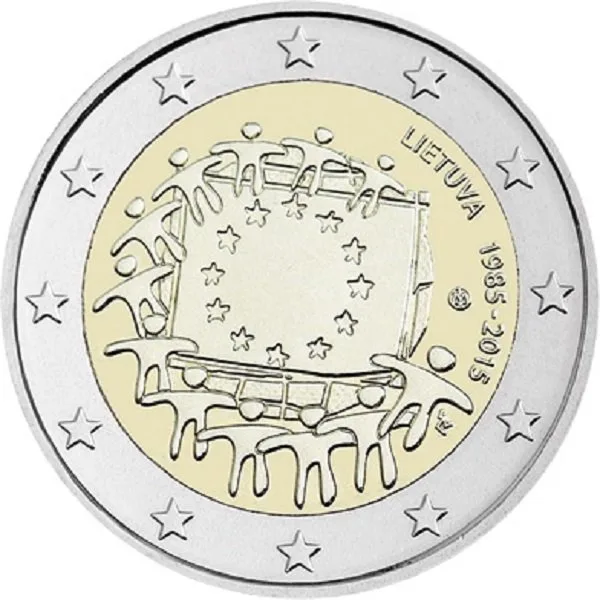
The EU flag as a symbol bringing peoples and cultures together in pursuit of shared ideals and a better future. Twelve stars take on human form, welcoming the birth of a new Europe. The issuing state "LIETUVA" and the years "1985–2015" run along the upper right of the coin ring. The mintmark sits to the right between the flag and the dates. The designer Georgios Stamatopoulos's initials appear at lower right.
Note on the coin
Fourth joint issue of the European Union. All 19 eurozone states issued a coin with the same design on varying dates. The coins differ only in the inscription, which appears in the respective national language.
Further information on the topic
For Lithuania, the European Union and its symbolism are no abstract project but closely tied to a concrete historical turning point: after decades of Soviet occupation, the country regained independence in 1990 as the first Soviet republic to do so, and joined the EU in 2004. The European flag — twelve gold stars on a blue background — stood for a membership Lithuania had actively pursued. Its symbolism dates back to 1955, when the Council of Europe introduced the banner; the number of stars does not represent a specific number of members but stands for completeness and unity. Since its adoption by the European Community in 1986, the flag has become the world's most recognised emblem of European unification.
The thirtieth anniversary of the flag's status as an official symbol of the European Community was marked in 2015 by a Europe-wide joint issue in which all euro states — Lithuania among them — took part with an identical design. Today the flag connects 27 member states with different languages, legal traditions, and historical experiences. For countries like Lithuania, which could only complete accession after the end of the Cold War, the symbol carries a particular dimension: it marks not just membership in an economic area, but the culmination of a long reorientation toward the West. The Lithuanian version of this joint coin accordingly bears the country name "Lietuva" and points to a membership that continues to enjoy broad support at home.
Technical data
| Face value | 2 euro |
|---|---|
| Material | Bimetallic – outer ring: cupronickel; centre: three layers (nickel-brass / nickel / nickel-brass) |
| Weight | 8.5 g |
| Diameter | 25.75 mm |
| Thickness | 2.20 mm |