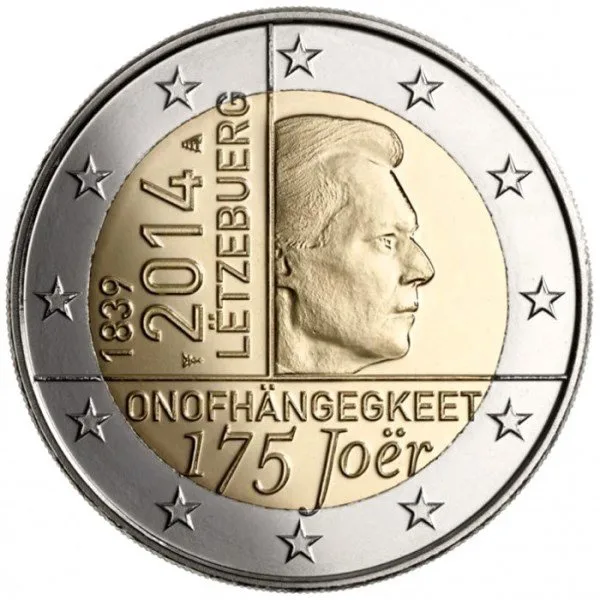
175 Years of Independence
 + Add to collection In collection ★ Wanted
 At a glance
| Country | Luxembourg |
|---|---|
| Year | 2014 |
| Issue date | 6 February 2014 |
| Coin type | Commemorative coin |
| Mintage | 522.000 (17.500 / 4.500) |
| Catalogue number | LU-14 G1 |
| Designer | Alain Hoffmann |
| Rarity | €€€€€ what does this mean? |
| Edge lettering |  |
| Market value (approx.) | 3,5 € · guide price, uncirculated Unlock · for members |
Coin description
Grand Duke Henri in right-facing profile, with the years "1839" and "2014" and the issuing state "LËTZEBUERG" arranged vertically to the left. In the lower field: the words "ONOFHÄNGEGKEET" and "175 Joër".
Note on the coin
In 2015 a retrospective set was issued comprising the Luxembourg €2 commemorative coins of 2013–2015 (LU-13 G1, LU-14 G1, LU-14 G2, LU-15 G1, LU-15 G2, LU-15 G3).
Further information on the topic
Luxembourg's independence is not a foundation built up over centuries but a relatively young one: the Treaty of London of 19 April 1839 recognised the Grand Duchy as a sovereign state under international law while simultaneously reducing its territory - the Walloon western part was ceded to Belgium. What remained was a small yet independent country among Europe's great powers, one that henceforth had to assert its own neutrality and state integrity. This configuration lastingly shaped Luxembourg's political self-image: a capacity for compromise, multilingualism, and close integration into European structures - Luxembourg was among the founding members of the European Communities - can be traced directly to the experience the country has gathered since 1839.
The Grand Ducal House of Nassau-Weilburg, from which Grand Duke Henri descends, stands in direct dynastic continuity with that founding phase of modern Luxembourg. Henri has reigned since 2000 as head of state of a country that in 2014 celebrated its 175th anniversary as an independent state. The Luxembourgish term "Onofhängegkeet" - independence - along with the years 1839 and 2014, mark precisely this span of time on the coin. Luxembourg, today home to several EU institutions and an international financial centre, has developed since 1839 from a neutralised buffer state into one of the wealthiest and most politically influential small states in the world.
Technical data
| Face value | 2 euro |
|---|---|
| Material | Bimetallic – outer ring: cupronickel; centre: three layers (nickel-brass / nickel / nickel-brass) |
| Weight | 8.5 g |
| Diameter | 25.75 mm |
| Thickness | 2.20 mm |
More 2-euro coins from Luxembourg
50th Anniversary of Grand Duke Jean's Accession to the Throne
Commemorative coin
30 Years of the European Flag
Commemorative coin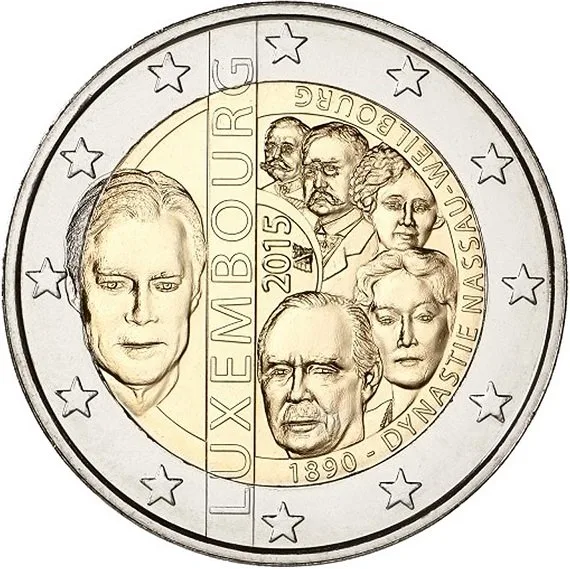
125 Years of the Nassau-Weilburg Dynasty
Commemorative coin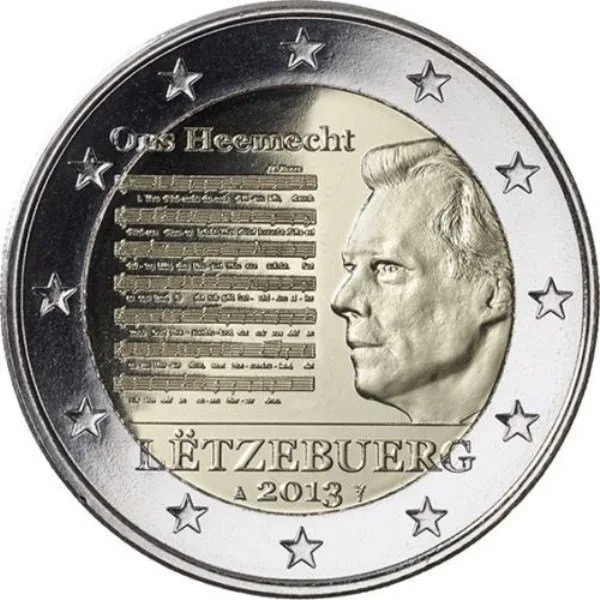
National Anthem of Luxembourg
Commemorative coin