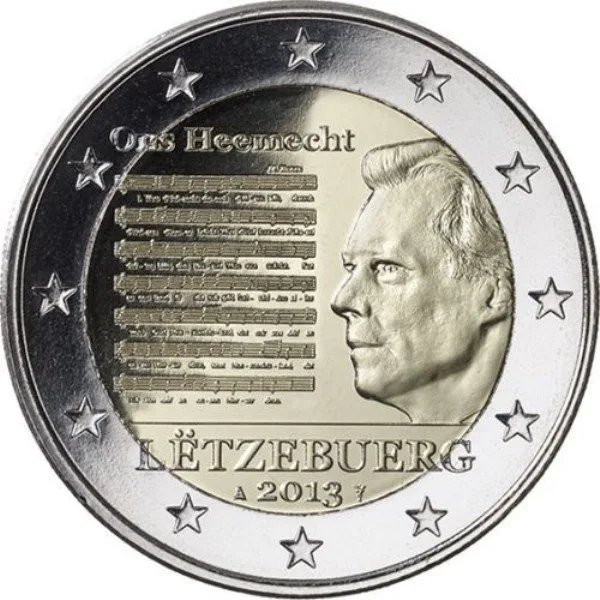
2 euro Luxembourg 2013 National Anthem of Luxembourg
 + Add to collection In collection ★ Wanted
At a glance
| Country | Luxembourg |
|---|---|
| Year | 2013 |
| Issue date | 7 November 2013 |
| Coin type | Commemorative coin |
| Mintage | 722,000 (17,500 / 4,500) |
| Catalogue number | LU-13 G1 |
| Designer | Alain Hoffmann |
| Rarity | €€€€€ what does this mean? |
| Edge lettering |  |
| Market value (approx.) | €4.50 · guide price, uncirculated Unlock · for members |
Market price history
Coin description
Grand Duke Henri's left-facing profile; to the left of the inner field: musical notation and the text of the national anthem. "Ons Heemecht" appears in the upper field; in the lower field: the country name "LËTZEBUERG" and the year "2013", flanked by the mintmaster's and mintmarks.
Note on the coin
In 2015 a retrospective set was issued comprising the Luxembourg 2-euro commemorative coins of 2013–2015 (LU-13 G1, LU-14 G1, LU-14 G2, LU-15 G1, LU-15 G2, LU-15 G3).
Further information on the topic
"Ons Heemecht" - "Our Homeland" - was first sung in public on 5 June 1864 in Ettelbruck, subsequently became Luxembourg's national anthem and has also been legally established as such since 1993. It is one of the few European anthems that carries no note of battle or triumph whatsoever. The text was written in 1859 by the poet Michel Lentz; the music was composed by Johann Anton Zinnen. What defines the song is its character as a homeland anthem in the literal sense: it describes the Moselle, the valleys and forests of Luxembourg, not the state or its history. Luxembourgish, the Lëtzebuergesch language, was barely codified in writing during Lentz's time - "Ons Heemecht" therefore also ranks among the early documents of an independent Luxembourgish linguistic identity.
That the Grand Duchy of Luxembourg dedicated a commemorative coin to the anthem in 2013 should be understood against the backdrop of a deliberately cultivated policy of multilingualism. Lëtzebuergesch was only recognised by law as an official language in 1984 - alongside French and German - and has since become a symbol of a national identity defined not by size but by continuity and cultural distinctiveness. At around 2,600 square kilometres, Luxembourg is one of the smallest states in the eurozone, yet one of the oldest sovereign ones: the Grand Duchy's independence was internationally guaranteed in 1867 by the Treaty of London. The 2013 coin shows the music and lyrics of the anthem alongside the portrait of Grand Duke Henri.
Technical data
| Face value | 2 euro |
|---|---|
| Material | Bimetallic – outer ring: cupronickel; centre: three layers (nickel-brass / nickel / nickel-brass) |
| Weight | 8.5 g |
| Diameter | 25.75 mm |
| Thickness | 2.20 mm |
More 2-euro coins from Luxembourg
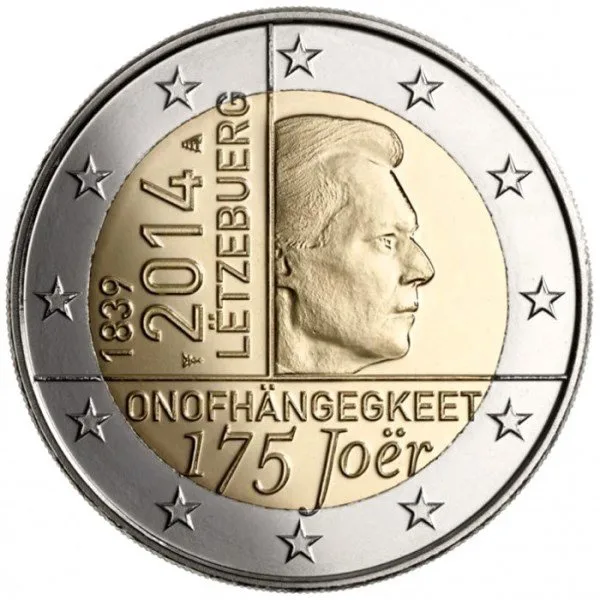
175 Years of Independence
Commemorative coin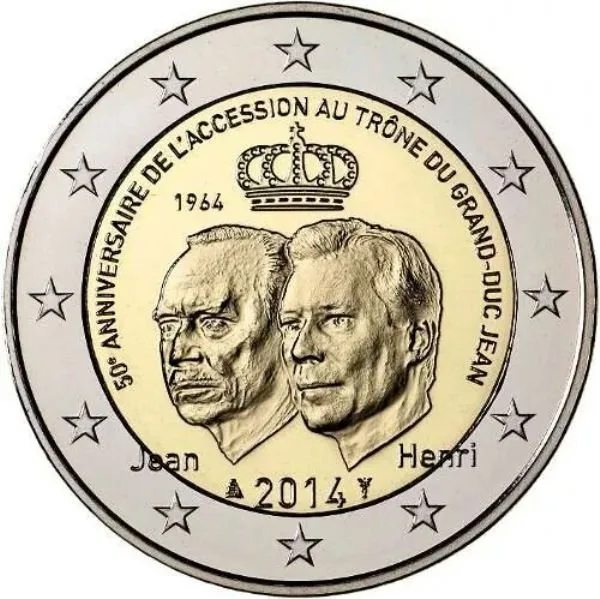
50th Anniversary of Grand Duke Jean's Accession to the Throne
Commemorative coin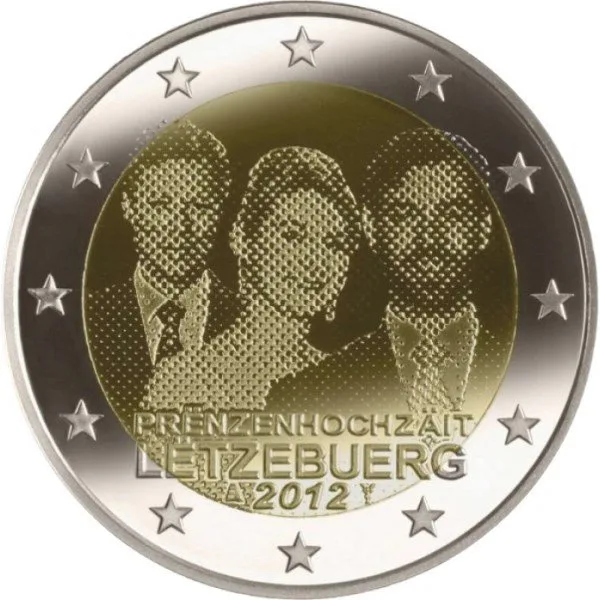
Wedding of Hereditary Grand Duke Guillaume and Stéphanie
Commemorative coin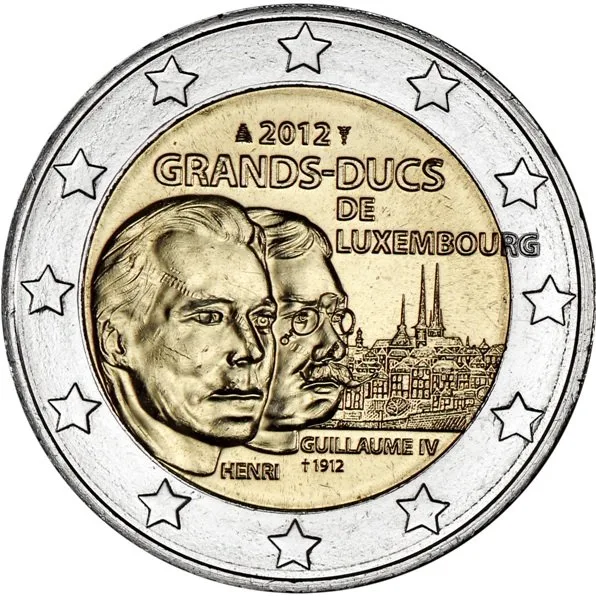
100th Anniversary of the Death of Grand Duke Guillaume IV
Commemorative coin