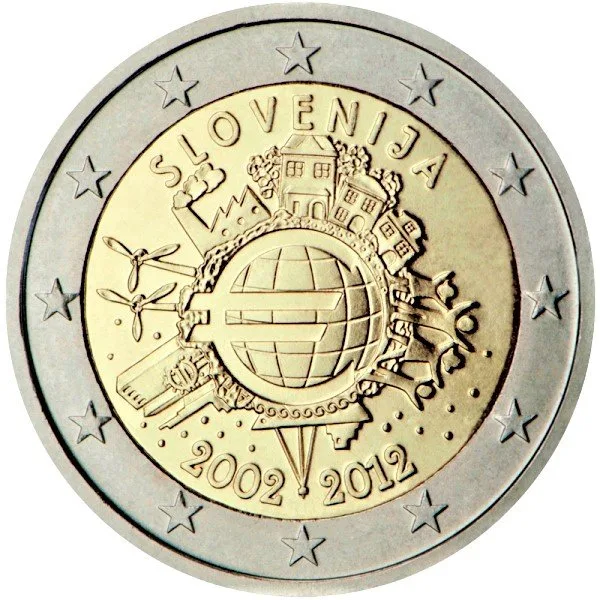
10 Years of Euro Banknotes and Coins
 + Add to collection In collection ★ Wanted
 At a glance
| Country | Slovenia |
|---|---|
| Year | 2012 |
| Issue date | 3 January 2012 |
| Coin type | Commemorative coin |
| Mintage | 1.000.000 (15.000/ 14.000) |
| Catalogue number | SI-12 G1 |
| Designer | Helmut Andexlinger |
| Rarity | €€€€€ what does this mean? |
| Edge lettering |  |
| Market value (approx.) | 4 € · guide price, uncirculated Unlock · for members |
Coin description
The euro has grown into a major factor both across Europe and globally, establishing itself as a key player in the international monetary system. The design elements surrounding the euro sign symbolise its significance for everyday people, the financial world (the ECB tower), trade (ships), industry (factories), the energy sector, and research and development (wind turbines). The initials of designer Helmut Andexlinger appear below the ECB tower. The names of the issuing states in their respective languages are inscribed centrally above the design, with the dates 2002–2012 below.
Note on the coin
Third joint issue of the European Union. All 17 eurozone states issued a coin with the same design on the anniversary date of 1 January 2012. The coins differ only in the legend, which appears in the respective national language. San Marino also issued a coin with the same design, which is not officially part of the joint issue.
Further information on the topic
On 1 January 2002, banknotes and coins were introduced simultaneously across twelve eurozone countries — a logistical undertaking without historical precedent. Within a few weeks, national currencies such as the Deutsche Mark, the French franc, and the Italian lira disappeared from circulation. Slovenia only joined the eurozone in 2007 and introduced euro cash accordingly later, but had been part of the European economic integration that preceded this monetary union from the outset. After regaining independence in 1991, the country moved swiftly toward EU membership, joining the European Union in 2004 — a basic prerequisite for its later adoption of the euro.
In its first ten years of existence, the euro developed into the world's second most important reserve currency, shaping trade, capital flows, and economic policy far beyond the eurozone. The European Central Bank, cross-border trade in goods, and the industrial interconnection of member states formed the institutional foundation of this currency. To mark the tenth anniversary of euro cash, all euro states jointly issued a commemorative coin in 2012 — a European joint issue with a uniform design. Slovenia took part as a full member of the eurozone, issuing the 2-euro commemorative coin together with all other euro countries.
Technical data
| Face value | 2 euro |
|---|---|
| Material | Bimetallic – outer ring: cupronickel; centre: three layers (nickel-brass / nickel / nickel-brass) |
| Weight | 8.5 g |
| Diameter | 25.75 mm |
| Thickness | 2.20 mm |
More 2-euro coins from Slovenia
100th Birthday of Franc Rozman
Commemorative coin
800 Years of Postojna Cave
Commemorative coin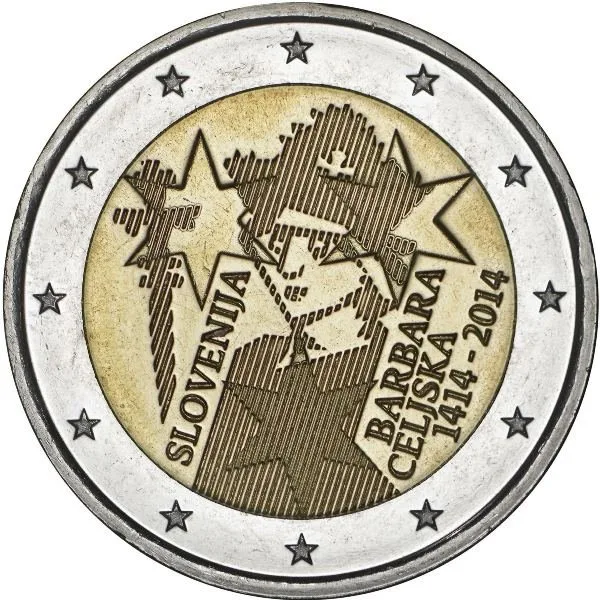
600th Anniversary of the Coronation of Barbara of Celje
Commemorative coin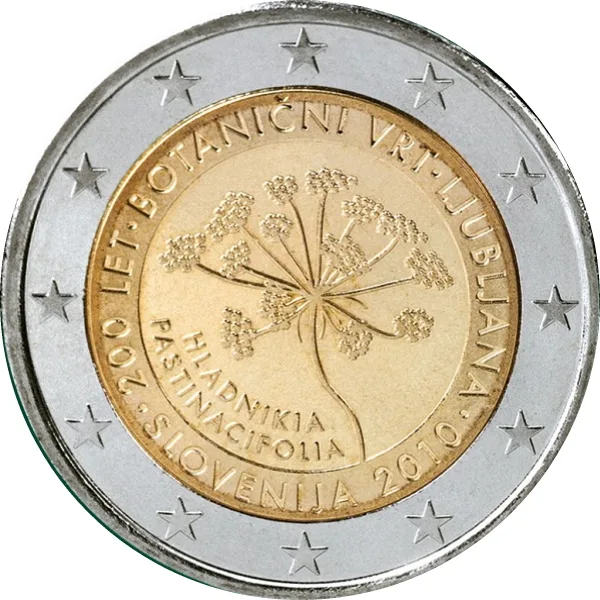
200 Years of the Ljubljana Botanical Garden
Commemorative coin