50 Years of the Treaties of Rome
 + Add to collection In collection ★ Wanted
 At a glance
| Country | Spain |
|---|---|
| Year | 2007 |
| Issue date | 25 March 2007 |
| Coin type | Commemorative coin |
| Mintage | 8.000.000 (59.766 / 1.800) |
| Catalogue number | ES-07 G1 |
| Designer | Münze Österreich, Real Casa de la Moneda, Istituto Poligrafico e Zecca dello Stato S.p.A |
| Rarity | €€€€€ what does this mean? |
| Edge lettering |  |
| Market value (approx.) | 5 € · guide price, uncirculated Unlock · for members |
Coin description
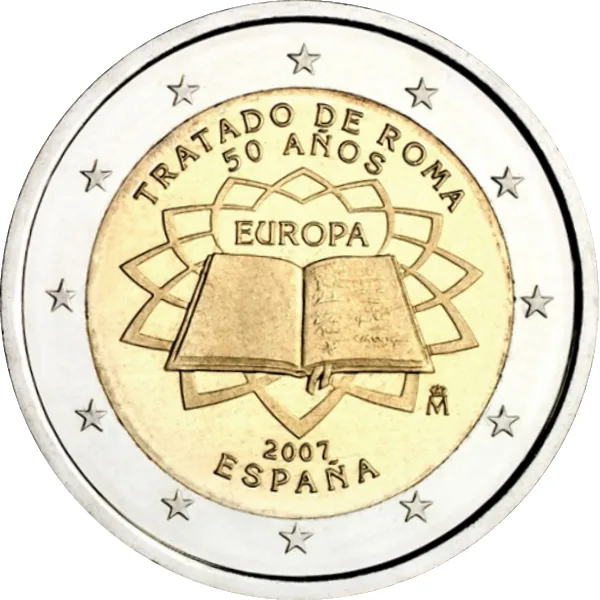
At the centre, the treaty document signed by the six founding members, set against the star-shaped paving of the Piazza del Campidoglio in Rome — designed by Michelangelo — where the Treaty was signed on 25 March 1957. Directly above the document, the word 'Europa' is inscribed in the language of each issuing state. The commemorative inscription appears above; the issuing state name in the relevant language(s) and the year 2007 appear below.
Note on the coin
First joint issue of the European Union. All 13 eurozone states issued a coin with the same design on 25 March 2007 to mark the anniversary. The coins differ only in their inscriptions, which appear in the respective national language.
Further information on the topic
In 1957, Spain was still far from Europe — not geographically, but politically. The Franco regime stood outside the architecture of Western European integration, and while the six founding states signed the treaties establishing the European Economic Community and the European Atomic Energy Community on the Capitoline Hill in Rome on 25 March 1957, Spain remained isolated. These treaties created the institutional framework for a common market, the removal of trade barriers and coordinated economic policy — a foundation from which the European Union would emerge decades later. The signing ceremony on the Capitoline Square, designed by Michelangelo, became a lasting symbol of this historic turning point.
Only after Franco's death and the democratic transition to a constitutional monarchy did Spain apply for EEC membership in 1977. Accession followed in 1986, together with Portugal, marking the southern enlargement of the European Communities. Since then, as one of the largest economies in the eurozone, Spain has carried considerable weight in the European institutional architecture — from the EU Council presidency to structural policy. Spain introduced the euro on 1 January 1999 (as scriptural money) and as cash in 2002. For the 50th anniversary of the Treaties of Rome in 2007, Spain took part in the Europe-wide joint issue in which all euro states released a 2-euro commemorative coin with a common design.
Technical data
| Face value | 2 euro |
|---|---|
| Material | Bimetallic – outer ring: cupronickel; centre: three layers (nickel-brass / nickel / nickel-brass) |
| Weight | 8.5 g |
| Diameter | 25.75 mm |
| Thickness | 2.20 mm |
More 2-euro coins from Spain
400 Years of Don Quixote
Commemorative coin
10 Years of Economic and Monetary Union
Commemorative coin
King Juan Carlos I (2010 – 2014)
Circulation coin
UNESCO World Heritage Site – Historic Centre of Córdoba
Commemorative coin