400 Years of Don Quixote
 + Add to collection In collection ★ Wanted
 At a glance
| Country | Spain |
|---|---|
| Year | 2005 |
| Issue date | 30 July 2005 |
| Coin type | Commemorative coin |
| Mintage | 8.000.000 (104.923 / 3.000) |
| Catalogue number | ES-05 G1 |
| Designer | Begoña Castellanos Garcia |
| Rarity | €€€€€ what does this mean? |
| Edge lettering |  |
| Market value (approx.) | 3,5 € · guide price, uncirculated Unlock · for members |
Coin description
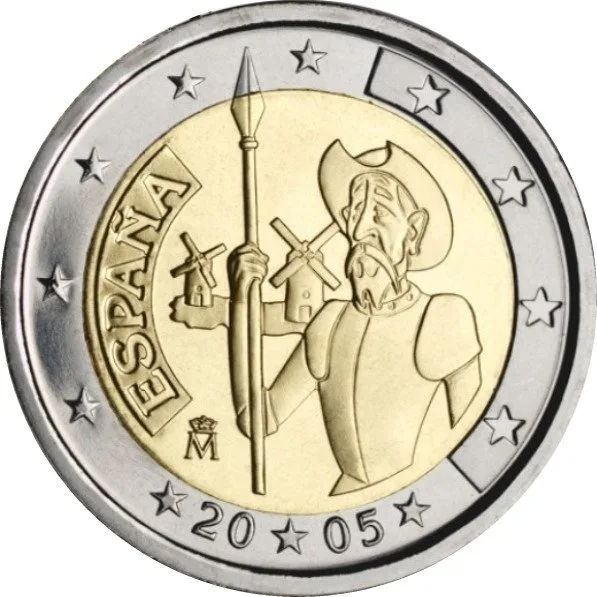
Miguel de Cervantes' fictional hero Don Quixote with a lance before the windmills; the state name 'ESPAÑA'; the year '2005' and the mintmark.
Further information on the topic
In the early 17th century, the Spanish writer Miguel de Cervantes Saavedra created one of the most influential figures in world literature: Don Quixote de la Mancha, the Knight of the Sorrowful Countenance. The first part of the novel appeared in Madrid in 1605, the second followed in 1615 — together they form the first modern prose work in European literary history. Cervantes, who spent much of his life in poverty and at times in captivity, originally set out to write a parody of the chivalric romances popular at the time. But his work far exceeded that intention: it portrays an aging country gentleman from the Spanish region of La Mancha who, after excessive reading of tales of chivalry, loses his mind and comes to see himself as a knight errant. At his side is the shrewd squire Sancho Panza, whose pragmatism contrasts with his master's idealistic delusions of grandeur.
The impact of Don Quixote on European literature and cultural history can hardly be overstated. Figures and motifs from the novel — tilting at windmills as a symbol of struggling against imaginary enemies, an unshakeable belief in a self-constructed reality — have become fixed elements of the collective cultural imagination. In Spain, Cervantes's work is regarded as national cultural heritage of the highest order; the Castilian language in which it was written still carries the nickname "Lengua de Cervantes" (the language of Cervantes) to this day. To mark the 400th anniversary of its first publication, Spain issued a 2-euro commemorative coin in 2005 honoring this literary milestone.
Technical data
| Face value | 2 euro |
|---|---|
| Material | Bimetallic – outer ring: cupronickel; centre: three layers (nickel-brass / nickel / nickel-brass) |
| Weight | 8.5 g |
| Diameter | 25.75 mm |
| Thickness | 2.20 mm |
More 2-euro coins from Spain
50 Years of the Treaties of Rome
Commemorative coin
10 Years of Economic and Monetary Union
Commemorative coin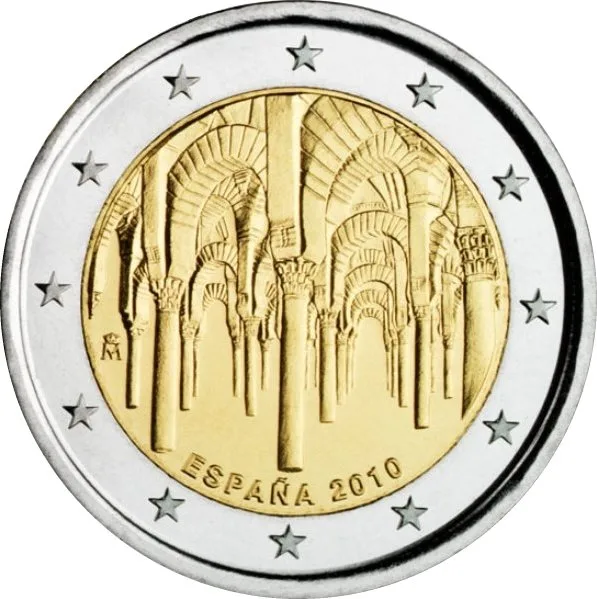
UNESCO World Heritage Site – Historic Centre of Córdoba
Commemorative coin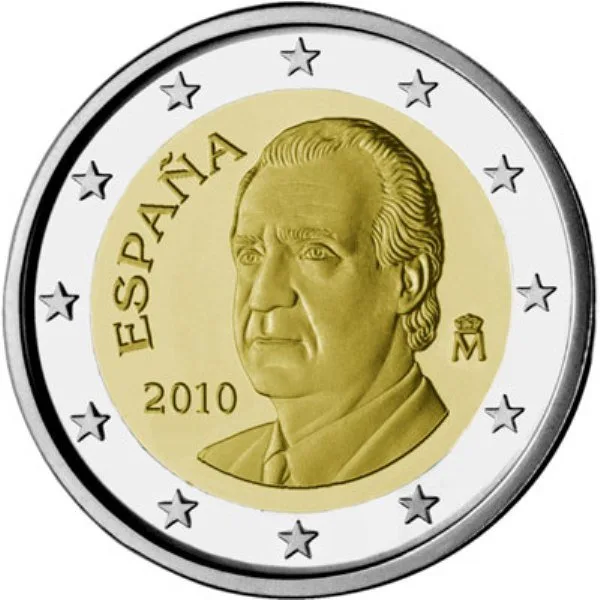
King Juan Carlos I (2010 – 2014)
Circulation coin