International Year of Astronomy
 + Add to collection In collection ★ Wanted
 At a glance
| Country | Vatican City |
|---|---|
| Year | 2009 |
| Issue date | 18 November 2009 |
| Coin type | Commemorative coin |
| Mintage | 106.084 (106.084 / – ) |
| Catalogue number | VA-09 G1 |
| Designer | Orietta Rossi |
| Rarity | €€€€€ what does this mean? |
| Edge lettering |  |
| Market value (approx.) | 50 € · guide price, uncirculated Unlock · for members |
Coin description
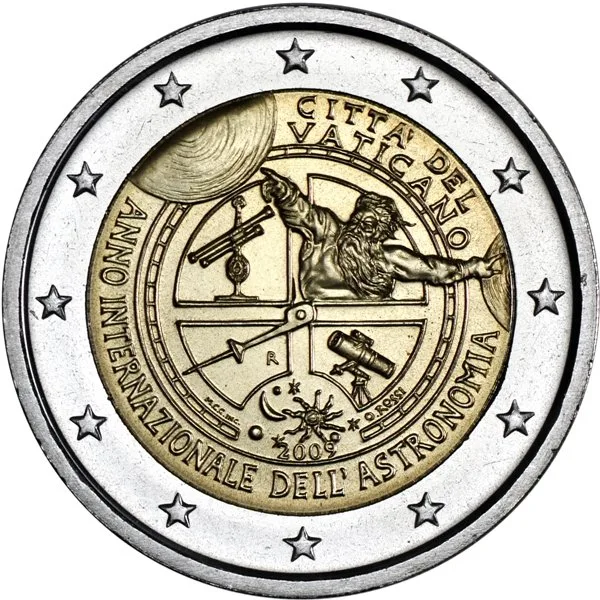
An astrolabe; at the centre, the creation of the Sun and Moon after Michelangelo's fresco in the Sistine Chapel; a Galilean telescope from 1609 and a reflecting telescope; the state name 'CITTÀ DEL VATICANO', the inscription 'Anno Internazionale Dell'Astronomia', the year 2009, the name of designer Orietta Rossi, the initials of engraver Maria Carmela Colaneri, and the mintmark 'R'.
Further information on the topic
Four hundred years ago, Galileo Galilei pointed his improved telescope systematically at the night sky for the first time - an act that reordered the history of astronomy. His observations of Jupiter's moons, the craters of the Moon and the phases of Venus provided concrete evidence for the heliocentric model of the universe and shook the geocentric explanatory model that the Church had upheld until then. That Galileo came into conflict with the Holy See over this and was condemned by the Inquisition tribunal in 1633 is one of the most consequential tensions between natural science and institutional religion in history. In 1992, the Catholic Church under John Paul II officially acknowledged the injustice of this trial - a late but weighty step that also realigned the Vatican's own understanding of matters of science.
The International Year of Astronomy 2009, proclaimed by UNESCO and the International Astronomical Union, marked the 400th anniversary of Galileo's groundbreaking observations of the heavens. For the Vatican, as an independent state with one of the oldest continuously operated observatories in the world - the Vatican Observatory traces its origins back to the 16th century - participation in this anniversary was more than a gesture. Papal astronomers continue their research to this day, at the observatory in Castel Gandolfo and at the Vatican Advanced Technology Telescope in Arizona. The Vatican's 2009 2-euro commemorative coin for the International Year of Astronomy commemorates this historic arc between Galileo's discoveries and the Holy See's ongoing scientific tradition.
Technical data
| Face value | 2 euro |
|---|---|
| Material | Bimetallic – outer ring: cupronickel; centre: three layers (nickel-brass / nickel / nickel-brass) |
| Weight | 8.5 g |
| Diameter | 25.75 mm |
| Thickness | 2.20 mm |