30 Years of the European Flag
 + Add to collection In collection ★ Wanted
 At a glance
| Country | Austria |
|---|---|
| Year | 2015 |
| Issue date | 30 October 2015 |
| Coin type | Commemorative coin |
| Mintage | 2.500.000 ( – / – ) |
| Catalogue number | AT-15 G1 |
| Designer | Georgios Stamatopoulos |
| Rarity | €€€€€ what does this mean? |
| Edge lettering |  |
| Market value (approx.) | 4 € · guide price, uncirculated Unlock · for members |
Coin description
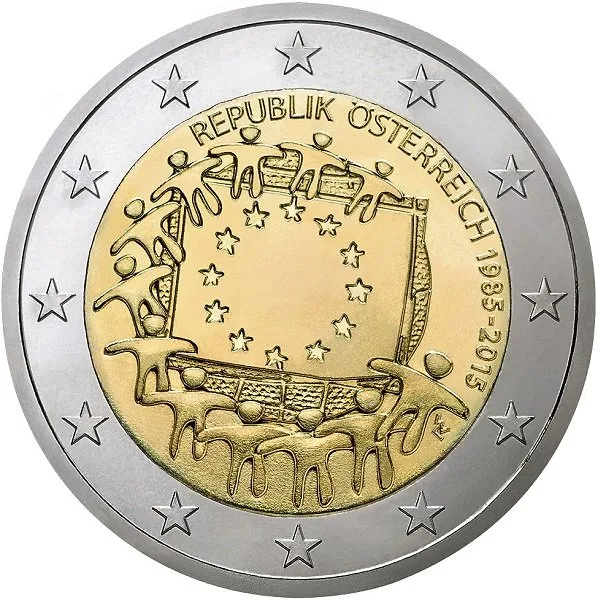
The EU flag as a symbol uniting peoples and cultures around shared values and ideals for a better future. Twelve stars take on human form and welcome the birth of a new Europe. Along the upper right of the coin ring: the issuing state "REPUBLIK ÖSTERREICH" and the dates "1985–2015". Lower right: the initials of designer Georgios Stamatopoulos.
Note on the coin
Fourth EU joint issue. All 19 eurozone states are releasing a coin with this design on various dates. The coins differ only in the inscription, which appears in the respective national language.
Further information on the topic
The European flag — a blue field with twelve gold stars arranged in a circle — did not originate as a flag of the European Union but as a symbol of the Council of Europe: the body founded in 1949 to safeguard human rights and parliamentary democracy adopted the emblem in 1955 after a lengthy design process. The twelve stars were never meant to count member states, but to signify perfection and unity — a symbolism deliberately conceived to be timeless. It was not until 1985 that the then European Community formally adopted the emblem as its own, creating a shared visual identity that has since come to represent the European integration process as a whole. Austria, which did not join the EU until 1995, had already known the flag as a symbol of the Council of Europe decades earlier.
The European Community's 1985 decision came during a period of accelerating integration: the single market was taking shape, the Schengen process was beginning, and the EC was expanding to ten members. The flag was meant to provide external recognisability and foster an internal sense of belonging — an aspiration that, given the political diversity of the member states, always remained a work in progress. To mark the thirtieth anniversary of this adoption, all the euro countries jointly commemorated the occasion in 2015, Austria among them with its own 2-euro commemorative coin.
Technical data
| Face value | 2 euro |
|---|---|
| Material | Bimetallic – outer ring: cupronickel; centre: three layers (nickel-brass / nickel / nickel-brass) |
| Weight | 8.5 g |
| Diameter | 25.75 mm |
| Thickness | 2.20 mm |
More 2-euro coins from Austria
200 Years of the Austrian National Bank
Commemorative coin
10 Years of Euro Banknotes and Coins
Commemorative coin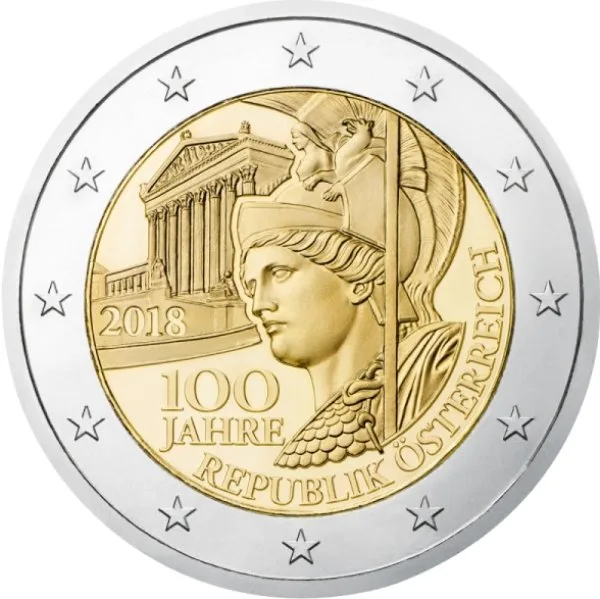
100 Years of the Republic of Austria
Commemorative coin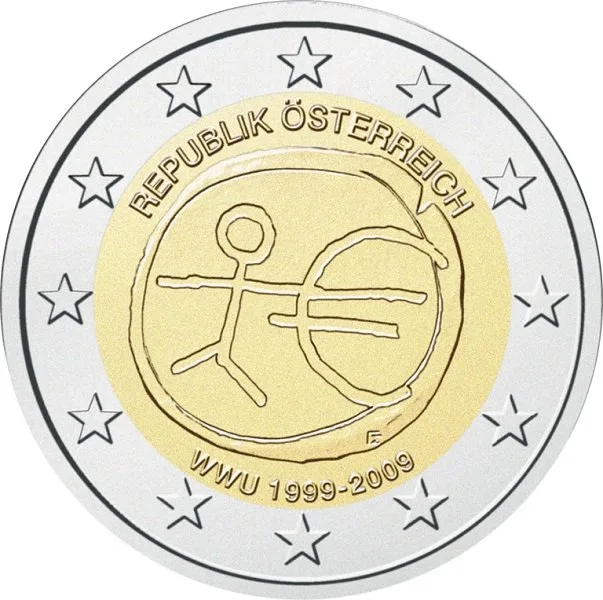
10 Years of Economic and Monetary Union
Commemorative coin