50 Years of the State Treaty
 + Add to collection In collection ★ Wanted
 At a glance
| Country | Austria |
|---|---|
| Year | 2005 |
| Issue date | 11 May 2005 |
| Coin type | Commemorative coin |
| Mintage | 7.000.000 (102.000 / 20.000) |
| Catalogue number | AT-05 G1 |
| Designer | Helmut Andexlinger |
| Rarity | €€€€€ what does this mean? |
| Edge lettering |  |
| Market value (approx.) | 5 € · guide price, uncirculated Unlock · for members |
Coin description
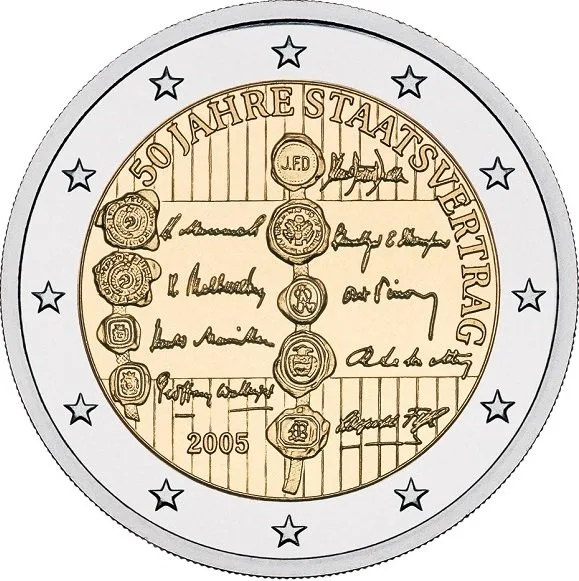
The treaty document with its seal and the signatures of the foreign ministers and ambassadors of the Soviet Union, Great Britain, the United States and France, as well as Austria's own Foreign Minister, set against a heraldic rendering of the Austrian national flag. The inscription "50 Jahre Staatsvertrag" and the year 2005.
Further information on the topic
On 15 May 1955, the foreign ministers of the four Allied powers — the Soviet Union, the United States, Great Britain and France — together with Austrian Foreign Minister Leopold Figl, signed the Austrian State Treaty at Vienna's Belvedere Palace. The document ended ten years of Allied occupation and re-established Austria as a sovereign, democratic and neutral state. The special feature of the treaty was that, unlike in Germany, it did not lead to a permanent division, but rested on a unique diplomatic constellation: the willingness of all four occupying powers to relinquish influence and stationing rights. After signing, Figl stepped onto the balcony and held up the document — a scene that became an iconic image of the Second Republic.
The declaration of neutrality, which Austria enshrined constitutionally a few months after the State Treaty in October 1955, shaped the country's foreign-policy identity far beyond the Cold War. Vienna developed into an international venue for negotiations and the seat of major organisations such as the IAEA and OPEC. The State Treaty is still regarded in Austria today as the founding document of the modern state — comparable in symbolic significance to the constitutions of other democracies. On the 50th anniversary of the treaty, marked in 2005, Austria commemorated with various events and this commemorative coin the event that decisively shaped the country's postwar history.
Technical data
| Face value | 2 euro |
|---|---|
| Material | Bimetallic – outer ring: cupronickel; centre: three layers (nickel-brass / nickel / nickel-brass) |
| Weight | 8.5 g |
| Diameter | 25.75 mm |
| Thickness | 2.20 mm |