10 Years of Euro Banknotes and Coins
 + Add to collection In collection ★ Wanted
 At a glance
| Country | Austria |
|---|---|
| Year | 2012 |
| Issue date | 2 January 2012 |
| Coin type | Commemorative coin |
| Mintage | 11.000.000 (50.000 / 10.000) |
| Catalogue number | AT-12 G1 |
| Designer | Helmut Andexlinger |
| Rarity | €€€€€ what does this mean? |
| Edge lettering |  |
| Market value (approx.) | 4 € · guide price, uncirculated Unlock · for members |
Coin description
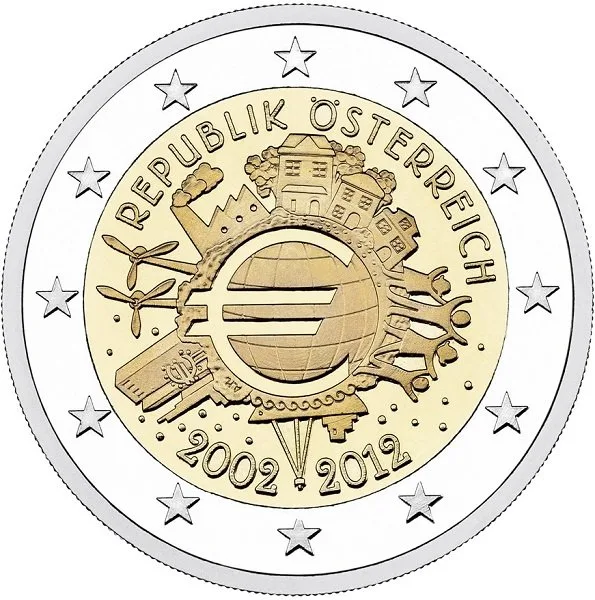
The euro has become a major force in Europe and around the world, establishing itself as a global player in the international monetary system. The motifs arranged around the euro sign symbolise the currency's significance for ordinary citizens, the financial sector (the ECB tower), trade (ships), industry (factories), energy, and research and development (wind turbines). The designer Helmut Andexlinger's initials appear beneath the ECB tower. The names of the issuing states in their national languages are struck centrally above the design; the years 2002–2012 below.
Note on the coin
Third EU joint issue. All 17 eurozone states issued a coin with the same design on the anniversary date of 1 January 2012. The coins differ only in the inscription, which appears in the respective national language. San Marino also issued a coin with the same design, which is not officially part of the joint issue.
Further information on the topic
On 1 January 2002, around 300 million people in twelve countries held euro banknotes and coins in their hands for the first time — a currency changeover on a historically unprecedented scale. Austria had been a participating state in Economic and Monetary Union from the outset and exchanged the schilling for the new common currency within a matter of weeks. By that point, the euro had already existed as book money for three years, integrating financial markets and simplifying cross-border trade within the eurozone. With the introduction of cash, however, it became a tangible everyday reality — in supermarkets, at public offices, while travelling. Austria's changeover process was among the smoother ones, aided by an early pre-distribution of the new coins and notes to banks and retailers.
In the ten years following the cash introduction, the euro developed into one of the world's leading reserve currencies and cemented its role in the international monetary system alongside the US dollar. Since then, the European Central Bank has steered monetary policy for all eurozone member states, which grew over this first decade from twelve to seventeen countries. At the same time, the sovereign debt crisis from 2010 onward put the young currency's institutional resilience to a severe test. The tenth anniversary of euro cash in 2012 thus fell during a period of intense debate over the stability of the monetary union and the need for reform. All euro states, Austria included, marked this anniversary together with a European joint issue.
Technical data
| Face value | 2 euro |
|---|---|
| Material | Bimetallic – outer ring: cupronickel; centre: three layers (nickel-brass / nickel / nickel-brass) |
| Weight | 8.5 g |
| Diameter | 25.75 mm |
| Thickness | 2.20 mm |