10 Years of Economic and Monetary Union
 + Add to collection In collection ★ Wanted
 At a glance
| Country | Austria |
|---|---|
| Year | 2009 |
| Issue date | 2 January 2009 |
| Coin type | Commemorative coin |
| Mintage | 5.000.000 (74.000 / 15.000) |
| Catalogue number | AT-09 G1 |
| Designer | Georgios Stamatopoulus |
| Rarity | €€€€€ what does this mean? |
| Edge lettering |  |
| Market value (approx.) | 3,5 € · guide price, uncirculated Unlock · for members |
Coin description
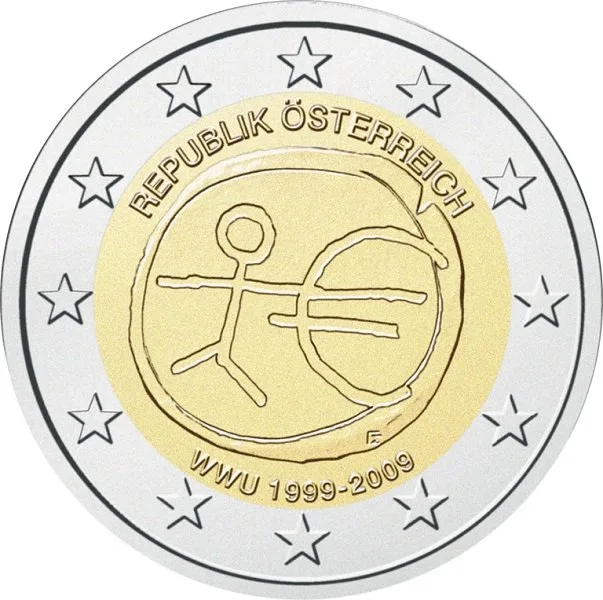
Centre: a stylised human figure on an ancient coin, its left arm extended to form the euro symbol. The artist's initials ΓΣ appear beneath the euro sign. The issuing state's name in the national language runs along the upper rim, while the dates 1999–2009 and the locally translated acronym for EMU appear along the lower rim.
Note on the coin
Second EU joint issue. All 16 eurozone states released a coin with this design on the anniversary date, 1 January 2009. The coins differ only in the inscription, which appears in the respective national language.
Further information on the topic
On 1 January 1999, eleven EU states entered the third stage of Economic and Monetary Union: the exchange rates of their currencies were irrevocably fixed, and monetary policy was transferred to the newly established European Central Bank. Austria was among these founding members from the start — and that was no foregone conclusion. The country had only joined the EU in 1995 and had to meet the Maastricht criteria within four years: price stability, low long-term interest rates, a stable budget deficit, and public debt within the target range. That Austria met these requirements in time is still regarded today as proof of the convergence capacity of even the newer member states.
The first ten years of the Economic and Monetary Union unfolded in an economically turbulent environment: after the bursting of the dot-com bubble in 2001, the introduction of euro cash in 2002, and several rounds of eurozone enlargement, the international financial crisis began in 2008, subjecting the young currency architecture to its first serious stress test. For Austria, the eurozone had brought tangible benefits up to that point — lower interest rates, the elimination of exchange-rate risk in trade with its most important partners, and a strengthened position as a hub for investment in Central and Eastern Europe. In 2009, all eurozone states jointly marked the tenth anniversary of the monetary union with a European joint issue in which, for the first time, all members of the eurozone participated with an identical design.
Technical data
| Face value | 2 euro |
|---|---|
| Material | Bimetallic – outer ring: cupronickel; centre: three layers (nickel-brass / nickel / nickel-brass) |
| Weight | 8.5 g |
| Diameter | 25.75 mm |
| Thickness | 2.20 mm |