10 Years of Economic and Monetary Union
 + Add to collection In collection ★ Wanted
 At a glance
| Country | Cyprus |
|---|---|
| Year | 2009 |
| Issue date | 5 January 2009 |
| Coin type | Commemorative coin |
| Mintage | 1.000.000 (35.000 / – ) |
| Catalogue number | CY-09 G1 |
| Designer | Georgios Stamatopoulos |
| Rarity | €€€€€ what does this mean? |
| Edge lettering |  |
| Market value (approx.) | 3,5 € · guide price, uncirculated Unlock · for members |
Coin description
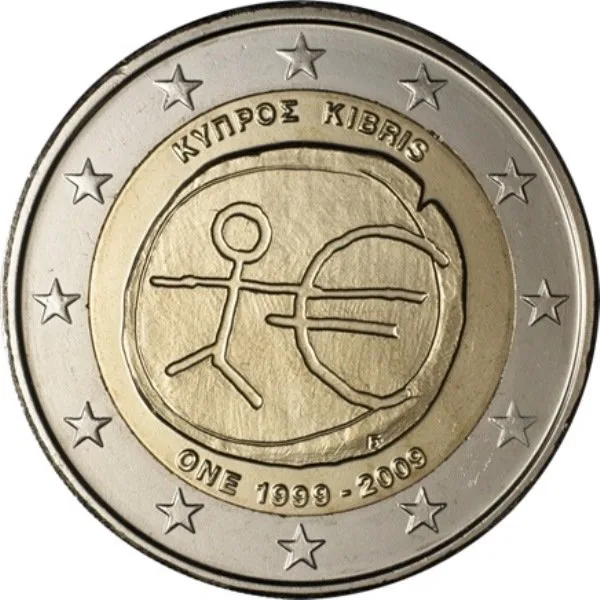
At the centre, a stylised human figure drawn from an ancient coin, with the left arm extending into the euro symbol. The artist's initials ΓΣ appear below the euro sign. The name of the issuing state in the national language(s) runs along the upper edge of the design, while the dates 1999–2009 and the local-language acronym for EMU appear along the lower edge.
Note on the coin
Second joint issue of the European Union. All 16 eurozone states issued a coin with the same design on 1 January 2009 to mark the anniversary. The coins differ only in their inscriptions, which appear in the respective national language.
Further information on the topic
For Cyprus, the introduction of the euro on 1 January 2008 marked the conclusion of a long process of rapprochement with the European Union. The country had joined the EU in 2004 and, in the following years, had made considerable economic adjustments to meet the Maastricht criteria: inflation rate, public debt and budget balance all had to be kept within tight limits. At the time, the Cypriot economy was heavily oriented towards tourism, financial services, and trade with the Middle East and the Arab world — a structure that benefited directly from the stable currency framework of the eurozone. For the Cypriot economy, joining the monetary union above all meant the elimination of exchange-rate risk in intra-European trade and improved access to European capital markets.
The Economic and Monetary Union itself dates back to decisions worked out in the late 1980s with the decisive involvement of the Delors Committee. The Maastricht Treaty of 1992 gave the project its legal basis; on 1 January 1999, the euro was introduced as scriptural money and the exchange rates of the eleven founding states were irrevocably fixed. The European Central Bank took over monetary policy for the entire euro area. Three years later, on 1 January 2002, the euro entered circulation as cash — a logistical operation without historical precedent in scale. The 2009 joint issue by all eurozone states commemorates the tenth anniversary of this monetary union, in which Cyprus has participated as a full member since joining in 2008.
Technical data
| Face value | 2 euro |
|---|---|
| Material | Bimetallic – outer ring: cupronickel; centre: three layers (nickel-brass / nickel / nickel-brass) |
| Weight | 8.5 g |
| Diameter | 25.75 mm |
| Thickness | 2.20 mm |