35 Years of the Erasmus Programme
 + Add to collection In collection ★ Wanted
 At a glance
| Country | Estonia |
|---|---|
| Year | 2022 |
| Issue date | 1 July 2022 |
| Coin type | Commemorative coin |
| Mintage | 1.000.000 (12.000 / – ) |
| Catalogue number | EE-22 G2 |
| Designer | Joaquin Jimenez |
| Rarity | €€€€€ what does this mean? |
| Edge lettering |  |
| Market value (approx.) | 3,5 € · guide price, uncirculated Unlock · for members |
Coin description
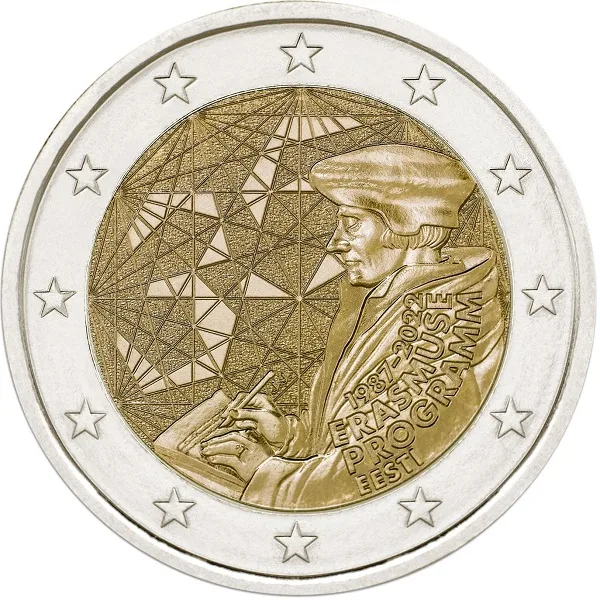
A blend of two core elements of the Erasmus programme: its original intellectual inspiration — Erasmus himself — and an allegory of his influence across Europe. The former is represented by one of the most familiar portraits of Erasmus; the latter by a beam of connections crossing the coin from beacon to beacon, evoking the countless intellectual and human exchanges between European students. Some of these connections form additional stars, symbolising the synergies arising from collaboration between countries.
Note on the coin
Fifth European Union joint issue. All 19 eurozone states are issuing a coin with the same design on various dates. The coins differ only in their inscriptions, which appear in the respective national language.
Further information on the topic
In 1987, the European Community launched an exchange programme set to fundamentally change academic mobility on the continent: Erasmus. The name was itself a statement — it referred to Desiderius Erasmus of Rotterdam, the 16th-century Dutch humanist who himself taught at universities in Paris, Oxford, Cambridge, Leuven and Turin, embodying an early model of cross-border knowledge exchange. What began in 1987 with around 3,000 students in eleven countries grew into one of the EU's best-known education programmes: to this day, more than ten million people across Europe have studied, taught or trained through Erasmus. Estonia, an EU member since 2004, has taken part intensively in European educational cooperation since its independence and, relative to its population size, has an above-average share of Erasmus participants.
The programme has expanded considerably since its founding. What began as student exchange became the Socrates programme in 1995, later Lifelong Learning, and since 2014 has officially been called Erasmus+, now also covering vocational training, youth work and sport. The underlying intellectual idea — openness to other cultures, languages and academic traditions as a condition for a shared European identity — has remained constant throughout, directly echoing the legacy of the Dutch scholar, who considered the borders between Europe's academic worlds permeable. To mark the Erasmus programme's 35th anniversary in 2022, all euro states honoured this milestone with a joint 2-euro commemorative coin — including Estonia as a committed partner in the European education area.
Official issues of the coin
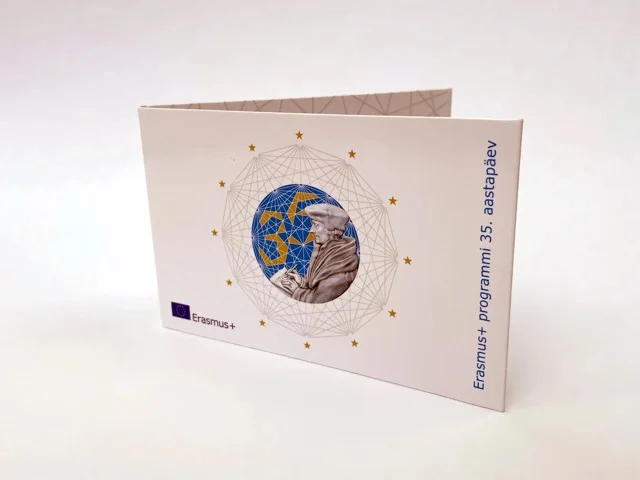 ©Image credit: Eesti Pank
Technical data
| Face value | 2 euro |
|---|---|
| Material | Bimetallic – outer ring: cupronickel; centre: three layers (nickel-brass / nickel / nickel-brass) |
| Weight | 8.5 g |
| Diameter | 25.75 mm |
| Thickness | 2.20 mm |