50 Years of the Treaty of Rome
 + Add to collection In collection ★ Wanted
 At a glance
| Country | Germany |
|---|---|
| Year | 2007 |
| Issue date | 25 March 2007 |
| Coin type | Commemorative coin |
| Mintage | varies by year & mint – see table below ↓ |
| Catalogue number | DE-07 G2 |
| Designer | Münze Österreich, Real Casa de la Moneda, Istituto Poligrafico e Zecca dello Stato S.p.A |
| Rarity | €€€€€ what does this mean? |
| Edge lettering |  |
| Market value (approx.) | 5 € · guide price, uncirculated Unlock · for members |
Coin description
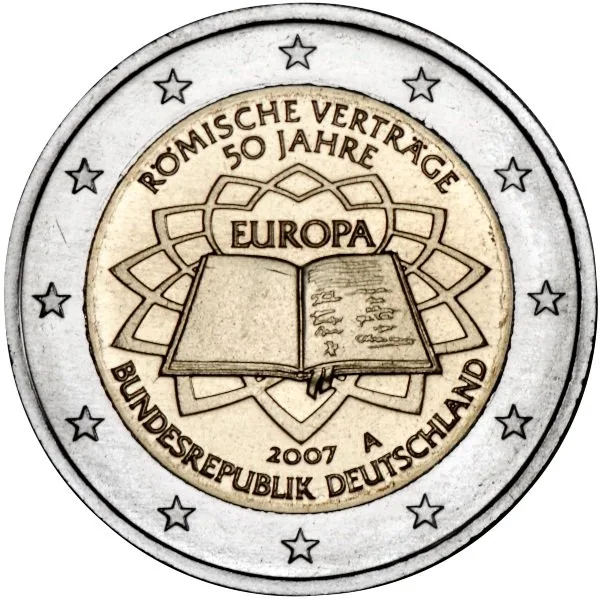
The treaty signed by the six founding states, set against the star-patterned mosaic of the Capitoline Hill piazza in Rome where it was signed. Above: the inscriptions 'Römische Verträge / 50 Jahre' and 'Europa'; below: the country name 'Bundesrepublik Deutschland', the twelve stars of the EU, the year 2007, and the mintmark A, D, F, G or J.
Note on the coin
First joint issue of the European Union. All 13 eurozone states issued a coin with the same design on the anniversary date of 25 March 2007. The coins differ only in the legend, which appears in the respective national language.
Further information on the topic
On 25 March 1957, the foreign ministers of the Federal Republic of Germany, France, Italy, and the three Benelux states signed two landmark treaties in the Palazzo dei Conservatori on Rome's Capitoline Hill: the Treaty establishing the European Economic Community (EEC) and the Treaty establishing the European Atomic Energy Community (Euratom). The location was chosen deliberately — the Capitoline Square, with its floor mosaic designed by Michelangelo, had for centuries stood as the centre of an ancient world power symbolising political unity. The treaties entered into force on 1 January 1958, creating a common market with free movement of goods, a common trade policy toward third countries, and initial steps toward coordinating economic policy. For the Federal Republic of Germany, membership meant both a return to the community of democratic nations after the Second World War and the embedding of the West German economy within a supranational framework that placed structural limits on nationalist unilateralism.
Over the following decades, the EEC developed from a customs union into an ever more tightly woven project of integration. The single market, the Maastricht Treaty of 1992, and finally the introduction of the euro as the common currency all built directly on the foundation laid by the Treaties of Rome. The signing marked its 50th anniversary in 2007 — a year in which the European Union already counted 27 member states and stood on the brink of signing the Lisbon Reform Treaty. All states then part of the eurozone marked the anniversary with a joint commemorative issue, making it one of the rare Europe-wide collaborations in the history of 2-euro commemorative coins.
Official announcement (EU Official Journal): ABl. C 65 vom 21.3.2007, S. 3 (2007/C 65/04)
Mintages by mint
| Mint | Mintage |
|---|---|
| A | 1.000.000 (90.000 / 95.000) |
| D | 14.500.000 (90.000 / 95.000) |
| F | 8.000.000 (90.000 / 95.000) |
| G | 5.000.000 (90.000 / 95.000) |
| J | 1.500.000 (90.000 / 95.000) |
Technical data
| Face value | 2 euro |
|---|---|
| Material | Bimetallic – outer ring: cupronickel; centre: three layers (nickel-brass / nickel / nickel-brass) |
| Weight | 8.5 g |
| Diameter | 25.75 mm |
| Thickness | 2.20 mm |