Saxony
 + Add to collection In collection ★ Wanted
 At a glance
| Country | Germany |
|---|---|
| Year | 2016 |
| Issue date | 5 February 2016 |
| Coin type | Commemorative coin |
| Mintage | varies by year & mint – see table below ↓ |
| Catalogue number | DE-16 G1 |
| Designer | Jordi Truxa |
| Rarity | €€€€€ what does this mean? |
| Edge lettering |  |
| Market value (approx.) | 3,5 € · guide price, uncirculated Unlock · for members |
Coin description
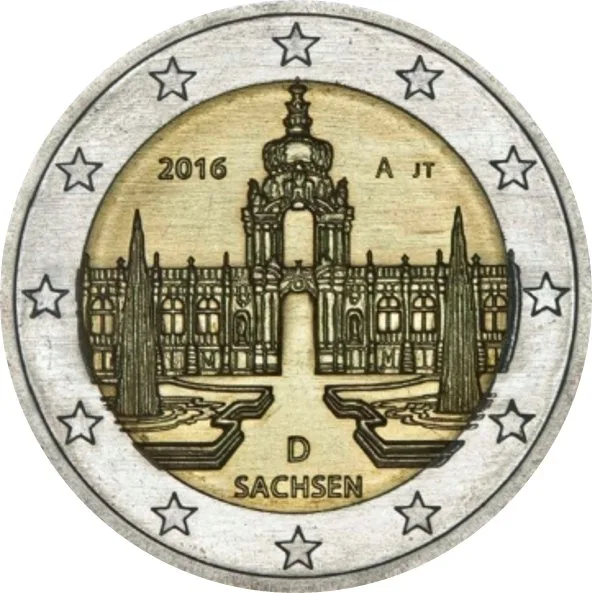
A view from the inner courtyard of the world-famous Dresden Zwinger towards the Crown Gate. Below: the name 'SACHSEN' and the country code 'D'; upper right: the mintmark ('A', 'D', 'F', 'G' or 'J') and the engraver's initials ('JT' — Jordi Truxa); upper left: the year '2016'.
Further information on the topic
Saxony ranks among the most culturally and economically influential regions of Germany. Today's federal state in the southeast of the country looks back on a history spanning more than a thousand years: as a margraviate, electorate, and kingdom, Saxony was for centuries a significant center of Central European politics, scholarship, and art. Dresden, the Saxon state capital, developed under the Wettin dynasty into one of the most splendid residence cities on the continent. The Zwinger, built in the late 17th and early 18th centuries under Elector Augustus the Strong, is regarded as one of the most significant buildings of German Baroque and today houses world-class collections. Leipzig, in turn, was equally influential as a trade fair city and music metropolis — birthplace of Richard Wagner and workplace of Johann Sebastian Bach.
Economically, Saxony experienced an early wave of industrialization in the 19th century: the Ore Mountains with their mining industry, the Vogtland with its textile industry, and the chemical triangle around Halle and Leipzig made the region one of the most important industrial locations in the German-speaking world. After German reunification in 1990, Saxony was re-established as one of the new federal states and has since developed into a significant hub for microelectronics and the automotive industry. The Federal Republic of Germany honored the state in 2016 as part of the German Federal States series with a 2-euro commemorative coin.
Official announcement (EU Official Journal): ABl. C 428 vom 19.12.2015, S. 7 (2015/C 428/04)
Mintages by mint
| Mint | Mintage |
|---|---|
| A | 6.000.000 (69.800 / 73.000) |
| D | 6.300.000 (65.825 / 67.000) |
| F | 7.200.000 (65.825 / 67.000) |
| G | 4.200.000 (65.825 / 67.000) |
| J | 6.300.000 (65.825 / 67.000) |
Technical data
| Face value | 2 euro |
|---|---|
| Material | Bimetallic – outer ring: cupronickel; centre: three layers (nickel-brass / nickel / nickel-brass) |
| Weight | 8.5 g |
| Diameter | 25.75 mm |
| Thickness | 2.20 mm |