Bavaria
 + Add to collection In collection ★ Wanted
 At a glance
| Country | Germany |
|---|---|
| Year | 2012 |
| Issue date | 3 February 2012 |
| Coin type | Commemorative coin |
| Mintage | varies by year & mint – see table below ↓ |
| Catalogue number | DE-12 G2 |
| Designer | Erich Ott |
| Rarity | €€€€€ what does this mean? |
| Edge lettering |  |
| Market value (approx.) | 3,5 € · guide price, uncirculated Unlock · for members |
Coin description
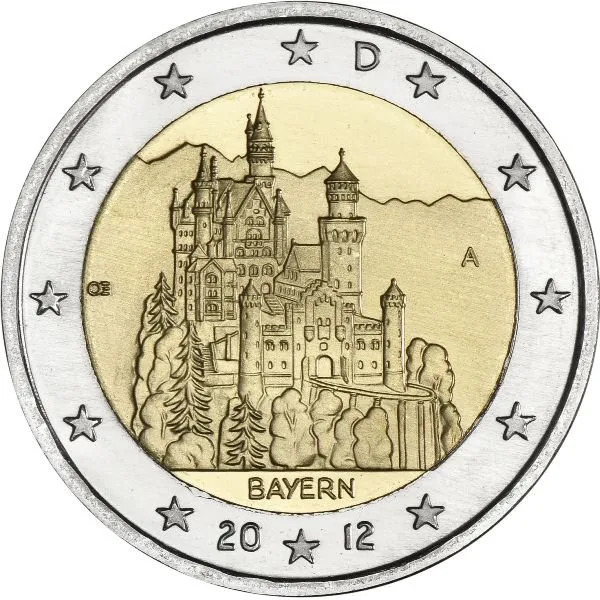
Neuschwanstein Castle from its most celebrated vantage point — the gatehouse in the foreground, with the medievalist towers and turrets rising behind it. The mountain panorama conveys a sense of the castle's position on a rocky outcrop above the Pöllat Gorge. The name 'BAYERN' links the depicted castle to the Free State. On the inner circle, the relevant mintmark (A, D, F, G or J) appears to the outer right, the artist's initials to the outer left.
Further information on the topic
Bavaria is Germany's largest federal state by area and looks back on a state history that reaches back well before the founding of the German Reich. As the Kingdom of Bavaria from 1806 to 1918, the Free State was an independent state with its own court, its own foreign policy and a pronounced sense of self-confidence vis-à-vis Prussia and the later German Empire. Neuschwanstein Castle, which King Ludwig II had built from 1869 on a rocky outcrop above the Pöllat Gorge in the Allgäu, is the best-known testimony to this era. Ludwig II did not have the castle built as a fortress or residence in the classical sense, but as a romanticised dream castle - an architectural homage to the Middle Ages and to the operas of Richard Wagner. The castle was never fully completed; Ludwig II died in 1886 under circumstances that remain unexplained to this day, only weeks after having been declared unfit to rule.
Neuschwanstein is today one of the most visited sights in Germany and has become a visual shorthand for Bavaria - even though it is a work of 19th-century fantasy architecture, not an authentic medieval castle. The Free State of Bavaria has been a state of the Federal Republic of Germany since 1946 and to this day cultivates a strong regional identity, expressed in its own constitutional law, its own constitution and a decidedly federal stance towards the national government. Bavaria's economic strength - with Munich as a financial and technology centre and strong industry in the Upper Palatinate and Middle Franconia - ranks among the highest in the European Union. As part of the German Federal States series, Germany issued a 2-euro commemorative coin for Bavaria in 2012.
Official announcement (EU Official Journal): ABl. C 10 vom 12.1.2012, S. 2 (2012/C 10/02)
Mintages by mint
| Mint | Mintage |
|---|---|
| A | 6.000.000 (92.000 / 95.000) |
| D | 6.300.000 (87.000 / 87.000) |
| F | 7.200.000 (87.000 / 87.000) |
| G | 4.200.000 (87.000 / 87.000) |
| J | 6.300.000 (87.000 / 87.000) |
Technical data
| Face value | 2 euro |
|---|---|
| Material | Bimetallic – outer ring: cupronickel; centre: three layers (nickel-brass / nickel / nickel-brass) |
| Weight | 8.5 g |
| Diameter | 25.75 mm |
| Thickness | 2.20 mm |