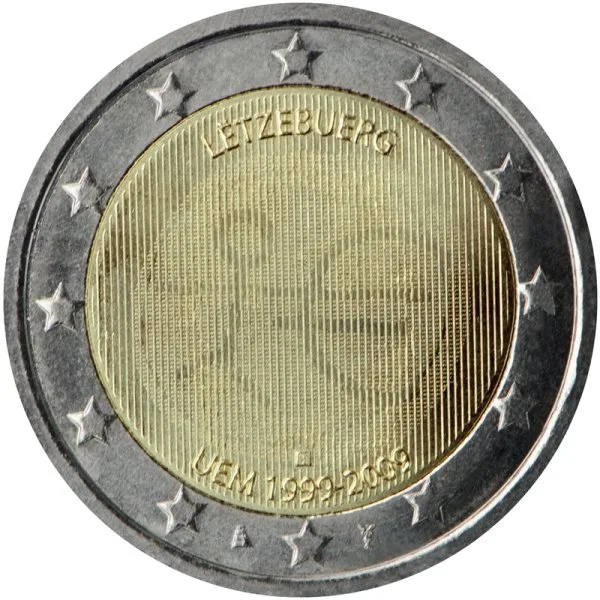
10 Years of Economic and Monetary Union
 + Add to collection In collection ★ Wanted
 At a glance
| Country | Luxembourg |
|---|---|
| Year | 2009 |
| Issue date | 15 January 2009 |
| Coin type | Commemorative coin |
| Mintage | 825.000 (20.000 / 5.000) |
| Catalogue number | LU-09 G1 |
| Designer | Georgios Stamatopoulos, Alain Hoffmann |
| Rarity | €€€€€ what does this mean? |
| Edge lettering |  |
| Market value (approx.) | 3,5 € · guide price, uncirculated Unlock · for members |
Coin description
At the centre a stylised human figure on an ancient coin, its left arm extended to form the euro symbol. The artist's initials ΓΣ appear below the euro symbol. The issuing state's name in the national language runs along the upper edge of the design; the dates 1999–2009 and the translated acronym EMU appear along the lower edge.
Note on the coin
In 2012 a retrospective set was issued comprising the Luxembourg €2 commemorative coins of 2009–2012 (LU-09 G1, LU-09 G2, LU-10 G1, LU-11 G1, LU-12 G1, LU-12 G2).
Second joint issue of the European Union. All 16 eurozone states issued a coin with the same design on 1 January 2009. The coins differ only in the inscription, which appears in the respective national language.
Further information on the topic
The Economic and Monetary Union is regarded as one of the most far-reaching integration steps in European history. Its foundations were laid in the Maastricht Treaty of 1992, with its actual completion following on 1 January 1999 with the introduction of the euro as scriptural money in eleven member states — including Luxembourg, a small, open country with a tightly interwoven economy that was among the early advocates of the common currency. Since then, the European Central Bank has managed monetary policy for the entire eurozone, while national central banks remained integrated within the Eurosystem. The goal was not only to eliminate exchange-rate risk within the internal market, but also to create a stable macroeconomic framework that would foster price stability and economic convergence.
In its first ten years, the euro grew into the world's second-largest reserve currency and shaped the everyday life of several hundred million people. Luxembourg, traditionally home to central European institutions such as the European Court of Justice and the European Investment Bank, benefited especially from the eurozone's integrated financial market. The Luxembourg financial centre grew substantially during this decade, aided in part by the stability of the common currency area. The tenth anniversary of the Economic and Monetary Union was marked in 2009 with a Europe-wide joint issue, in which all eurozone states took part with an identical design.
Technical data
| Face value | 2 euro |
|---|---|
| Material | Bimetallic – outer ring: cupronickel; centre: three layers (nickel-brass / nickel / nickel-brass) |
| Weight | 8.5 g |
| Diameter | 25.75 mm |
| Thickness | 2.20 mm |
More 2-euro coins from Luxembourg
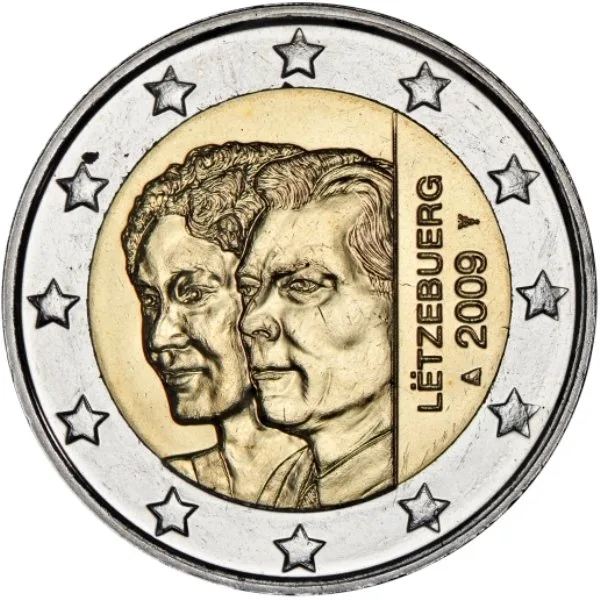
90th Anniversary of Grand Duchess Charlotte's Accession to the Throne
Commemorative coin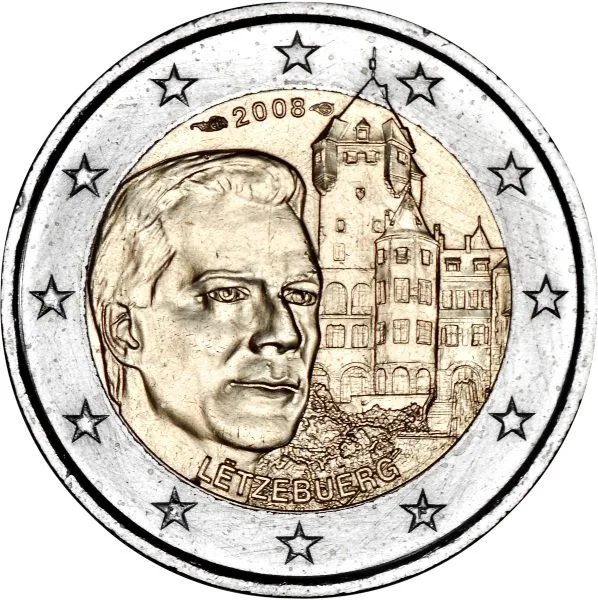
Berg Castle
Commemorative coin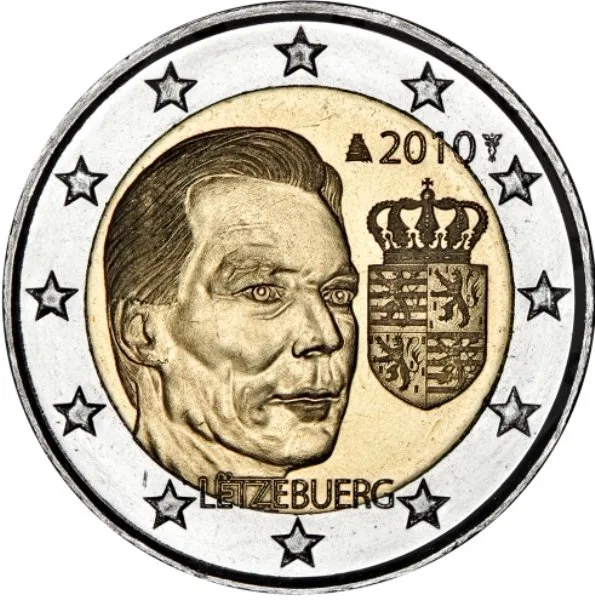
Coat of Arms of Grand Duke Henri
Commemorative coin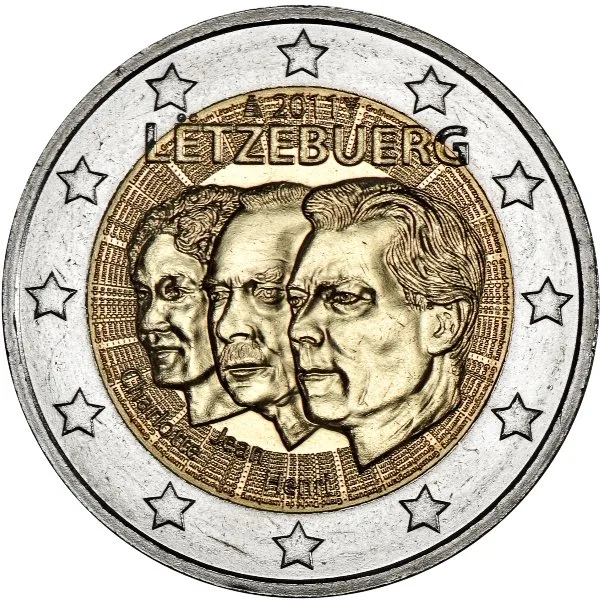
50th Anniversary of Hereditary Grand Duke Jean's Appointment as Lieutenant-Representative
Commemorative coin