10 Years of Euro Banknotes and Coins
 + Add to collection In collection ★ Wanted
 At a glance
| Country | Luxembourg |
|---|---|
| Year | 2012 |
| Issue date | 3 February 2012 |
| Coin type | Commemorative coin |
| Mintage | 532.500 (27.500 / 5.000) |
| Catalogue number | LU-12 G1 |
| Designer | Helmut Andexlinger |
| Rarity | €€€€€ what does this mean? |
| Edge lettering |  |
| Market value (approx.) | 4 € · guide price, uncirculated Unlock · for members |
Coin description
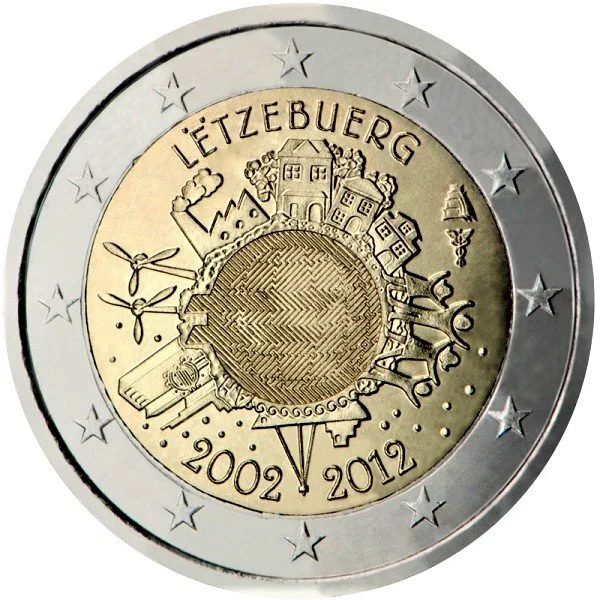
The euro has grown into a major force in Europe and worldwide, and a key player in the international monetary system. The motifs arranged around the euro sign symbolise its significance for people, the financial world (ECB tower), trade (ships), industry (factories), energy, and research and development (wind turbines). The designer Helmut Andexlinger's initials appear beneath the ECB tower. The issuing states' names in their national languages are struck at the centre above the design, the years 2002–2012 below.
Note on the coin
In 2012 a retrospective set was issued comprising the Luxembourg €2 commemorative coins of 2009–2012 (LU-09 G1, LU-09 G2, LU-10 G1, LU-11 G1, LU-12 G1, LU-12 G2).
Third joint issue of the European Union. All 17 eurozone states issued a coin with the same design on 1 January 2012. The coins differ only in the inscription, which appears in the respective national language. San Marino also issued a coin with the same design, which is not officially part of the joint issue.
Further information on the topic
Luxembourg was among the twelve founding states that introduced euro cash on 1 January 2002 — and the country had a particular institutional stake in this milestone. As host to several key EU institutions, including the Court of Justice of the European Union and the European Court of Auditors, Luxembourg had been closely tied to the building of shared European structures since the earliest days of integration. The transition from the Luxembourg franc to the euro proceeded smoothly; the population of this small country, with its open and strongly export-oriented economy, benefited immediately from the elimination of exchange-rate risk in cross-border trade and finance.
In the first ten years after the cash introduction, the euro developed into the world's second largest reserve currency and shaped the daily life of several hundred million people across the eurozone. For Luxembourg, whose financial sector ranks among Europe's most significant, the common currency also strengthened the country's position as an international financial centre. The cross-border circulation of the euro also considerably simplified economic activity in the Greater Region of Saar-Lor-Lux, where tens of thousands of cross-border commuters travel daily between Luxembourg, France, Belgium, and Germany. All euro states jointly marked the tenth anniversary of euro cash with a joint issue in 2012.
Technical data
| Face value | 2 euro |
|---|---|
| Material | Bimetallic – outer ring: cupronickel; centre: three layers (nickel-brass / nickel / nickel-brass) |
| Weight | 8.5 g |
| Diameter | 25.75 mm |
| Thickness | 2.20 mm |
More 2-euro coins from Luxembourg
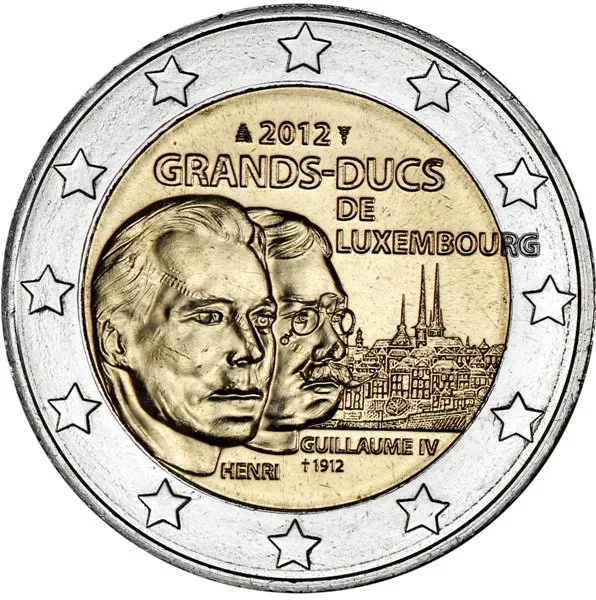
100th Anniversary of the Death of Grand Duke Guillaume IV
Commemorative coin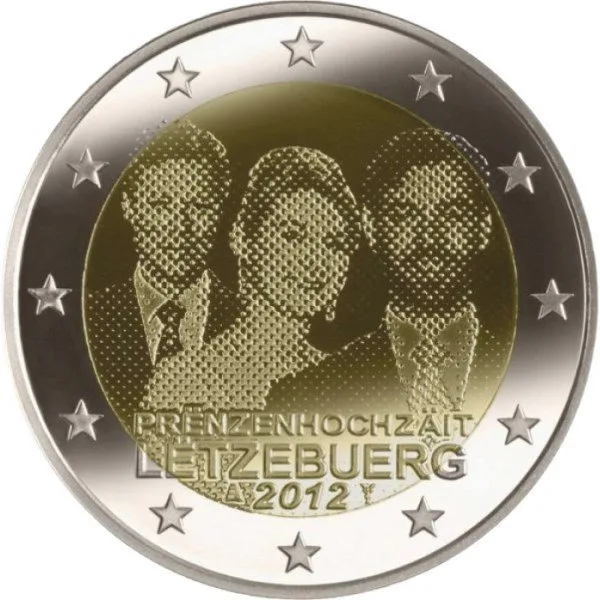
Wedding of Hereditary Grand Duke Guillaume and Stéphanie
Commemorative coin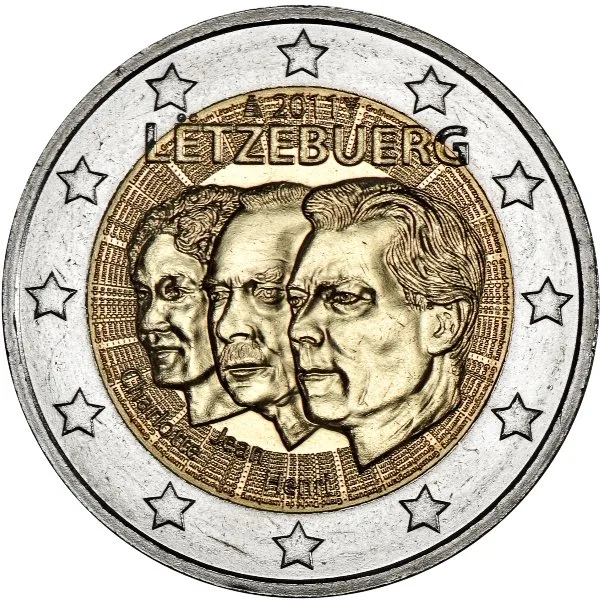
50th Anniversary of Hereditary Grand Duke Jean's Appointment as Lieutenant-Representative
Commemorative coin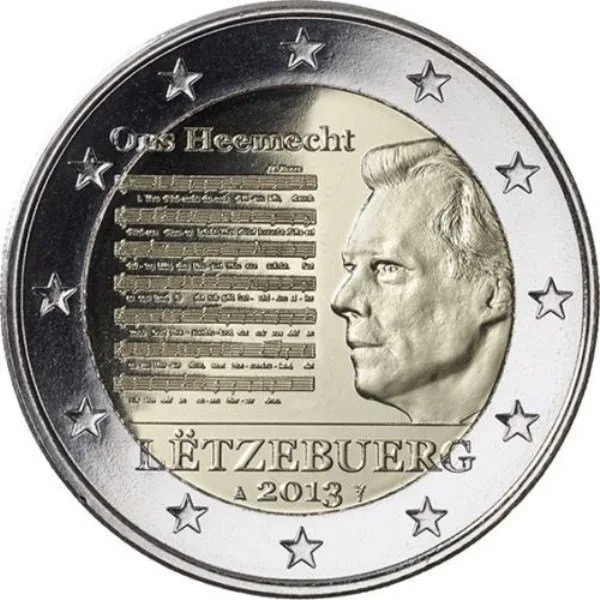
National Anthem of Luxembourg
Commemorative coin