10 Years of Euro Banknotes and Coins
 + Add to collection In collection ★ Wanted
 At a glance
| Country | Netherlands |
|---|---|
| Year | 2012 |
| Issue date | 13 February 2012 |
| Coin type | Commemorative coin |
| Mintage | 3.500.000 (50.000 / 7.500) |
| Catalogue number | NL-12 G1 |
| Designer | Helmut Andexlinger |
| Rarity | €€€€€ what does this mean? |
| Edge lettering |  |
| Market value (approx.) | 4 € · guide price, uncirculated Unlock · for members |
Coin description
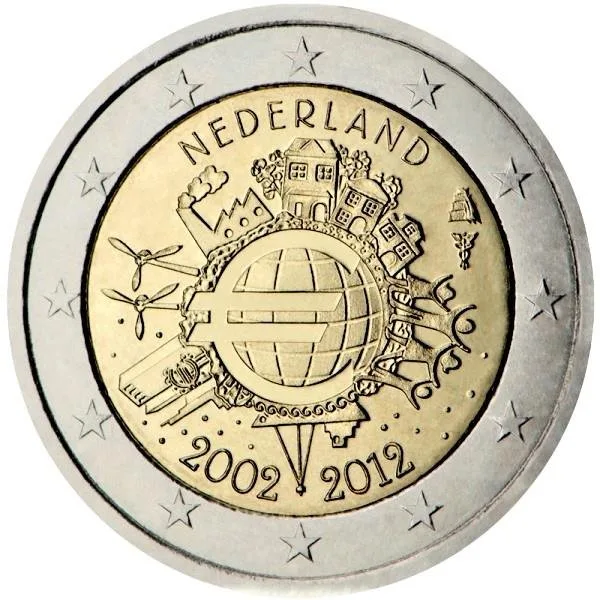
The euro has become a major force in Europe and around the world, establishing itself as a global player in the international monetary system. The motifs arranged around the euro sign symbolise the currency's significance for ordinary citizens, the financial sector (the ECB tower), trade (ships), industry (factories), energy, and research and development (wind turbines). The designer Helmut Andexlinger's initials appear beneath the ECB tower. The names of the issuing states in their national languages are struck centrally above the design; the years 2002–2012 below.
Note on the coin
Third EU joint issue. All 17 eurozone states released a coin with this design on the anniversary date, 1 January 2012. The coins differ only in the inscription, which appears in the respective national language. San Marino also issued a coin with the same design, which is not officially part of the joint issue.
Further information on the topic
On 1 January 2002, twelve EU states — the Netherlands among them — put euro banknotes and coins into circulation, ending an era of national currencies that in the Netherlands stretched back to the guilder. The introduction of euro cash was the most visible step of a monetary union whose legal foundations had already been laid in 1992 with the Maastricht Treaty — a treaty notably signed in a Dutch city. Since then, the euro has connected economies closely interwoven in trade, industry, and finance: the European Central Bank steers monetary policy for a currency area that today encompasses more than 340 million people, and the euro has established itself as the world's second most important reserve currency.
Ten years after the cash introduction, the euro was structurally firmly anchored in everyday life despite the concurrent sovereign debt crisis — in the Netherlands as in the other euro states. Internationally, the common currency had asserted itself as a major player in the global monetary system, with a growing share in world trade and in the foreign exchange reserves of central banks worldwide. To mark the tenth anniversary of euro cash, all euro states jointly issued a 2-euro commemorative coin with an identical design in 2012 — one of the few European joint issues in which every eurozone member state took part, the Netherlands among them.
Technical data
| Face value | 2 euro |
|---|---|
| Material | Bimetallic – outer ring: cupronickel; centre: three layers (nickel-brass / nickel / nickel-brass) |
| Weight | 8.5 g |
| Diameter | 25.75 mm |
| Thickness | 2.20 mm |
More 2-euro coins from the Netherlands
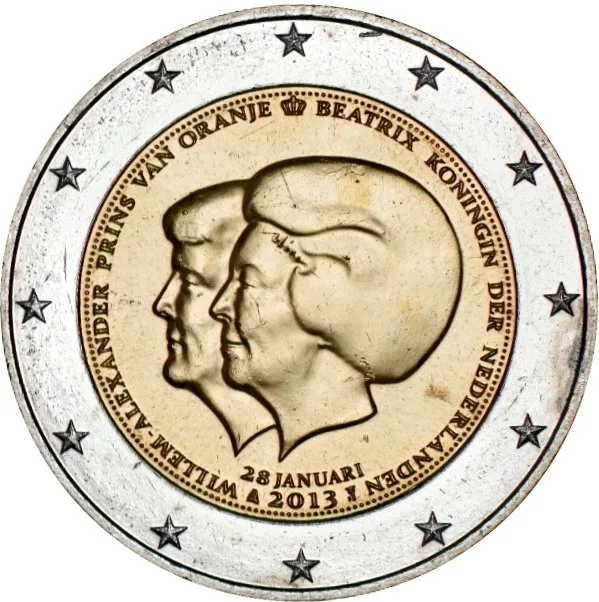
Change of Throne – Double Portrait of Queen Beatrix and Crown Prince Willem-Alexander
Commemorative coin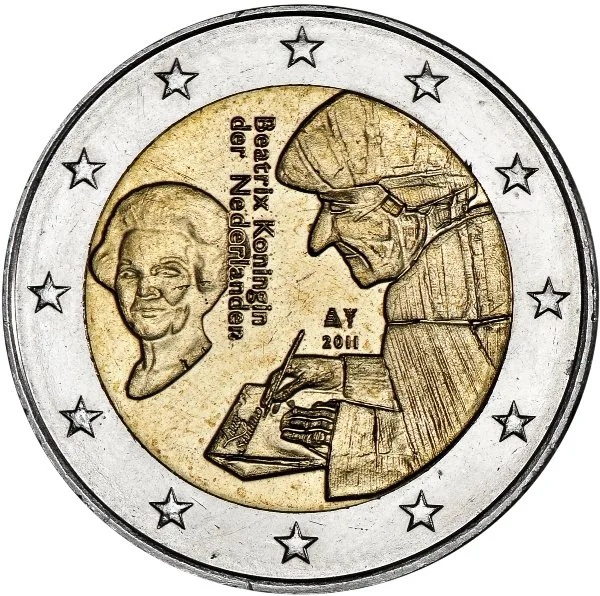
500 Years of Laus Stultitiae
Commemorative coin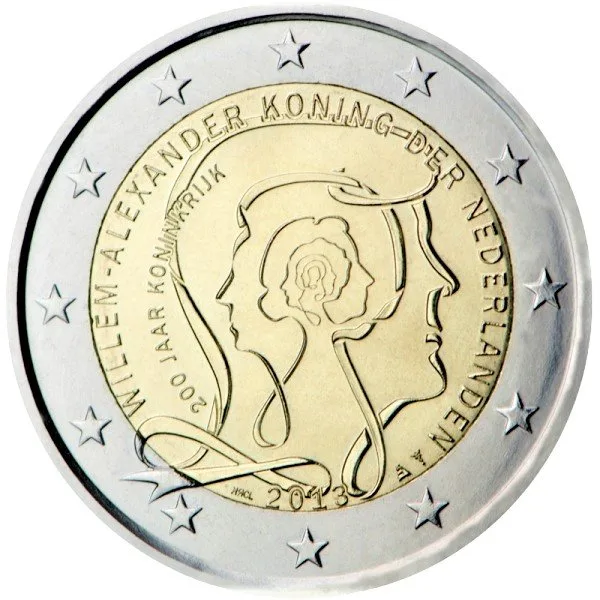
200 Years of the Kingdom of the Netherlands
Commemorative coin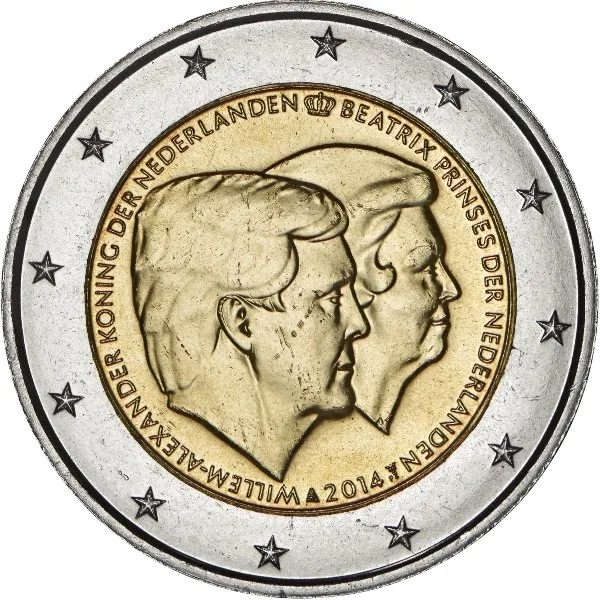
Change of Throne – Double Portrait of King Willem-Alexander and Princess Beatrix
Commemorative coin