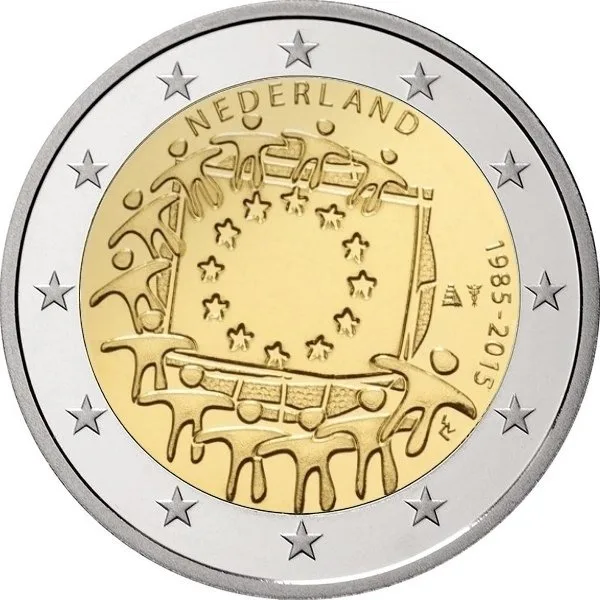
30 Years of the European Flag
 + Add to collection In collection ★ Wanted
 At a glance
| Country | Netherlands |
|---|---|
| Year | 2015 |
| Issue date | 13 October 2015 |
| Coin type | Commemorative coin |
| Mintage | 1.000.000 (15.000 / 12.000) |
| Catalogue number | NL-15 G1 |
| Designer | Georgios Stamatopoulos |
| Rarity | €€€€€ what does this mean? |
| Edge lettering |  |
| Market value (approx.) | 4 € · guide price, uncirculated Unlock · for members |
Coin description
The EU flag as a symbol uniting peoples and cultures around shared values and ideals for a better future. Twelve stars take on human form and welcome the birth of a new Europe. The issuing state "NEDERLAND" is inscribed at the top; the dates "1985–2015" to the right. The mint director's and mintmark symbols appear between the flag and the dates. Lower right: the initials of designer Georgios Stamatopoulos.
Note on the coin
Fourth EU joint issue. All 19 eurozone states are releasing a coin with this design on various dates. The coins differ only in the inscription, which appears in the respective national language.
Further information on the topic
On 26 May 1986, the European flag was officially introduced as the symbol of the European Community — even though the design, with its twelve gold stars on a blue background, had already been in use by the Council of Europe since 1955. The Council of Europe had originally designed the flag to represent the growing community of European states, long before the European Communities existed. The number twelve was chosen deliberately: not as a reference to a specific number of members, but as a symbol of completeness and unity — a number rooted in many cultures and traditions. The European Economic Community eventually adopted the emblem and made it official, and it can today be seen on institutional buildings, passports, and vehicles across all EU member states.
The Netherlands is among the founding members of European integration: as early as the Treaties of Rome in 1957, the country was part of the emerging European Economic Community. As one of the most economically robust and export-oriented states in the Community, Dutch support for a united Europe always carried practical as well as political weight. To mark the 30th anniversary of the European flag's adoption in 2015, the Netherlands joined all other euro states in the Europe-wide joint issue commemorating this occasion with an identical design — a comparatively rare instrument of European symbolic policy in the history of euro commemorative coins.
Technical data
| Face value | 2 euro |
|---|---|
| Material | Bimetallic – outer ring: cupronickel; centre: three layers (nickel-brass / nickel / nickel-brass) |
| Weight | 8.5 g |
| Diameter | 25.75 mm |
| Thickness | 2.20 mm |
More 2-euro coins from the Netherlands
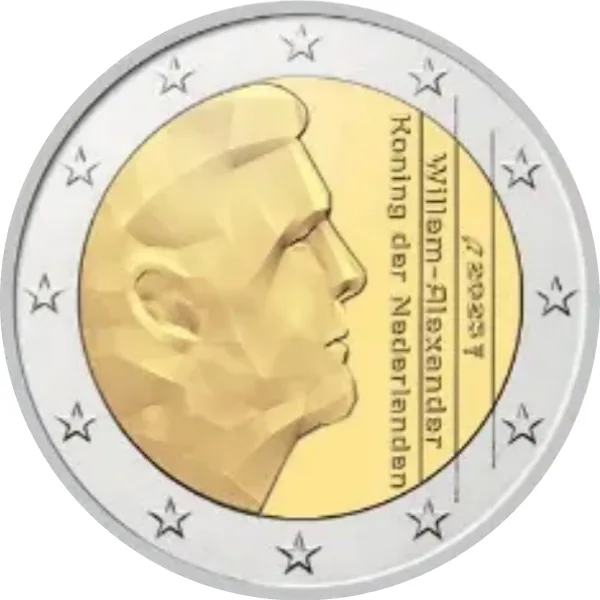
King Willem-Alexander
Circulation coin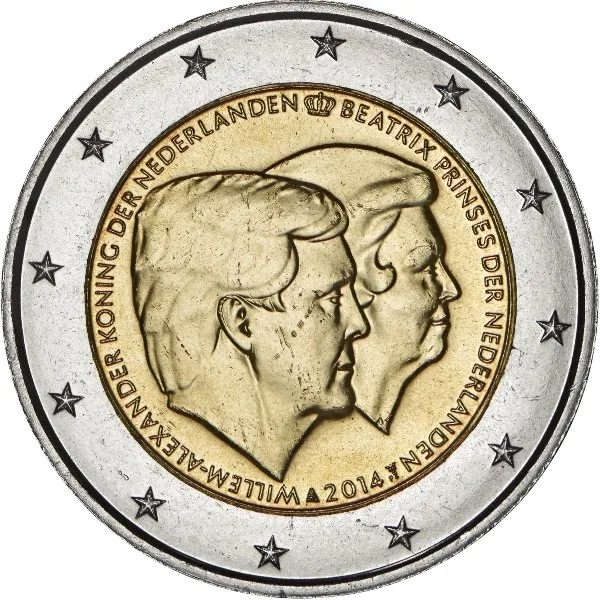
Change of Throne – Double Portrait of King Willem-Alexander and Princess Beatrix
Commemorative coin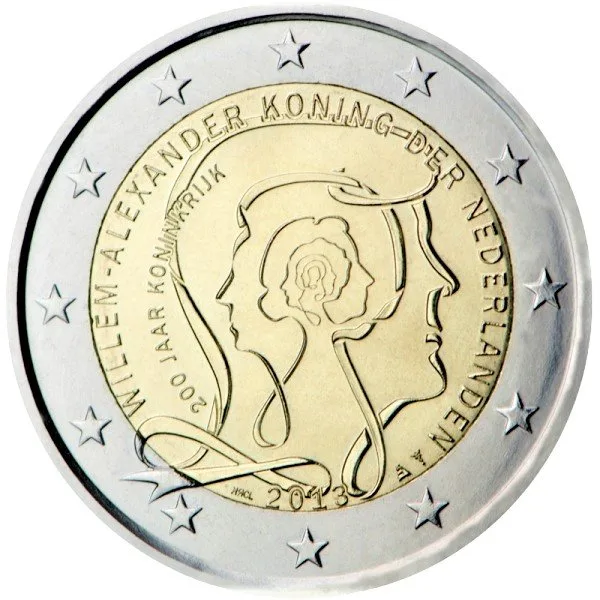
200 Years of the Kingdom of the Netherlands
Commemorative coin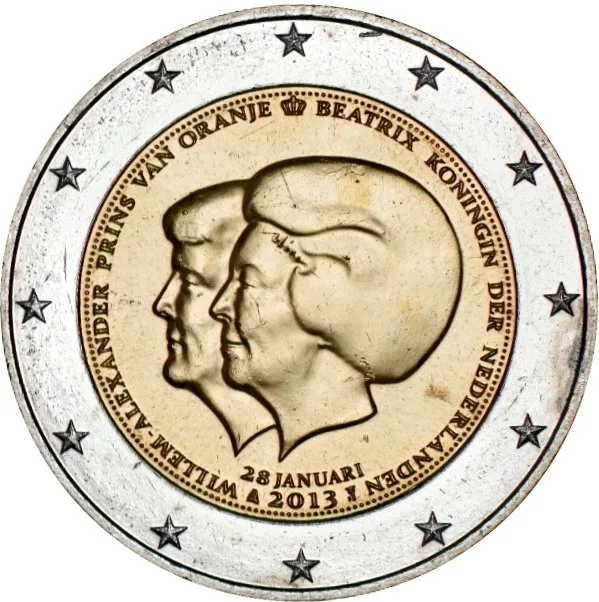
Change of Throne – Double Portrait of Queen Beatrix and Crown Prince Willem-Alexander
Commemorative coin