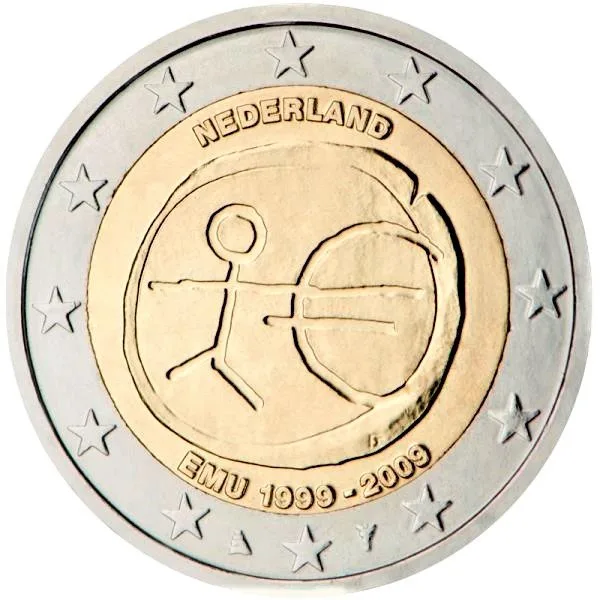
10 Years of Economic and Monetary Union
 + Add to collection In collection ★ Wanted
 At a glance
| Country | Netherlands |
|---|---|
| Year | 2009 |
| Issue date | 7 January 2009 |
| Coin type | Commemorative coin |
| Mintage | 5.309.500 (4.000 / 9.500) |
| Catalogue number | NL-09 G1 |
| Designer | Georgios Stamatopoulus |
| Rarity | €€€€€ what does this mean? |
| Edge lettering |  |
| Market value (approx.) | 3,5 € · guide price, uncirculated Unlock · for members |
Coin description
Centre: a stylised human figure on an ancient coin, its left arm extended to form the euro symbol. The artist's initials ΓΣ appear beneath the euro sign. The issuing state's name in the national language runs along the upper rim, while the dates 1999–2009 and the locally translated acronym for EMU appear along the lower rim.
Note on the coin
Second EU joint issue. All 16 eurozone states released a coin with this design on the anniversary date, 1 January 2009. The coins differ only in the inscription, which appears in the respective national language.
Further information on the topic
When eleven European states irrevocably fixed their exchange rates and introduced the common currency on 1 January 1999, the most far-reaching step in the history of European economic integration took place. The Economic and Monetary Union was not a spontaneous decision but the result of decades of preparatory work: the Werner Plan of the early 1970s failed due to diverging economic policies, and only the Delors Report of 1989 presented a realistic three-stage plan. The Maastricht Treaty of 1992 finally made the EMU binding and defined the convergence criteria member states had to meet — including price stability, sound public finances, and stable exchange rates. The Netherlands was among the founding members of the eurozone from the start, bringing the guilder, one of Europe's most stable currencies, into the union.
The euro's first ten years revealed both the potential and the complexity of a common currency without fully harmonised fiscal policy. By 2009, the euro area had grown to sixteen member states, and the euro had established itself as the world's second most important reserve currency. As an export-oriented economy, the Netherlands benefited significantly from the elimination of exchange-rate risk within the internal market; at the same time, structural differences between member states became more visible. To mark the tenth anniversary of the Economic and Monetary Union, all eurozone states issued a joint commemorative coin in 2009 — one of the few coordinated joint issues in the history of the euro.
Technical data
| Face value | 2 euro |
|---|---|
| Material | Bimetallic – outer ring: cupronickel; centre: three layers (nickel-brass / nickel / nickel-brass) |
| Weight | 8.5 g |
| Diameter | 25.75 mm |
| Thickness | 2.20 mm |
More 2-euro coins from the Netherlands
50 Years of the Treaties of Rome
Commemorative coin
500 Years of Laus Stultitiae
Commemorative coin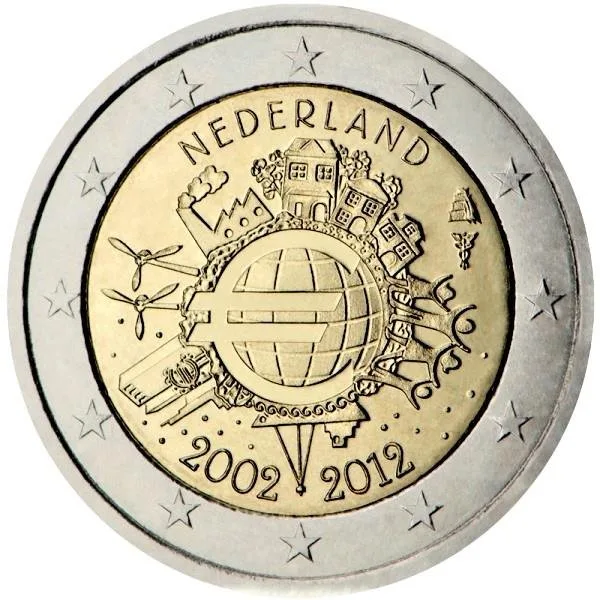
10 Years of Euro Banknotes and Coins
Commemorative coin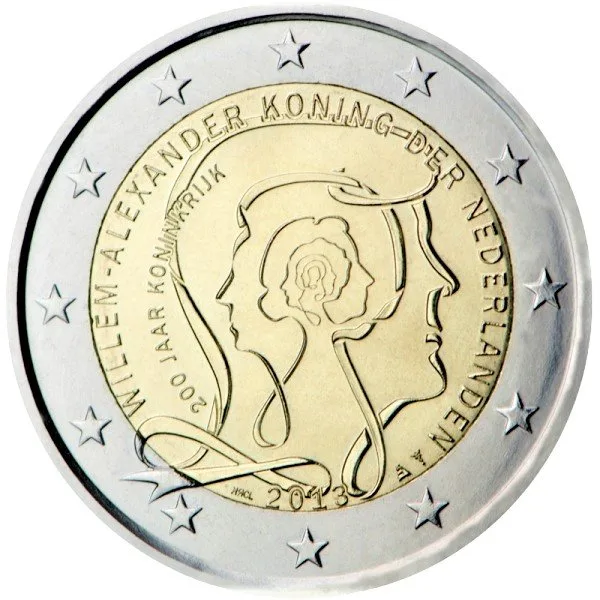
200 Years of the Kingdom of the Netherlands
Commemorative coin