70 Years of the Calouste Gulbenkian Foundation
 + Add to collection In collection ★ Wanted
 At a glance
| Country | Portugal |
|---|---|
| Year | 2026 |
| Issue date | 7 October 2026 |
| Coin type | Commemorative coin |
| Mintage | 124.000 (11.000 / 13.000) |
| Catalogue number | PT-26 G2 |
| Designer | Pedro Carvalho |
| Rarity | €€€€€ what does this mean? |
| Edge lettering |  |
| Market value (approx.) | 4 € · guide price, uncirculated Unlock · for members |
Coin description
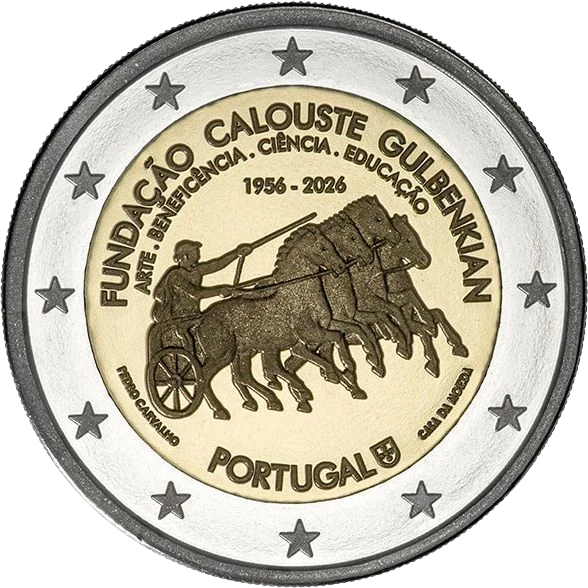
At the centre of the design is a finely detailed quadriga – an ancient two-wheeled chariot drawn by four horses. The motif is the official emblem of the Calouste Gulbenkian Foundation and has represented its four main fields of activity ever since the foundation was established. Along the upper edge are the occasion of issue, "FUNDAÇÃO CALOUSTE GULBENKIAN", the four guiding principles "ARTE • BENEFICÊNCIA • CIÊNCIA • EDUCAÇÃO" and the anniversary dates "1956 – 2026". At the bottom are the issuing country "PORTUGAL" together with the national coat of arms, the name of the Portuguese mint, "CASA DA MOEDA", and the name of the designer, "PEDRO CARVALHO". As usual, the outer ring bears the twelve stars of the European flag.
Further information on the topic
Calouste Sarkis Gulbenkian, born in 1869 in Istanbul into an Armenian merchant family, was one of the most influential business figures of the early 20th century. He owed his fortune chiefly to his pivotal role in developing the oil fields of Mesopotamia: as an intermediary between Ottoman authorities and European corporations, he secured a permanent five-percent stake in the later Iraq Petroleum Company — the origin of his nickname "Mr. Five Percent." At the same time, he spent decades assembling one of the most significant private art collections of his era, with works ranging from ancient Egypt and Persian manuscripts to European masters of the 17th and 18th centuries. Gulbenkian found his final home in occupied Lisbon in the 1940s, where he remained until his death in 1955.
When Gulbenkian died in 1955, he left his entire fortune, his collection, and his properties to a new foundation based in Lisbon. The Calouste Gulbenkian Foundation — Fundação Calouste Gulbenkian — founded in 1956, quickly grew into one of the most financially powerful private cultural institutions in Europe. Its activities span four areas — art, science, education, and humanitarian aid — with its own museum in Lisbon, housing Gulbenkian's original collection, forming the most visible expression of this work. The foundation also supports research projects, orchestras, exhibitions, and scholarship programs in Portugal and internationally. In 2026, Portugal marks the institution's 70th anniversary with a 2-euro commemorative coin, honoring an organization whose reach extends far beyond the country's borders.
Official issues of the coin
 ©Image credit: Imprensa Nacional – Casa da Moeda (INCM)
 ©Image credit: Imprensa Nacional – Casa da Moeda (INCM)
Technical data
| Face value | 2 euro |
|---|---|
| Material | Bimetallic – outer ring: cupronickel; centre: three layers (nickel-brass / nickel / nickel-brass) |
| Weight | 8.5 g |
| Diameter | 25.75 mm |
| Thickness | 2.20 mm |