35 Years of the Erasmus Programme
 + Add to collection In collection ★ Wanted
 At a glance
| Country | Slovenia |
|---|---|
| Year | 2022 |
| Issue date | 1 July 2022 |
| Coin type | Commemorative coin |
| Mintage | 1.000.000 ( – / 2.500) |
| Catalogue number | SI-22 G2 |
| Designer | Joaquin Jimenez |
| Rarity | €€€€€ what does this mean? |
| Edge lettering |  |
| Market value (approx.) | 3,5 € · guide price, uncirculated Unlock · for members |
Coin description
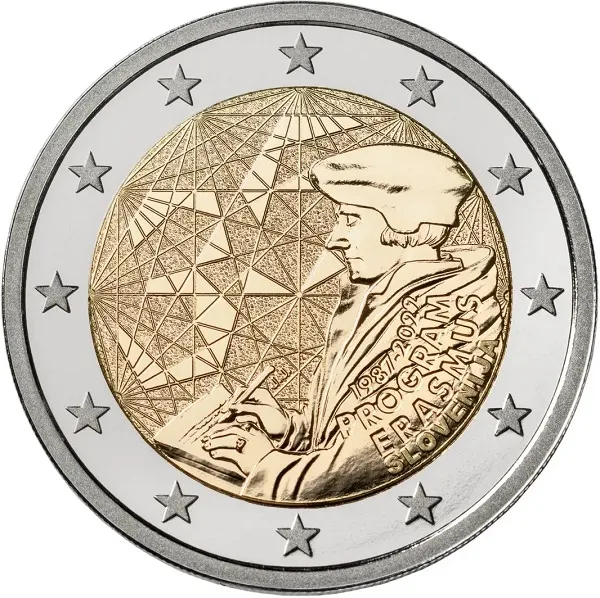
A blend of two central elements of the Erasmus programme: its original intellectual inspiration — Erasmus himself — and an allegory of his influence across Europe. The former is represented by one of the most recognised portraits of Erasmus; the latter by a web of connections passing from beacon to beacon across the coin, evoking the countless intellectual and personal exchanges between European students. Some of these connections form additional stars, born from the synergies between participating countries.
Note on the coin
Fifth joint issue of the European Union. All 19 eurozone states are issuing a coin with the same design on varying dates. The coins differ only in their inscriptions, which appear in the respective national language.
Further information on the topic
In 1987, when the European Community launched the Erasmus programme, Slovenia was still part of the Socialist Federal Republic of Yugoslavia — its accession to the EU, and thus to the European higher education area, lay more than a decade and a half away. Since joining the EU in 2004, Slovenia has fully participated in the programme, and its involvement has been above average from the start: relative to its population, the country is one of the most active Erasmus participant states, both in terms of outgoing students and in hosting international guests at Slovenian universities such as the University of Ljubljana or the University of Maribor. The programme is named after Erasmus of Rotterdam, the Dutch humanist and scholar of the late 15th and early 16th centuries, who himself moved between Europe's centres of learning throughout his life, embodying the ideal of cross-border knowledge exchange.
Slovenia's educational tradition reaches back well before its state independence: the University of Ljubljana was founded in 1919, but academic ties to Central Europe — particularly to Vienna and Graz — are considerably older and shaped the intellectual life of the region for centuries. Against this backdrop, the Erasmus programme represents for Slovenia not merely an EU funding scheme but a reconnection to a historically grown tradition of mobility in higher education. Today, thousands of Slovenian students and teachers use the programme every year for stays abroad across Europe. To mark the 35th anniversary of the Erasmus programme in 2022, all euro states, including Slovenia, took part in a joint commemorative coin issue.
Technical data
| Face value | 2 euro |
|---|---|
| Material | Bimetallic – outer ring: cupronickel; centre: three layers (nickel-brass / nickel / nickel-brass) |
| Weight | 8.5 g |
| Diameter | 25.75 mm |
| Thickness | 2.20 mm |
More 2-euro coins from Slovenia
150th Birthday of Jože Plečnik
Commemorative coin
150th Birthday of Josip Plemelj
Commemorative coin
200 Years of the Slovenian National Museum
Commemorative coin
250 Years of the National and University Library
Commemorative coin