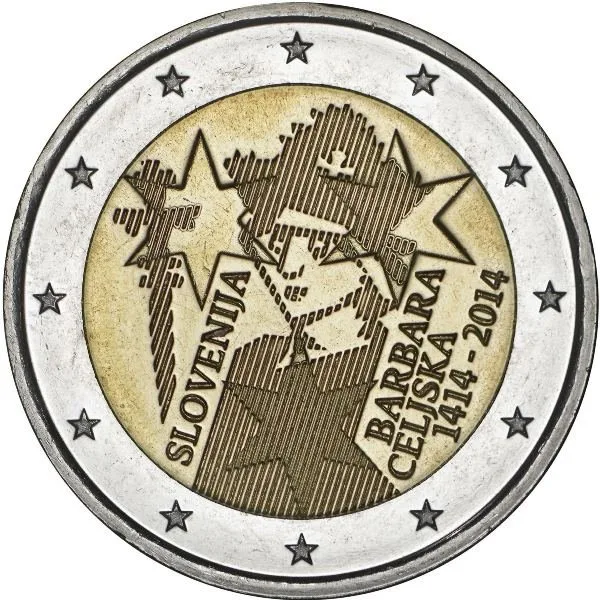
600th Anniversary of the Coronation of Barbara of Celje
 + Add to collection In collection ★ Wanted
 At a glance
| Country | Slovenia |
|---|---|
| Year | 2014 |
| Issue date | 17 November 2014 |
| Coin type | Commemorative coin |
| Mintage | 1.000.000 (15.000 / 6.500) |
| Catalogue number | SI-14 G1 |
| Designer | Studiobotas |
| Rarity | €€€€€ what does this mean? |
| Edge lettering |  |
| Market value (approx.) | 3,5 € · guide price, uncirculated Unlock · for members |
Coin description
A hatched depiction of Queen Barbara of Celje holding her sceptre. The design also features three six-pointed stars typical of the House of Celje. To the left, the inscription 'SLOVENIJA', and to the right 'BARBARA CELJSKA' with the years '1414–2014'.
Further information on the topic
Barbara of Celje ranks among the most significant female rulers to emerge from medieval Slovenia. As the daughter of Count Hermann II of Celje, she belonged to one of the most powerful noble houses in the south-eastern Alpine region, whose domain covered large parts of present-day Slovenia. Through her marriage to King Sigismund of Luxembourg in 1405 she rose to become Queen of Hungary, and in 1414 she was crowned German queen in Aachen — a position that made her one of the most influential women of her time. Her political agency was considerable: she acted as an independent player at court, maintained diplomatic contacts, and held her own in the power struggles of a male-dominated feudal society. Contemporary sources describe her as fluent in several languages and equally versed in courtly and ecclesiastical affairs.
The House of Celje, whose coat of arms bears its characteristic six-pointed stars, shaped the history of present-day Slovenia across several generations. The County of Celje — today's Celje — was the political and cultural center of this dynasty, which in the 15th century ranked among the most significant princely houses of Central Europe. With the death of the last Count of Celje in 1456, the male line of the family died out; its inheritance passed to the Habsburgs. Barbara herself outlived her husband Sigismund and spent her final years in Bohemia, where she died in 1451. Slovenia commemorates the 600th anniversary of her coronation with the 2014 2-euro commemorative coin, honoring a figure whose historical impact reached far beyond the borders of today's country.
Technical data
| Face value | 2 euro |
|---|---|
| Material | Bimetallic – outer ring: cupronickel; centre: three layers (nickel-brass / nickel / nickel-brass) |
| Weight | 8.5 g |
| Diameter | 25.75 mm |
| Thickness | 2.20 mm |
More 2-euro coins from Slovenia
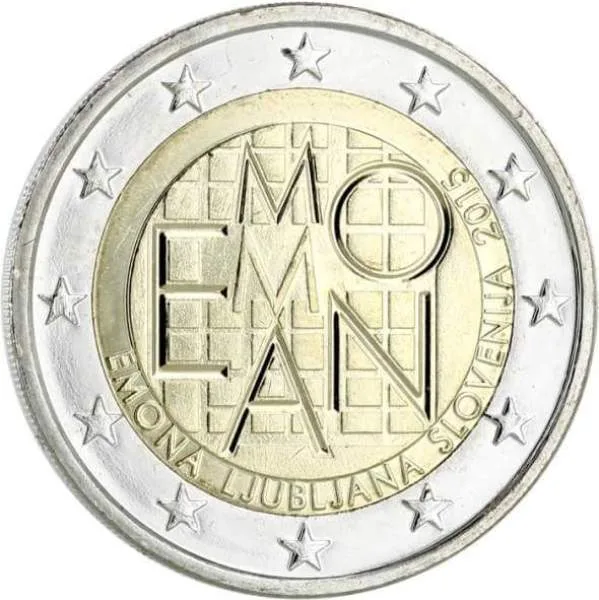
2,000 Years of the Roman Settlement of Emona – Ljubljana
Commemorative coin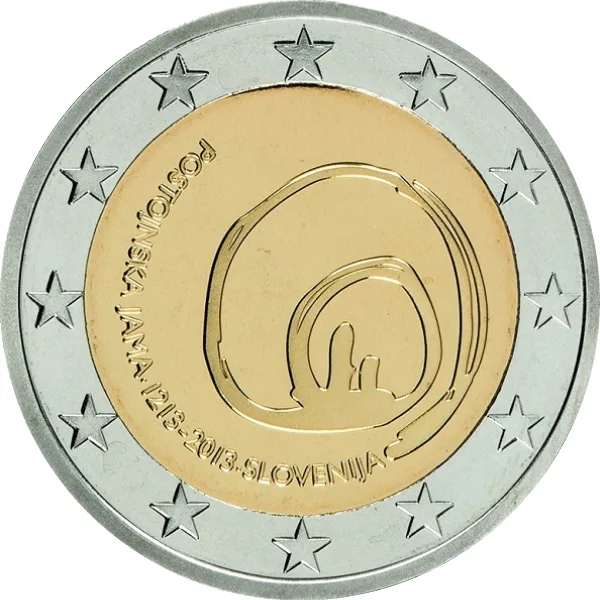
800 Years of Postojna Cave
Commemorative coin
30 Years of the European Flag
Commemorative coin
10 Years of Euro Banknotes and Coins
Commemorative coin