10 Years of Economic and Monetary Union
 + Add to collection In collection ★ Wanted
 At a glance
| Country | Slovenia |
|---|---|
| Year | 2009 |
| Issue date | 5 January 2009 |
| Coin type | Commemorative coin |
| Mintage | 1.000.000 ( – / – ) |
| Catalogue number | SI-09 G1 |
| Designer | Georgios Stamatopoulus |
| Rarity | €€€€€ what does this mean? |
| Edge lettering |  |
| Market value (approx.) | 4,5 € · guide price, uncirculated Unlock · for members |
Coin description
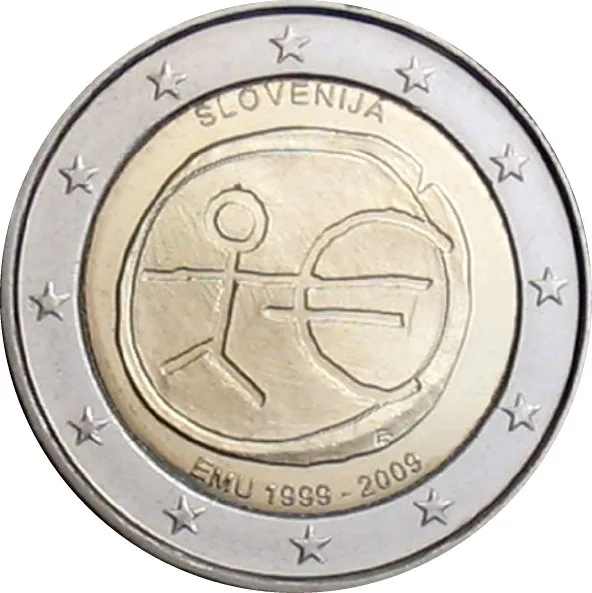
At the centre, a stylised human figure drawn from an ancient coin, with the left arm extending into the euro symbol. The artist's initials ΓΣ appear below the euro sign. The name of the issuing state in the national language(s) runs along the upper edge of the design, while the dates 1999–2009 and the local-language acronym for EMU appear along the lower edge.
Note on the coin
Second joint issue of the European Union. All 16 eurozone states issued a coin with the same design on 1 January 2009 to mark the anniversary. The coins differ only in their inscriptions, which appear in the respective national language.
Further information on the topic
When the European Economic and Monetary Union launched on 1 January 1999 with the introduction of the euro as scriptural money, Slovenia was not yet a member of the European Union. The country joined the EU only in 2004, as part of the first wave of eastern enlargement. Just three years later, on 1 January 2007, Slovenia became the first of the new EU member states to introduce the euro as cash — an economic-policy milestone marking the end of a long convergence process. The EMU emerged from the Maastricht Treaty of 1992 and, for the first time, set binding stability criteria for public finances and inflation that all candidate countries had to meet. Slovenia, which had initially operated its own currency, the tolar, after independence in 1991, went through this adjustment process in a comparatively short time.
The Economic and Monetary Union is regarded as the deepest form of economic integration that sovereign states have achieved to date: monetary policy, interest rate decisions and exchange rates have since been steered by the European Central Bank rather than national central banks. For Slovenia, joining the euro marked the conclusion of a fundamental economic transformation after the end of socialism. To mark the tenth anniversary of the EMU (1999–2009), all eurozone states jointly issued a 2-euro commemorative coin with an identical design — one of the few joint issues in the European coin programme and a rare sign of coordinated commemorative policy across the eurozone.
Technical data
| Face value | 2 euro |
|---|---|
| Material | Bimetallic – outer ring: cupronickel; centre: three layers (nickel-brass / nickel / nickel-brass) |
| Weight | 8.5 g |
| Diameter | 25.75 mm |
| Thickness | 2.20 mm |