10 Years of Euro Banknotes and Coins
 + Add to collection In collection ★ Wanted
 At a glance
| Country | Cyprus |
|---|---|
| Year | 2012 |
| Issue date | 13 February 2012 |
| Coin type | Commemorative coin |
| Mintage | 1.000.000 (17.000 / 8.000) |
| Catalogue number | CY-12 G1 |
| Designer | Helmut Andexlinger |
| Rarity | €€€€€ what does this mean? |
| Edge lettering |  |
| Market value (approx.) | 4 € · guide price, uncirculated Unlock · for members |
Coin description
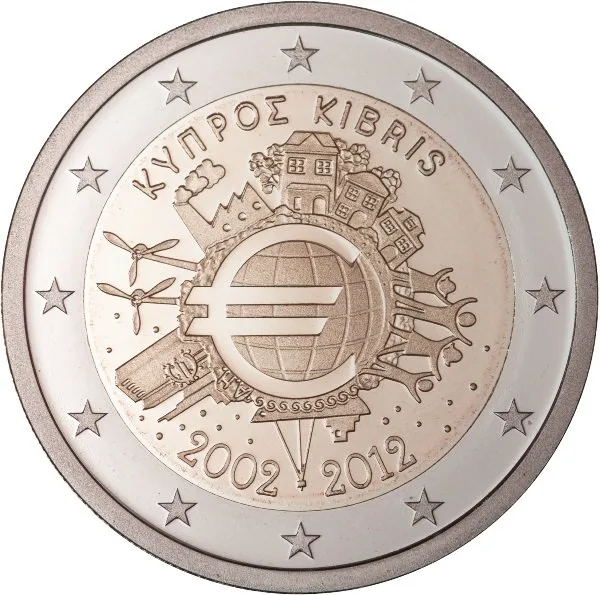
The euro has grown into a major factor both across Europe and globally, establishing itself as a key player in the international monetary system. The design elements surrounding the euro sign symbolise its significance for everyday people, the financial world (the ECB tower), trade (ships), industry (factories), the energy sector, and research and development (wind turbines). The initials of designer Helmut Andexlinger appear below the ECB tower. The names of the issuing states in their respective languages are inscribed centrally above the design, with the dates 2002–2012 below.
Note on the coin
Third joint issue of the European Union. All 17 eurozone states issued a coin with the same design on the anniversary date of 1 January 2012. The coins differ only in their inscriptions, which appear in the respective national language. San Marino also issued a coin with the same design, which is not officially part of the joint issue.
Further information on the topic
Cyprus did not join the European Union until 2004 and introduced euro cash on 1 January 2008 — six years after the original founding states of the eurozone. The island republic is thus among those countries that did not mint the common currency from the start but joined it as part of a gradually expanding monetary union. At the time of the euro cash introduction, Cyprus was politically divided: the northern part of the island has been under Turkish control since 1974 and lies outside the scope of the European currency area. The euro effectively applies only to the Republic of Cyprus in the southern part of the island — a geopolitical peculiarity unique within the eurozone.
In its first ten years as cash, the euro developed into the world's second most important reserve currency. For the Cypriot economy, heavily shaped by tourism, the financial sector, and trade in the eastern Mediterranean, the monetary union above all meant closer integration into the European single market and easier cross-border payments. The European Central Bank, international shipping, and Europe's industrial interconnection formed visible cornerstones of this currency union. To mark the tenth anniversary of euro cash, Cyprus issued a commemorative coin with a uniform design in 2012, together with all other euro states.
Technical data
| Face value | 2 euro |
|---|---|
| Material | Bimetallic – outer ring: cupronickel; centre: three layers (nickel-brass / nickel / nickel-brass) |
| Weight | 8.5 g |
| Diameter | 25.75 mm |
| Thickness | 2.20 mm |
More 2-euro coins from Cyprus
30 Years of the European Flag
Commemorative coin
10 Years of Economic and Monetary Union
Commemorative coin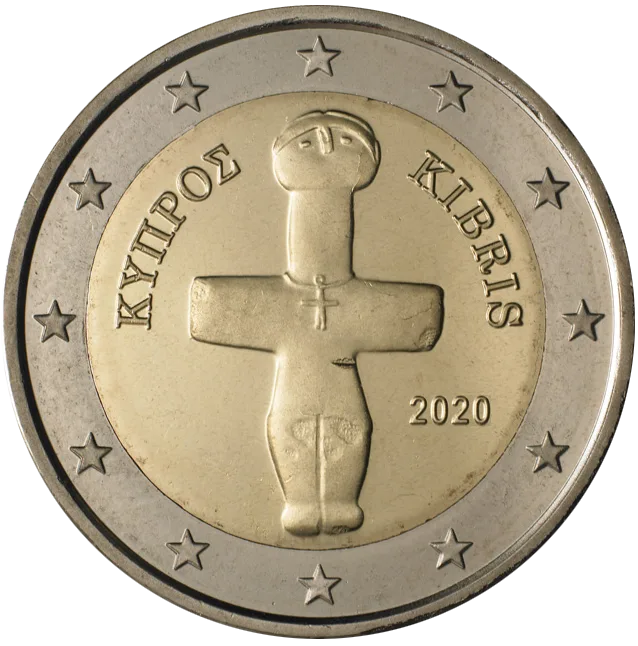
Idol of Pomos
Circulation coin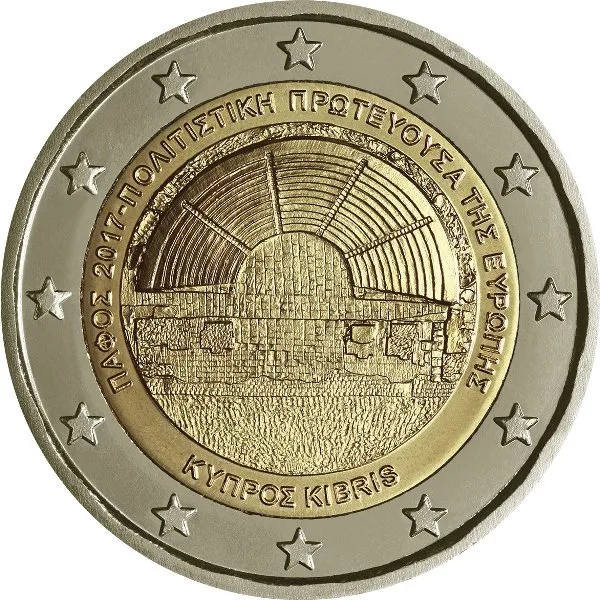
Paphos – European Capital of Culture 2017
Commemorative coin