200 Years of the Discovery of Antarctica
 + Add to collection In collection ★ Wanted
 At a glance
| Country | Estonia |
|---|---|
| Year | 2020 |
| Issue date | 27 January 2020 |
| Coin type | Commemorative coin |
| Mintage | 750.000 (10.000 / – ) |
| Catalogue number | EE-20 G1 |
| Designer | Tiiu Pirsko, Mati Veermets |
| Rarity | €€€€€ what does this mean? |
| Edge lettering |  |
| Market value (approx.) | 3,5 € · guide price, uncirculated Unlock · for members |
Coin description
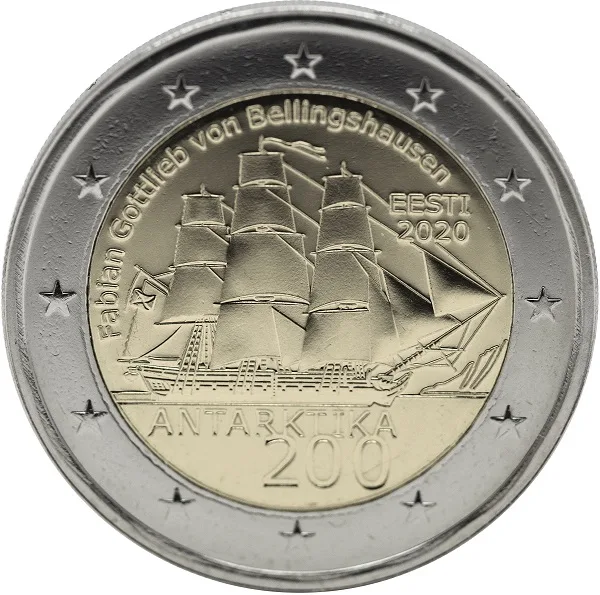
The three-masted corvette Vostok, aboard which Fabian von Bellingshausen (1778–1852) set out in 1819 on the first Russian expedition to the South Polar region. His name runs along the upper left edge. To the right appear the issuing country "EESTI" and the year "2020". Below the ship on the water's surface the inscription "ANTARKTIKA" and "200" can be read, and along the right edge a schematic depiction of the Antarctic ice shelf he first sighted.
Further information on the topic
Fabian Gottlieb von Bellingshausen, born in 1778 on the Estonian island of Ösel (present-day Saaremaa), was an officer of the Imperial Russian Navy and a trained hydrographer. His connection to science reaches back to his early career: as a young officer, he took part in the first Russian circumnavigation of the globe under Adam von Krusenstern and was responsible for the mapping work. When he took command of the expedition to the southern polar region in 1819, he led two sloops - the Vostok and the Mirny - into waters that no European had until then systematically explored. In January 1820, the crews sighted the Antarctic ice shelf, which experts today regard as one of the first documented pieces of evidence of the discovery of the Antarctic continent. Russia, Britain and the American sealer Nathaniel Palmer all claim this first discovery; Bellingshausen's detailed records and maps are considered particularly reliable.
For Estonia, Bellingshausen carries a special identity-related significance: as the son of a Baltic German noble family from what is now Estonian territory, he represents the region's scientific and maritime contribution to the Russian Empire - and thus to a chapter of European exploration history reaching far beyond the Baltic Sea. The Bellingshausen Sea, a Soviet Antarctic research station, and several geographical features in the Southern Ocean are named after him. In 2020, Estonia commemorated the 200th anniversary of the expedition that expanded humanity's picture of the planet by an entire continent, with a 2-euro commemorative coin.
Official issues of the coin
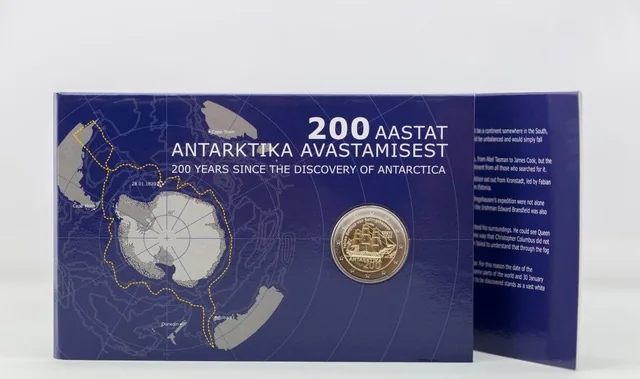 ©Image credit: Eesti Pank
Technical data
| Face value | 2 euro |
|---|---|
| Material | Bimetallic – outer ring: cupronickel; centre: three layers (nickel-brass / nickel / nickel-brass) |
| Weight | 8.5 g |
| Diameter | 25.75 mm |
| Thickness | 2.20 mm |