500 Years of the First Printed Text in Estonian
 ©Image credit: Numismatische Sammlung der Deutschen Bundesbank + Add to collection In collection ★ Wanted
 At a glance
| Country | Estonia |
|---|---|
| Year | 2025 |
| Issue date | 30 January 2025 |
| Coin type | Commemorative coin |
| Mintage | 850.000 (8.500 / – ) |
| Catalogue number | EE-25 G1 |
| Designer | Svetlin Balezdrov |
| Rarity | €€€€€ what does this mean? |
| Edge lettering |  |
| Market value (approx.) | 3,5 € · guide price, uncirculated Unlock · for members |
Coin description
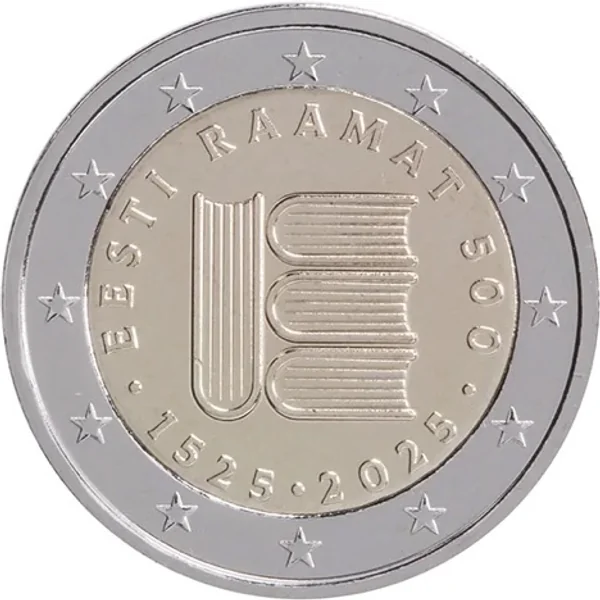
Four stylised books at the centre, arranged to form the letter E. Above, along the inner rim, the commemoration inscription "EESTI KIRJAKEEL 500"; along the lower edge the years "1525" and "2025", separated by dots.
Further information on the topic
The written codification of a language is rarely a single, one-off act — yet for Estonian, a concrete starting point can be identified: in 1525, a small catechism was printed in Lübeck containing the first known texts in the Estonian language. These were translations of Lutheran statements of faith — the Lord's Prayer, the Creed and the Ten Commandments — created in the context of the Reformation, which also quickly took hold in Livonia. That it was religious texts that founded Estonian written language was no coincidence: the Lutheran church needed to reach the population in its own tongue. This pragmatism had long-term consequences: the written codification laid the foundation for a literary tradition that carried Estonia through centuries of Swedish, Russian and eventually Soviet rule.
The path from these first printed lines to a modern standard language was a long one. In the 19th century, Estonia experienced a national awakening movement that placed language and literature at its centre. The national epic "Kalevipoeg", begun in 1857, became a symbol of a cultural self-confidence that culminated in the founding of the Republic of Estonia in 1918. Today, Estonian is the official language of an EU member state and one of the most thoroughly digitised small languages in the world — with its own language portal, statutorily regulated language policy, and a vibrant contemporary literature. In 2025, Estonia marks the 500th anniversary of the first printing of Estonian-language text, commemorating a moment whose impact reaches far beyond the history of the book.
Official issues of the coin
 ©Image credit: Eesti Pank
Technical data
| Face value | 2 euro |
|---|---|
| Material | Bimetallic – outer ring: cupronickel; centre: three layers (nickel-brass / nickel / nickel-brass) |
| Weight | 8.5 g |
| Diameter | 25.75 mm |
| Thickness | 2.20 mm |