Veterans of the Estonian Defence Forces
 + Add to collection In collection ★ Wanted
 At a glance
| Country | Estonia |
|---|---|
| Year | 2027 |
| Issue date | 2027 |
| Coin type | Commemorative coin |
| Mintage | 1.000.000 (– / –) |
| Catalogue number | EE-27 G1 |
| Designer | Kerli Tamjärv |
| Rarity | €€€€€ what does this mean? |
| Edge lettering |  |
Coin description
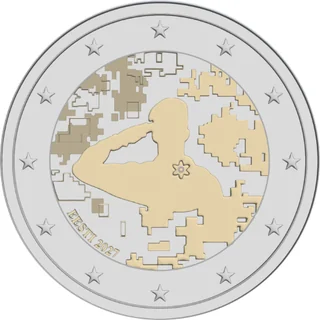
A silhouette of a saluting soldier of the Estonian Defence Forces. On the chest is the stylised veterans’ flower (“Sinilill”, liverleaf), which in Estonia symbolises recognition and support for veterans. The background is a pixelated camouflage pattern evoking digital camouflage and representing the modern Estonian Defence Forces. At the lower left are the country name “EESTI” and the year “2027”. The outer ring shows the twelve stars of the European Union.
Further information on the topic
Estonia's Defence Forces were established immediately after the restoration of state independence in August 1991. Their institutional foundation, however, reaches deeper: between 1918 and 1920, the Estonian army fought in the War of Independence against Russian troops and Baltic German units — and prevailed. This victory is still regarded today as the founding moment of modern Estonia. The armed forces were dissolved after the Soviet occupation of 1940; those who nonetheless stood up for the country's defense did so under changing and often life-threatening conditions. The so-called Forest Brothers — partisans who resisted the Soviet regime well into the 1950s — stand in particular for active resistance against the occupying power in Estonian memory.
The "Resistance" series, under which Estonia is issuing a 2-euro commemorative coin in 2027, takes up precisely this line of tradition. At its center are the veterans of the Estonian Defence Forces — people whose service was rendered under the conditions of the Cold War, the restoration of the republic, or earlier conflicts. In Estonian remembrance culture, armed resistance against foreign rule occupies a central place; it is understood not as a historical footnote but as part of a continuous national narrative stretching from 1918 to the present. The theme thus touches not only military history but also questions of national identity and state sovereignty that remain politically alive in the Baltic context today.
Technical data
| Face value | 2 euro |
|---|---|
| Material | Bimetallic – outer ring: cupronickel; centre: three layers (nickel-brass / nickel / nickel-brass) |
| Weight | 8.5 g |
| Diameter | 25.75 mm |
| Thickness | 2.20 mm |