100th Anniversary of the Treaty of Tartu
 + Add to collection In collection ★ Wanted
 At a glance
| Country | Estonia |
|---|---|
| Year | 2020 |
| Issue date | 1 February 2020 |
| Coin type | Commemorative coin |
| Mintage | 1.000.000 (10.000 / – ) |
| Catalogue number | EE-20 G2 |
| Designer | Ivar Sakk |
| Rarity | €€€€€ what does this mean? |
| Edge lettering |  |
| Market value (approx.) | 4 € · guide price, uncirculated Unlock · for members |
Coin description
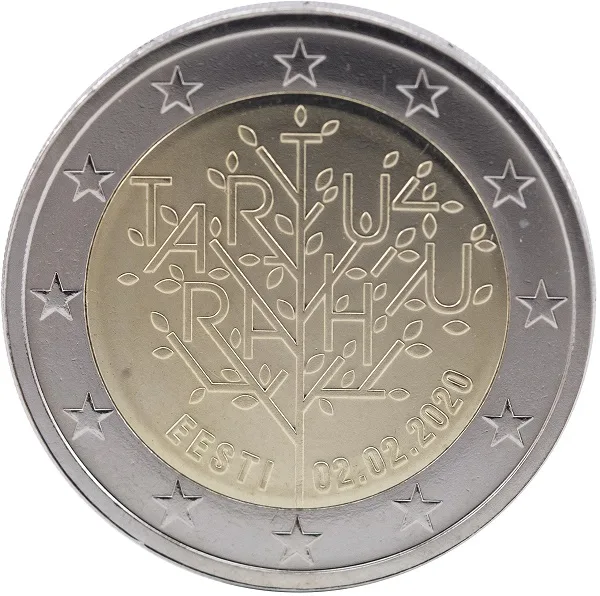
A stylised tree representing the young Estonian nation. Among the small leaves of its branches the commemoration inscription "TARTU RAHU" (the Treaty of Tartu) can be made out. The issuing country "EESTI" and the date 02.02.2020 appear along the lower edge of the coin.
Further information on the topic
The Treaty of Tartu of 2 February 1920 marks one of the most significant turning points in Estonian history: with it, Soviet Russia officially recognised Estonia's independence and renounced all territorial claims. For the young republic, which had only declared its statehood in 1918, this treaty was far more than a diplomatic document - it secured territorial integrity after the Estonian War of Independence and created the international legal foundation of the new state. Tartu, then still known as Dorpat, was a symbolically fitting venue for the negotiations as a university town and Estonia's intellectual and cultural centre. The treaty is still regarded today as a reference point for Estonian sovereignty and is regularly cited in historical and legal debates on state continuity between the first Estonian state (1918-1940) and the restored republic after 1991.
The signing of the agreement ended an armed conflict that had put the young Estonia under simultaneous pressure from several sides: Red Army troops in the east, Baltic German Freikorps units in the west. The fact that Estonia successfully concluded this war and was able to negotiate peace on equal terms had a lasting impact on the national self-image. To this day, street names, school curricula and state ceremonies commemorate this moment. On the centenary of the treaty's conclusion, Eesti - Estonia - issued a 2-euro commemorative coin in 2020, honouring this founding document of modern Estonian statehood.
Official issues of the coin
 ©Image credit: Eesti Pank
 ©Image credit: Eesti Pank
Technical data
| Face value | 2 euro |
|---|---|
| Material | Bimetallic – outer ring: cupronickel; centre: three layers (nickel-brass / nickel / nickel-brass) |
| Weight | 8.5 g |
| Diameter | 25.75 mm |
| Thickness | 2.20 mm |