100 Years of the Rising Sun National Symbol
 + Add to collection In collection ★ Wanted
 At a glance
| Country | Latvia |
|---|---|
| Year | 2019 |
| Issue date | 17 September 2019 |
| Coin type | Commemorative coin |
| Mintage | 307.000 (7.000 / – ) |
| Catalogue number | LV-19 G1 |
| Designer | Ivars Drulle |
| Rarity | €€€€€ what does this mean? |
| Edge lettering |  |
| Market value (approx.) | 5 € · guide price, uncirculated Unlock · for members |
Coin description
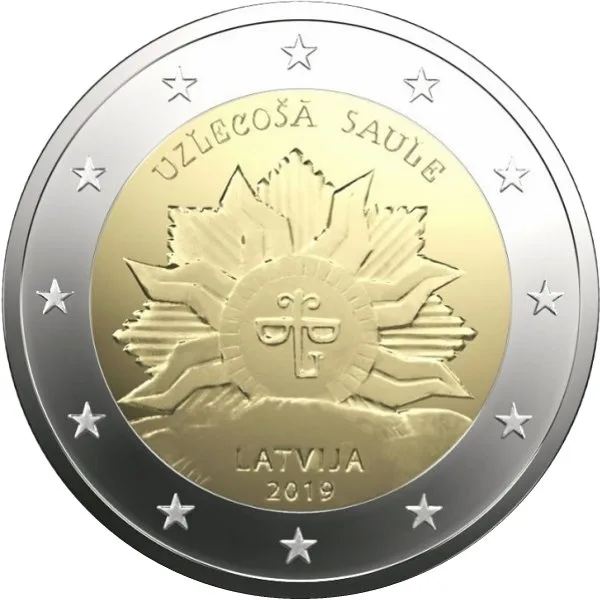
A coat of arms featuring a rising sun with the letters "BL" — Brīvā Latvija (Free Latvia) — at the centre of the sun disc, designed by Ansis Cīrulis in 1917 as the basis for one of the core elements of today's Latvian state arms. Above, the commemorative inscription "UZLECOŠĀ SAULE" (Rising Sun). The issuing state "LATVIJA" and the issue year "2019" appear along the lower edge.
Further information on the topic
The upper part of Latvia's state coat of arms bears a rising sun, a design that traces back to a 1917 creation by the artist Ansis Cīrulis. Cīrulis, a key figure in Latvian applied art and Art Nouveau, developed the motif during the political upheavals that preceded the end of the First World War. The inscription "Brīvā Latvija" — Free Latvia — on the sun disc anchored the symbol from the outset in the idea of state independence. When Latvia declared its independence on 18 November 1918, this emblem became part of the emerging national self-understanding. Today's coat of arms, fixed in its complete form in 1921 and reintroduced after the restoration of independence in 1990, preserves this sun shape in the upper half of the shield — complemented by the red lion of Courland and the silver griffin of Livonia, as well as three golden stars representing the historic regions of Courland, Livonia and Latgale.
Latvia is among those European states whose state symbolism spans an unusually direct historical arc: from the national aspirations of the late tsarist era, through suppression during the Soviet occupation (1940–1941, 1944–1991), to restoration after the non-violent liberation of 1991, the flag and coat of arms remained present as symbols of identity — among Latvians in exile, but also in the collective memory within the country itself. In this context, the rising sun is not merely a heraldic element but a recurring motif of Latvian identity: it appears in folk song, in poetry, and in the visual arts. To mark the centenary of the first use of the sun motif in the Latvian state emblem, Latvia issued a 2-euro commemorative coin in 2019.
Technical data
| Face value | 2 euro |
|---|---|
| Material | Bimetallic – outer ring: cupronickel; centre: three layers (nickel-brass / nickel / nickel-brass) |
| Weight | 8.5 g |
| Diameter | 25.75 mm |
| Thickness | 2.20 mm |