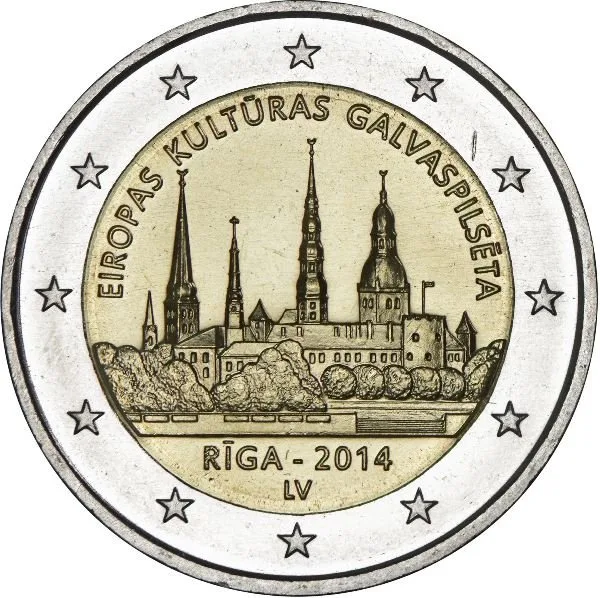
Riga – European Capital of Culture 2014
 + Add to collection In collection ★ Wanted
 At a glance
| Country | Latvia |
|---|---|
| Year | 2014 |
| Issue date | 12 August 2014 |
| Coin type | Commemorative coin |
| Mintage | 1.005.000 (5.000 / – ) |
| Catalogue number | LV-14 G1 |
| Designer | Heinrihs Vorkals |
| Rarity | €€€€€ what does this mean? |
| Edge lettering |  |
| Market value (approx.) | 5 € · guide price, uncirculated Unlock · for members |
Coin description
The Riga skyline and the historic city centre, designated a UNESCO World Heritage Site. Above the design, the inscription "EIROPAS KULTURAS GALVASPILSETA" (European Capital of Culture). Below, the city's name and the issue year "RIGA – 2014", with the Latvian country code "LV" beneath.
Further information on the topic
Riga is one of the most important cities in the Baltics, with a history spanning more than eight hundred years. Founded in 1201 as a trading post of the Teutonic Order, the city rapidly developed into an economic centre of the Hanseatic League and shaped the region for centuries. Its old town, inscribed on the UNESCO World Heritage list in 1997, combines medieval architecture with one of the world's densest ensembles of Art Nouveau buildings - roughly a third of the historic building stock dates from this era, making Riga a unique testament to architecture around 1900. After Latvia regained independence in 1991, the capital underwent a profound cultural transformation: museums, theatres and a vibrant creative scene established Riga as the cultural centre of gravity in Northeastern Europe.
This development reached a provisional high point in 2014, when Riga held the title of European Capital of Culture together with Umeå and Košice. For Latvia, it was the first time hosting this EU programme, which since 1985 has annually recognised cities for their cultural achievements and their role in European coexistence. Riga used the year to realise projects at the intersection of urban development, cultural heritage and contemporary art, placing particular emphasis on the relationship between architecture and collective memory. Latvia marked the occasion in 2009 with a 2-euro commemorative coin that gives visible expression to the capital's cultural weight within a European context.
Technical data
| Face value | 2 euro |
|---|---|
| Material | Bimetallic – outer ring: cupronickel; centre: three layers (nickel-brass / nickel / nickel-brass) |
| Weight | 8.5 g |
| Diameter | 25.75 mm |
| Thickness | 2.20 mm |