Baltic Culture
 + Add to collection In collection ★ Wanted
 At a glance
| Country | Lithuania |
|---|---|
| Year | 2016 |
| Issue date | 3 May 2016 |
| Coin type | Commemorative coin |
| Mintage | 1.000.000 (10.000 / – ) |
| Catalogue number | LT-16 G1 |
| Designer | Jolanta Mikulskytė & Giedrius Paulauskis |
| Rarity | €€€€€ what does this mean? |
| Edge lettering |  |
| Market value (approx.) | 3,5 € · guide price, uncirculated Unlock · for members |
Coin description
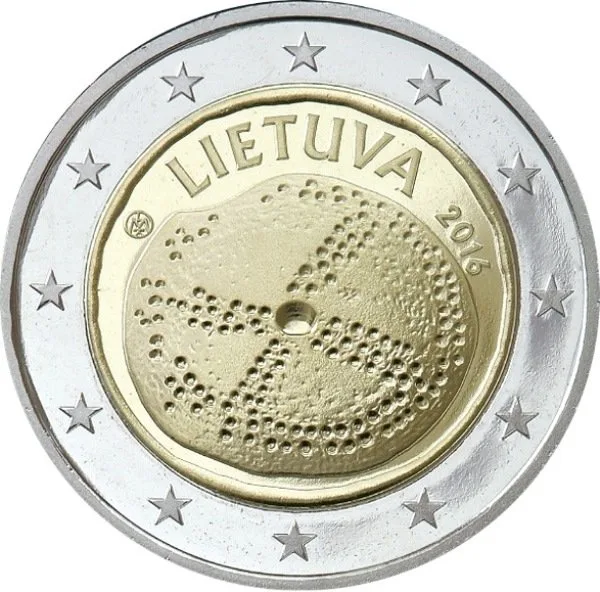
An amber disc — one of the most distinctive symbols of Baltic culture — decorated with a cross of drilled dots representing the Earth's axis. The issuing state "LIETUVA" appears at the top, flanked by the mintmark and the year "2016".
Further information on the topic
Amber has been one of the most defining cultural materials of the Baltic region for millennia. Along the Baltic coast — in present-day Lithuania, Latvia and Estonia — it was already mined, traded and worked into jewellery as early as the Neolithic period. The so-called Amber Road connected the Baltic region across Central Europe as far as Rome, giving the Baltic peoples an early position as trading partners within a continental network. For the pre-Christian cultures of the region, amber was not merely a trade good but also held symbolic significance: it was regarded as the sun stone, associated with light and cosmic order. The geometric decorations found on Baltic amber discs — crosses, dots, axis lines — reflect mythological ideas in which the cardinal directions and the world axis played a central role.
Despite shared Indo-European roots, Baltic culture is not a monolithic concept: the Baltic languages — Lithuanian and Latvian — are regarded as the most archaic among the living Indo-European languages, preserving structures long vanished in other branches. Lithuania, which developed into the largest state by area in medieval Europe, always stood at the intersection of East Slavic, Germanic and Scandinavian influences without ever losing its cultural distinctiveness. Cultivating this identity — through language, folk art and symbolism — has taken on a political dimension, particularly following the decades of Soviet rule. With the 2-euro commemorative coin of 2016, Lithuania honours this cultural continuity, placing amber as a symbol of Baltic history at its centre.
Technical data
| Face value | 2 euro |
|---|---|
| Material | Bimetallic – outer ring: cupronickel; centre: three layers (nickel-brass / nickel / nickel-brass) |
| Weight | 8.5 g |
| Diameter | 25.75 mm |
| Thickness | 2.20 mm |