Lithuanian Ethnographic Regions – Mažoji Lietuva
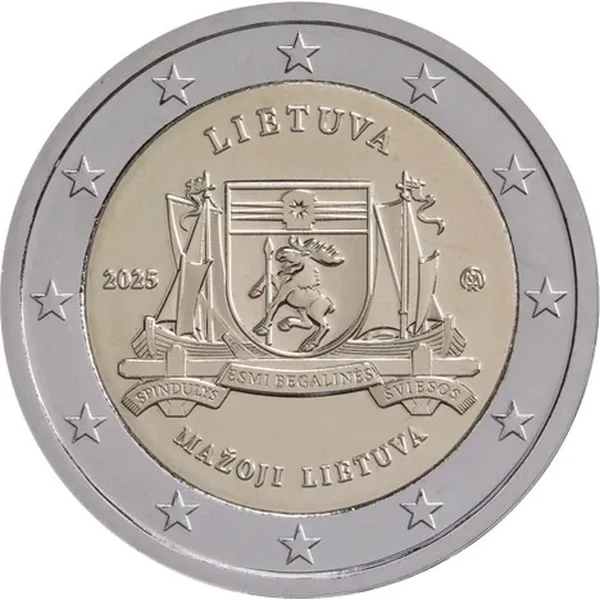 ©Image credit: Numismatische Sammlung der Deutschen Bundesbank + Add to collection In collection ★ Wanted
 At a glance
| Country | Lithuania |
|---|---|
| Year | 2025 |
| Issue date | 22 December 2025 |
| Coin type | Commemorative coin |
| Mintage | 500.000 (5.000 / – ) |
| Catalogue number | LT-25 G2 |
| Designer | Rolandas Rimkūnas |
| Rarity | €€€€€ what does this mean? |
| Edge lettering |  |
| Market value (approx.) | 3,5 € · guide price, uncirculated Unlock · for members |
Coin description
The coat of arms of the ethnographic region of Mažoji Lietuva (Lithuania Minor). At the centre the shield depicts an elk holding a spear in its forelegs, surmounted by a lighthouse with a characteristic flash pattern. On either side of the shield: traditional Curonian fishing vessels. Below, the motto — a quotation from Vydūnas: "SPINDULYS ESMI BEGALINĖS ŠVIESOS" (I am a ray of infinite light). Above: the issuing state "LIETUVA"; to the left: the year "2025"; to the right: the Lithuanian mintmark. The inscription "MAŽOJI LIETUVA" completes the design at the bottom.
Further information on the topic
Mažoji Lietuva — Lithuania Minor in English — denotes the part of the historic Lithuanian settlement area that lay east of the Neman and belonged for centuries to the Duchy of Prussia, later Prussia and finally the German Empire. The region was shaped by a distinctive folk culture centred on the Curonian Lagoon, with its characteristic Curonian boats: flat-bottomed, high-sailed fishing boats that defined the coastal landscape for generations. The lighthouse as a regional symbol points to the maritime character of a coastal landscape that linked trade and fishing routes along the Baltic coast. Despite centuries of belonging to German states, the Lithuanian-speaking population — the so-called Lietuvininkai — preserved their language, traditional dress and customs. Significant Lithuanian literature and journalism emerged precisely here, because German press freedoms in the 19th century allowed the publication of Lithuanian-language books that were banned in Tsarist Lithuania.
After the First World War, the Klaipėda region — the northernmost part of Lithuania Minor — came under Lithuanian administration in 1923 following the Klaipėda Revolt, making it the only part of the region to become part of independent Lithuania. The remaining parts of Lithuania Minor stayed with the German Empire and, after the Second World War, became part of the Soviet Union; the Lithuanian population was expelled or fled. Today, Mažoji Lietuva is regarded as one of the five ethnographic regions of Lithuania, whose cultural heritage — traditional dress, dialect, folk building styles, and the symbolism of coat of arms, elk and Curonian boat — is kept alive in the country's collective memory. With the 2025 2-euro commemorative coin, Lithuania honours this region as part of its series on ethnographic regions.
Official issues of the coin
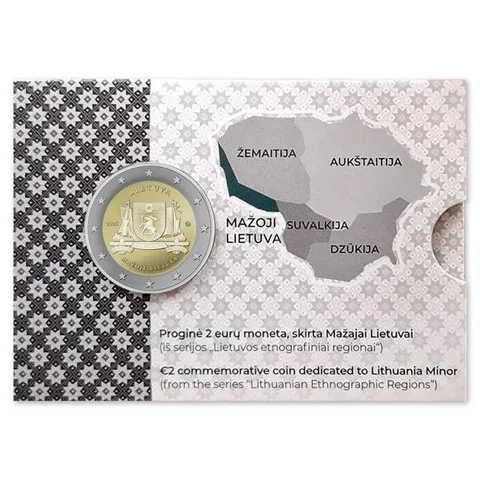 ©Image credit: Lietuvos Bankas
Technical data
| Face value | 2 euro |
|---|---|
| Material | Bimetallic – outer ring: cupronickel; centre: three layers (nickel-brass / nickel / nickel-brass) |
| Weight | 8.5 g |
| Diameter | 25.75 mm |
| Thickness | 2.20 mm |