The Lithuanian Language
 + Add to collection In collection ★ Wanted
 At a glance
| Country | Lithuania |
|---|---|
| Year | 2015 |
| Issue date | 14 December 2015 |
| Coin type | Commemorative coin |
| Mintage | 1.000.000 (10.000 / – ) |
| Catalogue number | LT-15 G2 |
| Designer | Liudas Parulskis |
| Rarity | €€€€€ what does this mean? |
| Edge lettering |  |
| Market value (approx.) | 3,5 € · guide price, uncirculated Unlock · for members |
Coin description
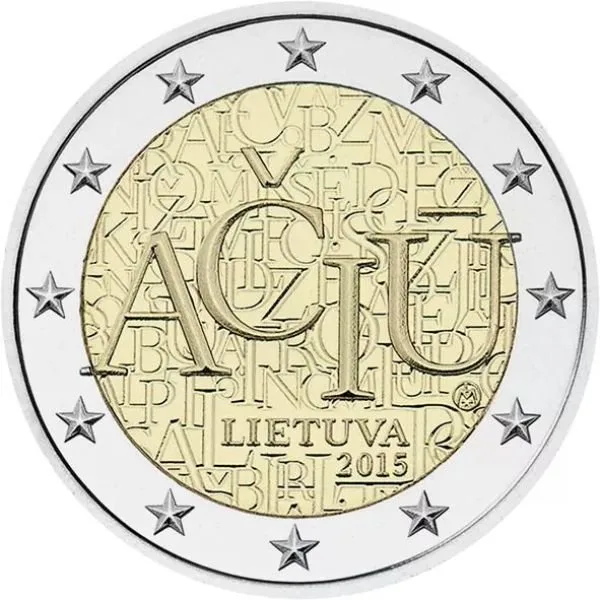
The word "ACIU" (THANK YOU) — one of the most beautiful words in the Lithuanian language. For this project, a bespoke Lithuanian typeface was created to mark the centenary of the lifting of the ban on Lithuanian-language books printed in Latin characters; it is based on the Latin script and better accommodates the most frequent letter combinations in Lithuanian. The background of the design is filled with all the letters of the Lithuanian alphabet in a word-cloud arrangement. Below: the issuing state "LIETUVA" and the year "2015"; beneath "ACIU" to the lower right: the Lithuanian mintmark.
Further information on the topic
Lithuanian is regarded as one of the oldest living Indo-European languages and has preserved many archaic features long lost in other European languages. Linguists therefore consider it a particularly valuable source for research into the Proto-Indo-European language. Its history is closely tied to the struggle for cultural self-assertion: from 1864 to 1904, the Tsarist authorities banned the printing of Lithuanian texts in the Latin alphabet, attempting to replace the written language with Cyrillic characters. This so-called press ban failed in the face of massive popular resistance — the so-called Knygnešiai, book smugglers, illegally brought printed works from neighbouring East Prussia into the country and thereby secured the survival of Lithuanian literary culture.
The lifting of the press ban in 1904 marked a decisive turning point for the Lithuanian national movement and paved the way toward state independence, which Lithuania first achieved in 1918. The Lithuanian language became a pillar of national identity — standardised and developed during the interwar period, it survived the Soviet era as a living everyday language. Today, Lithuanian is one of 24 official languages of the European Union and is spoken by around three million people. On the occasion of the 100th anniversary of the lifting of the press ban, Lithuania issued a 2-euro commemorative coin in 2015, for which a new typeface was specially developed, drawing on the typographic tradition of Latin letterforms.
Technical data
| Face value | 2 euro |
|---|---|
| Material | Bimetallic – outer ring: cupronickel; centre: three layers (nickel-brass / nickel / nickel-brass) |
| Weight | 8.5 g |
| Diameter | 25.75 mm |
| Thickness | 2.20 mm |