10 Years of Economic and Monetary Union
 + Add to collection In collection ★ Wanted
 At a glance
| Country | Portugal |
|---|---|
| Year | 2009 |
| Issue date | 5 January 2009 |
| Coin type | Commemorative coin |
| Mintage | 1.285.000 (20.000 / 15.000) |
| Catalogue number | PT-09 G1 |
| Designer | Georgios Stamatopoulus |
| Rarity | €€€€€ what does this mean? |
| Edge lettering |  |
| Market value (approx.) | 3,5 € · guide price, uncirculated Unlock · for members |
Coin description
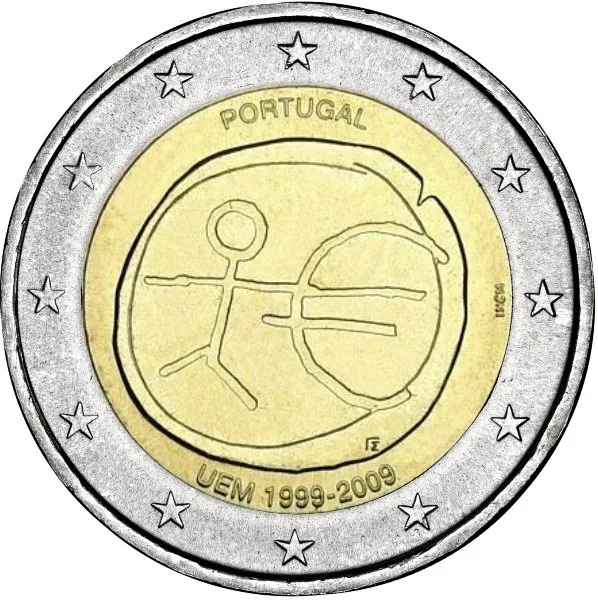
Centre: a stylised human figure on an ancient coin, its left arm extended to form the euro symbol. The artist's initials ΓΣ appear beneath the euro sign. The issuing state's name in the national language runs along the upper rim, while the dates 1999–2009 and the locally translated acronym for EMU appear along the lower rim.
Note on the coin
Second EU joint issue. All 16 eurozone states released a coin with this design on the anniversary date, 1 January 2009. The coins differ only in the inscription, which appears in the respective national language.
Further information on the topic
The Economic and Monetary Union of the European Union is one of the most far-reaching integration steps in post-war European history. With the introduction of the euro as book money on 1 January 1999, eleven member states - including Portugal - relinquished their national monetary sovereignty and transferred monetary policy to the newly established European Central Bank in Frankfurt am Main. This followed years of convergence efforts: the 1992 Maastricht criteria set binding ceilings on inflation, government debt and budget deficits, forcing participating countries into sometimes drastic structural reforms. For Portugal, this meant, among other things, a profound fiscal consolidation that first put the country in a position to meet the accession conditions.
Ten years after the launch of the Monetary Union, the EU community took a first assessment in 2009: the euro had established itself as a stable transaction currency, simplified intra-European trade, and eliminated exchange-rate risks for export-oriented economies such as Portugal's. At the same time, structural weaknesses in the construction became apparent - a lack of fiscal coordination and differing levels of competitiveness among member states - which soon came to light openly in the sovereign debt crisis. All eurozone states jointly marked the anniversary with a Europe-wide common issue, in which Portugal also participated, giving visible expression to the shared history of this monetary milestone.
Technical data
| Face value | 2 euro |
|---|---|
| Material | Bimetallic – outer ring: cupronickel; centre: three layers (nickel-brass / nickel / nickel-brass) |
| Weight | 8.5 g |
| Diameter | 25.75 mm |
| Thickness | 2.20 mm |