50th Anniversary of the Carnation Revolution
 + Add to collection In collection ★ Wanted
 At a glance
| Country | Portugal |
|---|---|
| Year | 2024 |
| Issue date | 22 April 2024 |
| Coin type | Commemorative coin |
| Mintage | 515.000 (7.500 / 7.500) |
| Catalogue number | PT-24 G1 |
| Designer | Henrique Cayatte |
| Rarity | €€€€€ what does this mean? |
| Edge lettering |  |
| Market value (approx.) | 4 € · guide price, uncirculated Unlock · for members |
Coin description
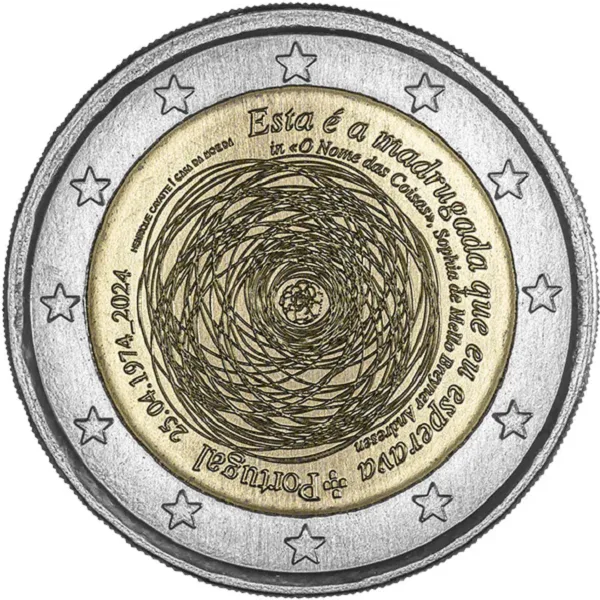
A carnation at centre — the enduring symbol of the revolution — surrounded by concentric circles. Along the right edge runs the verse "Esta é a madrugada que eu esperava" ("This is the dawn I was waiting for"), from the poem "O Nome das Coisas" by Sophia de Mello Breyner Andresen. Along the lower edge: the coat of arms, the issuing state "Portugal" and the dates "25.04.1974_2024". Upper left: the designer's name "HENRIQUE CAYATTE" and the mint name "CASA DA MOEDA".
Further information on the topic
25 April 1974 marks one of the most consequential turning points in Portuguese history. Within a matter of hours, a military movement — the Movimento das Forças Armadas — brought down an authoritarian regime that had shaped Portugal for more than four decades. The Estado Novo, under António de Oliveira Salazar and later Marcelo Caetano, had kept the country politically isolated, suppressed freedom of speech and the press, and waged a costly colonial war in Africa that strained both society and the economy. The people of Lisbon poured into the streets and placed carnations in soldiers' rifle barrels — a spontaneous image that gave the revolution its name: the Carnation Revolution. Within two years, democratic institutions were established, the colonies were granted independence, and Portugal opened politically and economically toward Europe.
The Carnation Revolution is regarded today as the founding moment of modern Portuguese democracy. It ushered in not only the transition to a parliamentary republic but also fundamentally transformed the country's society and self-image. Portugal joined the European Community in 1986 — a step that would not have been possible without the democratic opening of 1974. The poet Sophia de Mello Breyner Andresen, whose work was deeply rooted in democratic resistance, wrote her poem "O Nome das Coisas" on the very day of the uprising — an immediate testimony to the spirit of change. Her line "Esta é a madrugada que eu esperava" ("This is the dawn I was waiting for") captures the collective experience of a generation. Portugal marks the 50th anniversary of the revolution of 25 April 1974 in 2024.
Technical data
| Face value | 2 euro |
|---|---|
| Material | Bimetallic – outer ring: cupronickel; centre: three layers (nickel-brass / nickel / nickel-brass) |
| Weight | 8.5 g |
| Diameter | 25.75 mm |
| Thickness | 2.20 mm |