50 Years of the Treaties of Rome
 + Add to collection In collection ★ Wanted
 At a glance
| Country | Portugal |
|---|---|
| Year | 2007 |
| Issue date | 25 March 2007 |
| Coin type | Commemorative coin |
| Mintage | 1.520.000 (15.000 / 5.000) |
| Catalogue number | PT-07 G1 |
| Designer | Münze Österreich, Real Casa de la Moneda, Istituto Poligrafico e Zecca dello Stato S.p.A |
| Rarity | €€€€€ what does this mean? |
| Edge lettering |  |
| Market value (approx.) | 5 € · guide price, uncirculated Unlock · for members |
Coin description
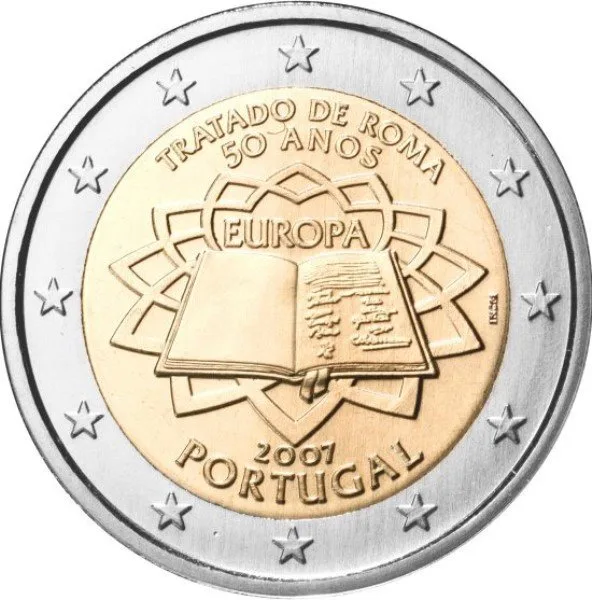
Centre: the treaty document, signed by the six founding members, set against the background of Michelangelo's star-patterned paving on the Piazza del Campidoglio in Rome, where it was signed on 25 March 1957. Directly above the document: the word "Europe" in the national language. Above: the commemorative inscription; below: the issuing state in the national language and the year 2007.
Note on the coin
First EU joint issue. All 13 eurozone states released a coin with this design on the anniversary date, 25 March 2007. The coins differ only in the inscription, which appears in the respective national language.
Further information on the topic
On 25 March 1957, the foreign ministers of six Western European states signed two agreements on Capitoline Hill in Rome that permanently altered the course of the postwar European order. The Treaty establishing the European Economic Community (EEC) and the Euratom Treaty jointly created a legal framework for an integrated internal market, coordinated economic policy, and the peaceful use of nuclear energy. The signing took place in the Palazzo dei Senatori, surrounded by Michelangelo's star-paved Capitoline square, which has since served as the visual symbol of the Treaties of Rome. The six founding states — Belgium, the Federal Republic of Germany, France, Italy, Luxembourg and the Netherlands — thereby laid an institutional foundation from which the European Communities, and eventually the European Union, emerged over the following decades.
Portugal was not among the signatory states in 1957; the country was still under the authoritarian Estado Novo regime at the time and kept its distance from Western European integration. Only after the Carnation Revolution of 1974 did Portugal gradually open up to democratic Europe, applying for EEC membership in 1977 and being admitted in 1986 together with Spain as the first pair of southern enlargement countries. Portugal introduced the euro on 1 January 2002. To mark the 50th anniversary of the Treaties of Rome in 2007, all eurozone states — including Portugal — jointly issued a 2-euro commemorative coin, one of the few Europe-wide joint issues with a uniform design.
Technical data
| Face value | 2 euro |
|---|---|
| Material | Bimetallic – outer ring: cupronickel; centre: three layers (nickel-brass / nickel / nickel-brass) |
| Weight | 8.5 g |
| Diameter | 25.75 mm |
| Thickness | 2.20 mm |