500th Birthday of Fernão Mendes Pinto
 + Add to collection In collection ★ Wanted
 At a glance
| Country | Portugal |
|---|---|
| Year | 2011 |
| Issue date | 8 September 2011 |
| Coin type | Commemorative coin |
| Mintage | 520.000 (12.500 / 7.500) |
| Catalogue number | PT-11 G1 |
| Designer | Isabel Carriço Almada, Fernando Branco |
| Rarity | €€€€€ what does this mean? |
| Edge lettering |  |
| Market value (approx.) | 7 € · guide price, uncirculated Unlock · for members |
Coin description
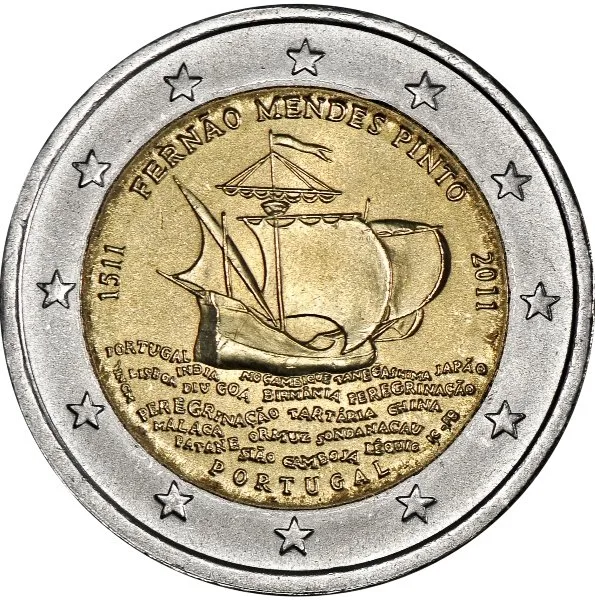
A sailing ship riding waves formed from the names of Fernão Mendes Pinto's destinations. Above: the inscription "Fernão Mendes Pinto" and the dates 1511 and 2011; below: the state inscription "Portugal", the twelve stars of the European Union, the INCM mintmark and the designers' initials IC-FB.
Further information on the topic
Fernão Mendes Pinto is one of the most colourful travellers of the 16th century - a Portuguese adventurer, merchant and chronicler whose life, spanning journeys across Asia, enslavement, shipwrecks and diplomatic missions, was scarcely to be surpassed. Born around 1511 in Montemor-o-Velho, Portugal, he set out for Asia in the 1530s and, over more than two decades, travelled through regions largely unknown to Europeans: the coasts of the Persian Gulf, Abyssinia, India, the Malay realm, Siam, China and Japan. His observations, his contacts with Jesuit missionaries such as Francis Xavier, and his account of the earliest European contacts with Japan make him a central figure in the history of Portuguese discovery.
His major work, Peregrinação, published posthumously in 1614, describes these journeys in a tone that shifts between factual report and literary reflection. For a long time the text was considered unreliable or even fictional - more recent research, however, has shown that many of his accounts are historically and geographically sound. Pinto was not a heroic explorer in the classic sense but a keen observer of foreign societies, who did not conceal the darker sides of Portuguese expansion either. Portugal honoured him on the occasion of his 500th birth anniversary in 2011 with a 2-euro commemorative coin underlining his significance for national memory and the history of European world travel.
Technical data
| Face value | 2 euro |
|---|---|
| Material | Bimetallic – outer ring: cupronickel; centre: three layers (nickel-brass / nickel / nickel-brass) |
| Weight | 8.5 g |
| Diameter | 25.75 mm |
| Thickness | 2.20 mm |
More 2-euro coins from Portugal
100 Years of the Portuguese Republic
Commemorative coin
Guimarães – European Capital of Culture 2012
Commemorative coin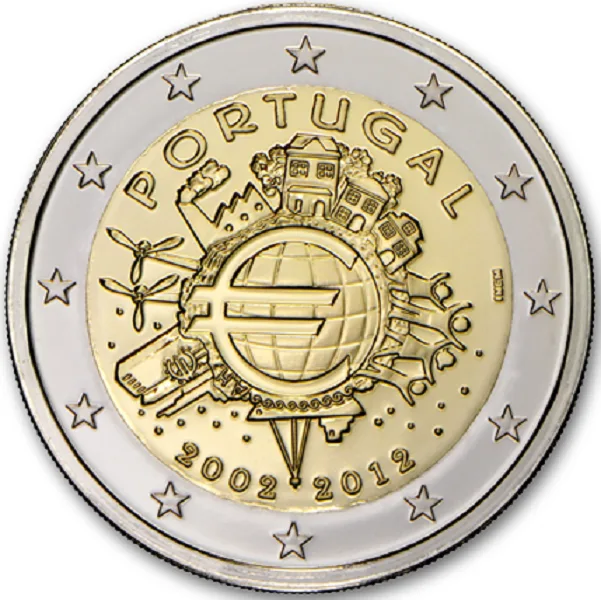
10 Years of Euro Banknotes and Coins
Commemorative coin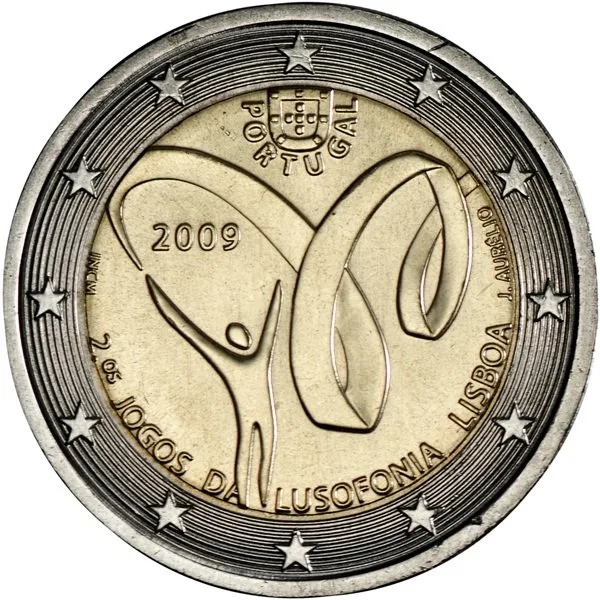
2nd Lusophony Games 2009 in Lisbon
Commemorative coin