100 Years of the Portuguese Republic
 + Add to collection In collection ★ Wanted
 At a glance
| Country | Portugal |
|---|---|
| Year | 2010 |
| Issue date | 7 September 2010 |
| Coin type | Commemorative coin |
| Mintage | 1.035.000 (20.000 / 15.000) |
| Catalogue number | PT-10 G1 |
| Designer | José Cândido |
| Rarity | €€€€€ what does this mean? |
| Edge lettering |  |
| Market value (approx.) | 3,5 € · guide price, uncirculated Unlock · for members |
Coin description
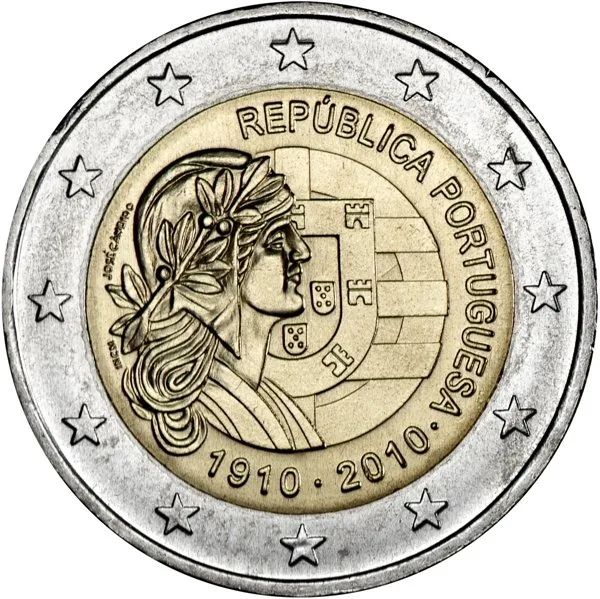
The allegorical figure "República", representing freedom, before the Portuguese coat of arms, the state inscription "República Portuguesa", the dates "1910" and "2010", the designer's name José Cândido, and the INCM mintmark.
Further information on the topic
Portugal is one of the few European countries whose transition to democracy did not follow the end of a lost war but arose from a popular movement - though the first chapter of its republican history began more than sixty years earlier. On 5 October 1910, the monarchy was overthrown following an uprising by the military and republican civilian forces; King Manuel II fled into exile. The First Portuguese Republic, proclaimed on that day, was a break with a centuries-old dynastic order and, at the same time, an attempt to lead Portugal into modernity: separation of church and state, freedom of the press, secularism in education. At the time, the country was still a colonial power with possessions stretching from Angola to Timor, and the new republic inherited this legacy along with its contradictions.
The First Republic proved politically unstable - between 1910 and 1926 governments succeeded one another in rapid succession, until a military coup ended parliamentary democracy. Nevertheless, 5 October remains a national holiday in Portugal to this day and is regarded as the founding moment of the modern state. The image of the "República" as a symbolic figure of freedom, used early on in printmaking and on stamps, remained a visual point of reference for Portuguese identity through every change of regime. On the hundredth anniversary of the founding of the Republic, Portugal recalled with this issue in 2010 a date that holds a firm place in the country's collective memory.
Technical data
| Face value | 2 euro |
|---|---|
| Material | Bimetallic – outer ring: cupronickel; centre: three layers (nickel-brass / nickel / nickel-brass) |
| Weight | 8.5 g |
| Diameter | 25.75 mm |
| Thickness | 2.20 mm |