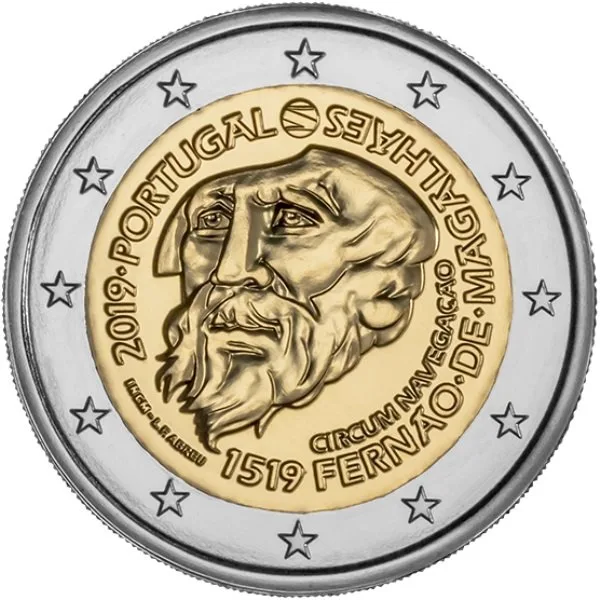
500 Years of Ferdinand Magellan's Circumnavigation
 + Add to collection In collection ★ Wanted
 At a glance
| Country | Portugal |
|---|---|
| Year | 2019 |
| Issue date | 8 May 2019 |
| Coin type | Commemorative coin |
| Mintage | 770.000 (10.000 / 10.000) |
| Catalogue number | PT-19 G1 |
| Designer | Luís Filipe de Abreu |
| Rarity | €€€€€ what does this mean? |
| Edge lettering |  |
| Market value (approx.) | 3 € · guide price, uncirculated Unlock · for members |
Coin description
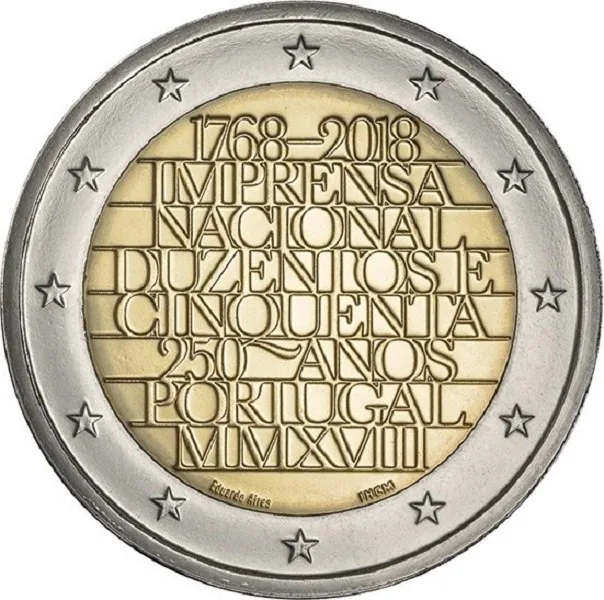
Three-quarter profile portrait of a bearded Ferdinand Magellan. The legend "2019 · PORTUGAL" runs to the left; below right: "CIRCUM NAVEGACÃO 1519 FERNÃO · DE · MAGALHÃES". Lower left: the INCM mintmark and the designer's name "L.F. ABREU" (Luís Filipe de Abreu). A stylised armillary sphere separates the inscription above.
Further information on the topic
Fernão de Magalhães was one of the boldest navigators of his time: a Portuguese in Spanish service who set sail from Seville in 1519 with five ships, setting in motion the first circumnavigation of the globe in history. Born into the Portuguese nobility, he had taken part in voyages to India as a young man and knew the eastern route around the Cape of Good Hope from his own experience. For his westward counterpart, he sought the backing of the Spanish king Charles I and was commissioned to find a western route to the Spice Islands. The expedition navigated the previously unknown strait at the southern tip of South America — today the Strait of Magellan — and then crossed the Pacific, at the time uncharted in its extent. Magalhães himself did not live to see the return to Europe: he was killed in an armed conflict in the Philippines in April 1521. His captain, Juan Sebastián Elcano, brought the Victoria back to Spain in 1522 as the only surviving ship, with 18 survivors aboard.
For Portugal, Fernão de Magalhães remains a central figure of the Age of Discovery that shaped the country in the 15th and 16th centuries, despite his service under the Spanish flag. Lisbon and the Iberian seafaring tradition as a whole owe to this era a world-historical significance that remains anchored in the cultural memory to this day. The circumnavigation provided empirical proof of the Earth's spherical shape and fundamentally changed the European view of the world — including the understanding of the true size of the Pacific Ocean. Portugal recalls the 500th anniversary of this expedition's departure with its 2019 2-euro commemorative coin, honouring one of the most consequential undertakings in the history of seafaring.
Technical data
| Face value | 2 euro |
|---|---|
| Material | Bimetallic – outer ring: cupronickel; centre: three layers (nickel-brass / nickel / nickel-brass) |
| Weight | 8.5 g |
| Diameter | 25.75 mm |
| Thickness | 2.20 mm |
More 2-euro coins from Portugal
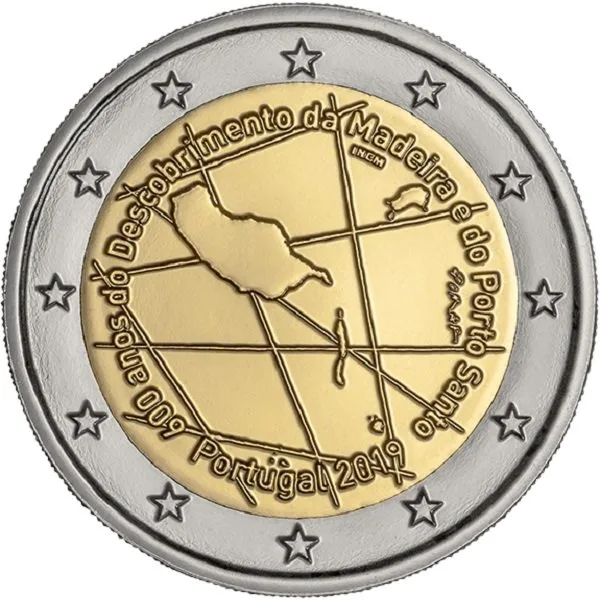
600 Years of the Discovery of Madeira
Commemorative coin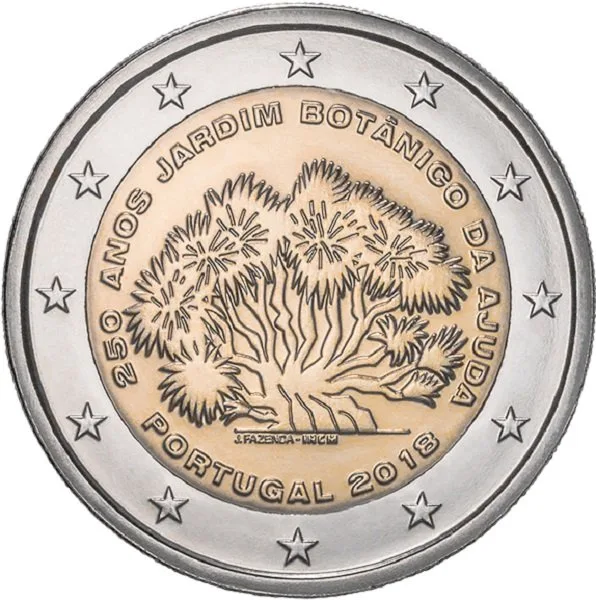
250 Years of the Ajuda Botanical Garden in Lisbon
Commemorative coin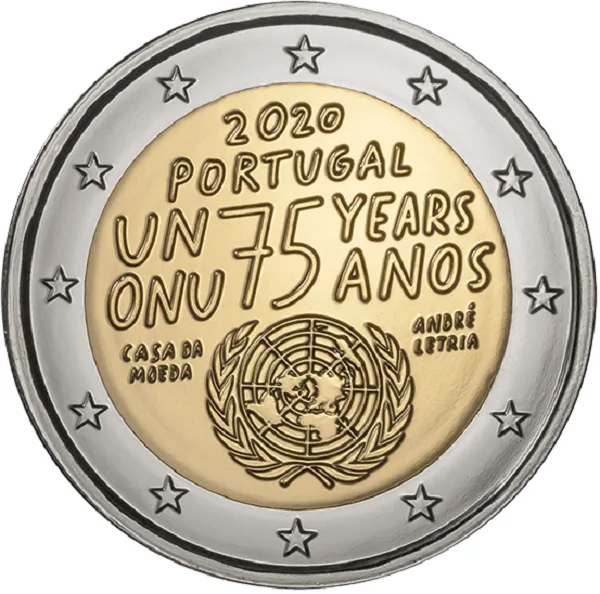
75 Years of the United Nations
Commemorative coin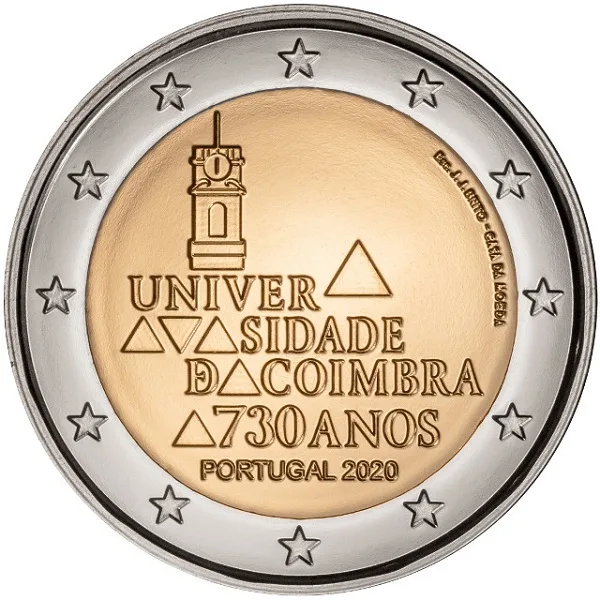
730 Years of the University of Coimbra
Commemorative coin