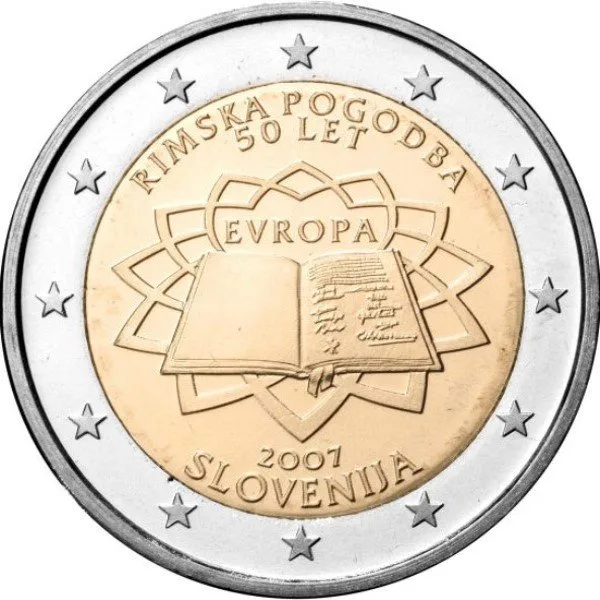
50 Years of the Treaties of Rome
 + Add to collection In collection ★ Wanted
 At a glance
| Country | Slovenia |
|---|---|
| Year | 2007 |
| Issue date | 25 March 2007 |
| Coin type | Commemorative coin |
| Mintage | 400.000 (990 / – ) |
| Catalogue number | SI-07 G1 |
| Designer | Münze Österreich, Real Casa de la Moneda, Istituto Poligrafico e Zecca dello Stato S.p.A |
| Rarity | €€€€€ what does this mean? |
| Edge lettering |  |
| Market value (approx.) | 28 € · guide price, uncirculated Unlock · for members |
Coin description
At the centre, the treaty document signed by the six founding members, set against the star-shaped paving of the Piazza del Campidoglio in Rome — designed by Michelangelo — where the Treaty was signed on 25 March 1957. Directly above the document, the word 'Europa' is inscribed in the language of each issuing state. The commemorative inscription appears above; the issuing state name in the relevant language(s) and the year 2007 appear below.
Note on the coin
First joint issue of the European Union. All 13 eurozone states issued a coin with the same design on the anniversary date of 25 March 2007. The coins differ only in the legend, which appears in the respective national language.
Further information on the topic
For Slovenia, the 1957 Treaties of Rome carry special historical weight: when Western Europe laid the foundation for its integration with the creation of the European Economic Community and the European Atomic Energy Community, Slovenia still belonged to Yugoslavia and was cut off from the emerging Common Market. Only after independence in 1991 did the path to Europe open up — Slovenia joined the EU in 2004 and, in 2007, became the first of the new member states to adopt the euro. The treaties, signed on 25 March 1957 on Capitoline Hill in Rome, thus mark the distant starting point of a process that ended with Slovenia becoming a full member of the eurozone.
The Treaties of Rome are regarded as one of the most consequential turning points in postwar European history. The six founding states — Germany, France, Italy, Belgium, the Netherlands and Luxembourg — used the EEC to create an internal market that dismantled tariffs, enabled the free movement of goods, and drove Europe's economic interconnection over the long term. What began in 1957 with six countries today encompasses a Union of 27 member states. On the occasion of the 50th anniversary of the signing of the treaties, all eurozone states jointly issued a 2-euro commemorative coin in 2007 — the first Europe-wide joint issue of its kind.
Technical data
| Face value | 2 euro |
|---|---|
| Material | Bimetallic – outer ring: cupronickel; centre: three layers (nickel-brass / nickel / nickel-brass) |
| Weight | 8.5 g |
| Diameter | 25.75 mm |
| Thickness | 2.20 mm |