500th Birthday of Adam Bohorič
 + Add to collection In collection ★ Wanted
 At a glance
| Country | Slovenia |
|---|---|
| Year | 2020 |
| Issue date | 23 December 2020 |
| Coin type | Commemorative coin |
| Mintage | 1.000.000 (7.000 / 2.500) |
| Catalogue number | SI-20 G1 |
| Designer | Lana Semečnik |
| Rarity | €€€€€ what does this mean? |
| Edge lettering |  |
| Market value (approx.) | 4 € · guide price, uncirculated Unlock · for members |
Coin description
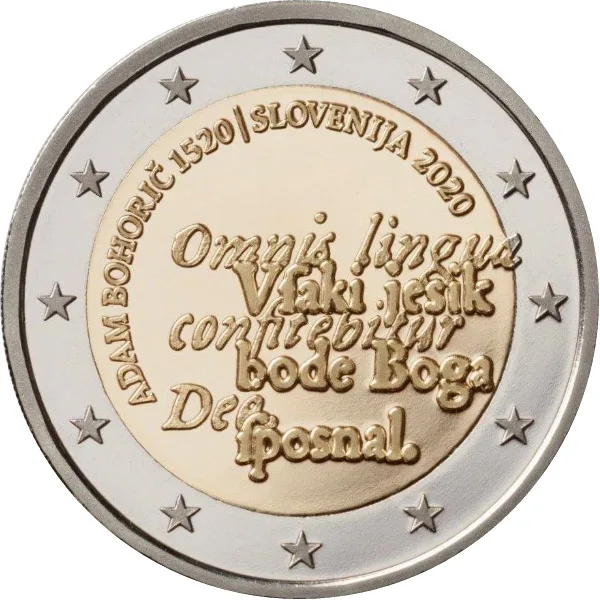
Two passages from the biblical glossary translated into Slovenian by Bohorič. The first is a verse from the Epistle to the Romans, chapter 14: 'Omnis lingua confitebitur Deo' ('Every tongue shall confess to God'), which appears in Latin as a shadowed background. The verse 'Vsaki jesik bode Boga sposnal' appears in relief in the foreground in Slovenian. Running along the left edge, the commemorative inscription 'ADAM BOHORIČ 1520', separated by a vertical rule from the issuing state 'SLOVENIJA' and the year '2020'.
Further information on the topic
Adam Bohorič was born around 1520 in Lower Styria and is one of the key figures in the history of the Slovenian language. As a Protestant and humanist, he worked mainly as rector of the provincial school in Ljubljana, where he maintained close contact with Primož Trubar and the circle of Slovenian reformers. His major work, the "Arcticae horulae" published in 1584, is the first printed grammar of the Slovenian language. In it, Bohorič developed a distinct orthography for Slovenian — known as Bohorič alphabet — based on the Latin alphabet, which remained in use until the 19th century. His work was based, among other things, on the translation of the Bible into Slovenian, in which he participated as co-editor; individual Bible verses he transcribed testify to the ambition of placing the vernacular on an equal footing with Latin.
The significance of Bohorič's work extends beyond linguistics: by systematising Slovenian grammatically, he created a foundation for a sense of literary community in a region that was politically highly fragmented. His grammar influenced the written form used by entire generations and thus represents an early building block of what would later lead to the Slovenian national movement and, eventually, statehood. In 2020, Slovenia marked his 500th birthday with a 2-euro commemorative coin honouring this reformer of the language — a tribute underscoring his place in the country's cultural memory.
Technical data
| Face value | 2 euro |
|---|---|
| Material | Bimetallic – outer ring: cupronickel; centre: three layers (nickel-brass / nickel / nickel-brass) |
| Weight | 8.5 g |
| Diameter | 25.75 mm |
| Thickness | 2.20 mm |