200 Years of the Ljubljana Botanical Garden
 + Add to collection In collection ★ Wanted
 At a glance
| Country | Slovenia |
|---|---|
| Year | 2010 |
| Issue date | 10 May 2010 |
| Coin type | Commemorative coin |
| Mintage | 1.000.000 (70.00 / 20.000) |
| Catalogue number | SI-10 G1 |
| Designer | Gorazd Učakar |
| Rarity | €€€€€ what does this mean? |
| Edge lettering |  |
| Market value (approx.) | 4 € · guide price, uncirculated Unlock · for members |
Coin description
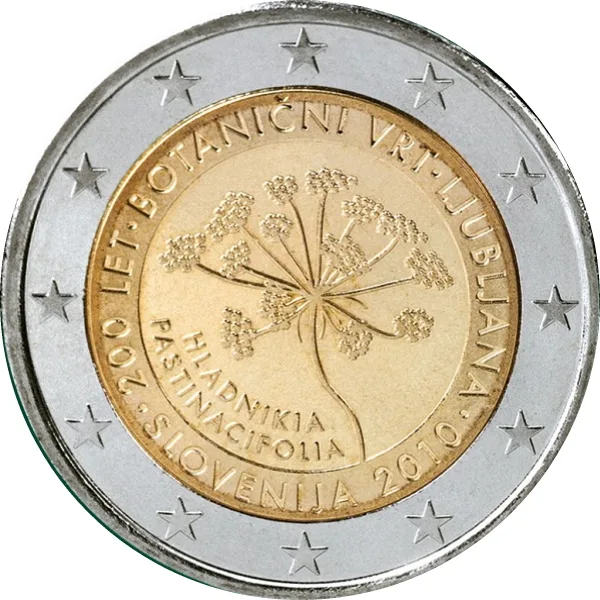
The Hladnikia, a significant Slovenian plant; the inscriptions 'Hladnikia Pastinacifolia' and '· 200 Let · Botanicni Vrt · Ljubljana ·'; the state name 'Slovenija' and the year 2010.
Further information on the topic
The Ljubljana Botanical Garden is one of Slovenia's oldest scientific institutions. It was founded in 1810 on the initiative of the naturalist Franz de Paula Adam von Hohenwart, initially as an academic teaching facility of the then Lyceum school. Located in the heart of the Slovenian capital, close to the old town, it is today one of the most important botanical collections in Central Europe. Particular attention is given to Slovenia's native flora, which, despite the country's small size, displays extraordinary biodiversity — owing to the convergence of alpine, Pannonian and Mediterranean climate zones. Related to this is Hladnikia pastinacifolia, a plant species found exclusively in Slovenia, belonging to the carrot family, named after the Slovenian botanist Franz Hladnik, who directed and substantially built up the garden between 1810 and 1840.
Hladnik himself is a key figure in the history of Slovenian natural science. He not only laid the foundations for the systematic development of the garden's collection but also extensively documented the native plant world and maintained exchanges with leading botanists of his time. Under his leadership, the garden developed from a teaching institution into a recognised research site. Today it maintains several thousand plant species and also serves as a refuge for Slovenia's threatened endemic species. To mark the 200th anniversary of the Ljubljana Botanical Garden, Slovenia issued a 2-euro commemorative coin in 2010 recalling this scientific and natural-historical tradition.
Technical data
| Face value | 2 euro |
|---|---|
| Material | Bimetallic – outer ring: cupronickel; centre: three layers (nickel-brass / nickel / nickel-brass) |
| Weight | 8.5 g |
| Diameter | 25.75 mm |
| Thickness | 2.20 mm |