35 Years of the Erasmus Programme
 + Add to collection In collection ★ Wanted
 At a glance
| Country | Lithuania |
|---|---|
| Year | 2022 |
| Issue date | 1 July 2022 |
| Coin type | Commemorative coin |
| Mintage | 300.000 (– / –) |
| Catalogue number | LT-22 G2 |
| Designer | Joaquin Jimenez |
| Rarity | €€€€€ what does this mean? |
| Edge lettering |  |
| Market value (approx.) | 3,5 € · guide price, uncirculated Unlock · for members |
Coin description
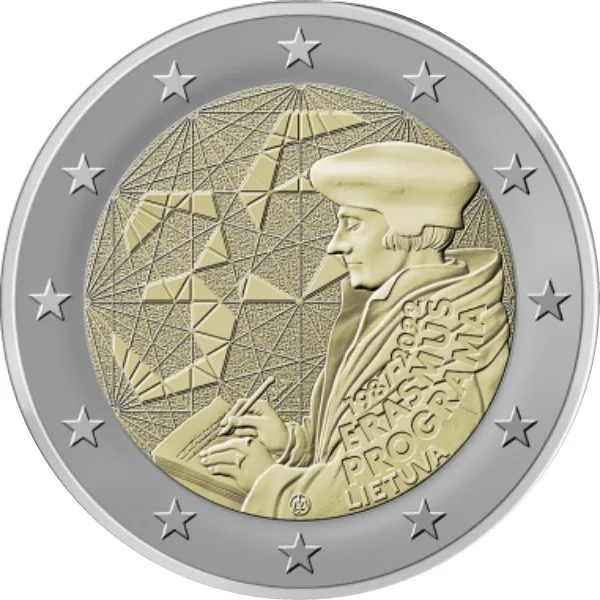
A blend of two defining elements of the Erasmus programme: its original intellectual inspiration — Erasmus himself — and an allegory of his influence on Europe. The former is represented by one of the best-known portraits of Erasmus; the latter by a web of connections arcing from beacon to beacon across the coin, evoking the countless academic and human exchanges among European students. Some of these connections form additional stars, born from the synergies between participating countries.
Note on the coin
Fifth joint issue of the European Union. All 19 eurozone states issue a coin with the same design on varying dates. The coins differ only in the inscription, which appears in the respective national language.
Further information on the topic
Launched in 1987, the European exchange programme bears the name of the Dutch humanist Desiderius Erasmus of Rotterdam — a scholar who moved between Europe's universities around 1500, teaching in Paris, Oxford, Cambridge, Turin and Basel, and whose intellectual work would have been unthinkable without the network of these institutions. The programme named after him created a structured framework for student stays abroad within Europe: starting as a pilot project with around 3,000 participants in eleven countries, it had grown by 2022 to over twelve million people who, over 35 years, studied or worked for a semester or longer at a partner university in Europe. Erasmus himself stands not merely as the programme's namesake but as the embodiment of the idea that education arises from movement and encounter — a conviction that runs through his major work, "In Praise of Folly", as much as through his lifelong resistance to intellectual provincialism.
Following independence in 1990, Lithuania gradually joined European structures and officially joined the Erasmus programme after EU accession in 2004. Since then, Lithuanian universities — foremost among them Vilnius University, founded in 1579 and thus one of the oldest in the Baltic states — have seen a steadily growing number of Erasmus exchanges, both outgoing and incoming. In Lithuania, the programme holds particular significance as a bridge between the post-Soviet education system and European academic standards: for many Lithuanian students, an Erasmus stay in the years following EU accession was their first extended time in Western Europe. To mark the Erasmus programme's 35th anniversary in 2022, Lithuania joined all euro states in the European joint issue of this 2-euro commemorative coin.
Technical data
| Face value | 2 euro |
|---|---|
| Material | Bimetallic – outer ring: cupronickel; centre: three layers (nickel-brass / nickel / nickel-brass) |
| Weight | 8.5 g |
| Diameter | 25.75 mm |
| Thickness | 2.20 mm |