150 Years of the Luxembourg Constitution
 + Add to collection In collection ★ Wanted
 At a glance
| Country | Luxembourg |
|---|---|
| Year | 2018 |
| Issue date | 8 January 2018 |
| Coin type | Commemorative coin |
| Mintage | 311.000 (7.500 / 3.500) |
| Catalogue number | LU-18 G1 |
| Designer | Herbert Wähner |
| Rarity | €€€€€ what does this mean? |
| Edge lettering |  |
| Market value (approx.) | 3,5 € · guide price, uncirculated Unlock · for members |
Coin description
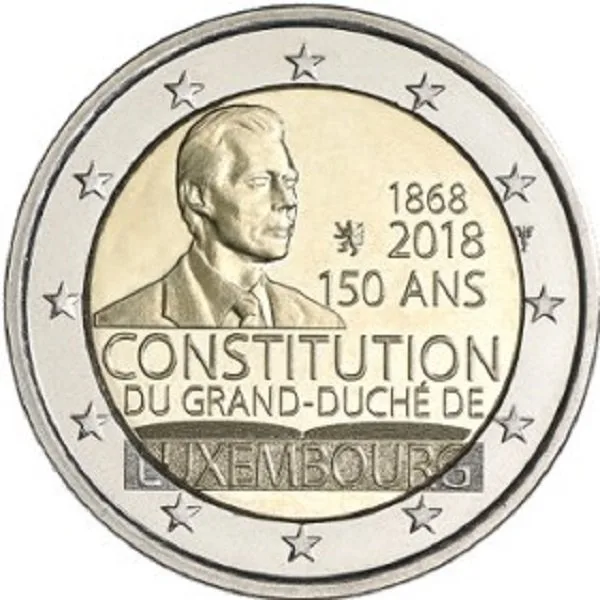
A portrait of Grand Duke Henri looking right. To the right: the years "1868–2018" and "150 Jahre". Below the portrait: the inscription "CONSTITUTION DU GRAND-DUCHÉ DE LUXEMBOURG", alongside an open book in cross-section.
Note on the coin
In 2018 a retrospective set was issued comprising the Luxembourg €2 commemorative coins of 2016–2018 (LU-16 G2, LU-17 G2, LU-17 G4, LU-18 G3, LU-18 G6) with the 2018 mintmarks.
Further information on the topic
The constitution of the Grand Duchy of Luxembourg of 1868 emerged during a period of profound political reorganisation. Following the Treaty of London of 1867, which assigned Luxembourg the status of a permanently neutral and demilitarised state, the new constitution created the legal foundation for a sovereign, constitutional nation-state. It replaced the predecessor constitution of 1856, which had still been strongly shaped by German constitutional law, and enshrined liberal fundamental rights, the separation of powers, and parliamentary participation. Grand Duke William III of the Netherlands signed the document on 17 October 1868. The basic law has been reformed several times since, but has retained its structural continuity for 150 years.
Luxembourg is one of the oldest constitutional democracies in Europe, and the 1868 constitution is regarded as a fixed point in that development. The document still regulates the relationship between the Grand Duke as head of state, the Chamber of Deputies and the judiciary today. Grand Duke Henri, who has reigned since 2000, embodies this constitutional continuity as the current head of state. To mark the 150th anniversary of the Luxembourg constitution in 2018, Luxembourg honoured this founding document with a 2-euro commemorative coin.
Technical data
| Face value | 2 euro |
|---|---|
| Material | Bimetallic – outer ring: cupronickel; centre: three layers (nickel-brass / nickel / nickel-brass) |
| Weight | 8.5 g |
| Diameter | 25.75 mm |
| Thickness | 2.20 mm |
More 2-euro coins from Luxembourg
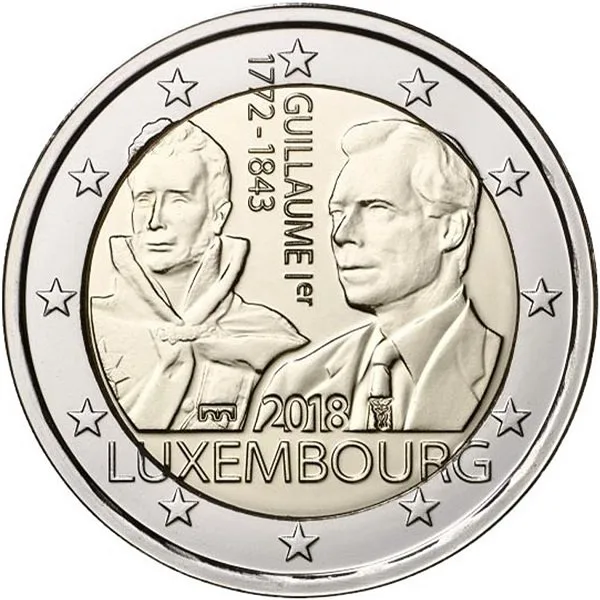
175th Anniversary of the Death of Grand Duke Guillaume I
Commemorative coin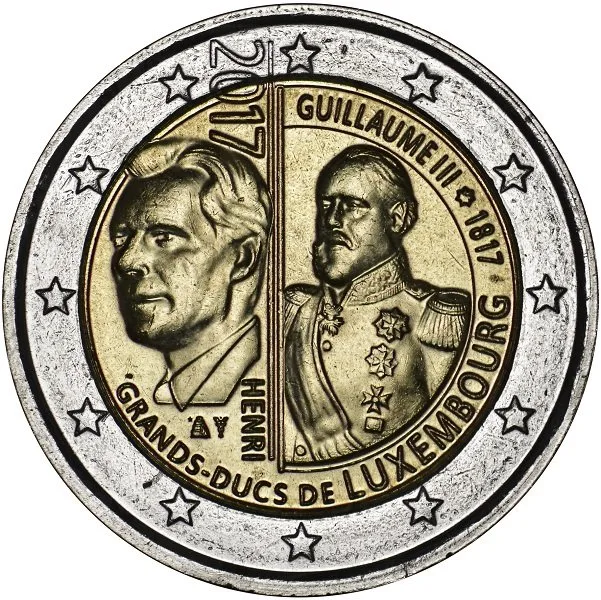
200th Birthday of Grand Duke Guillaume III
Commemorative coin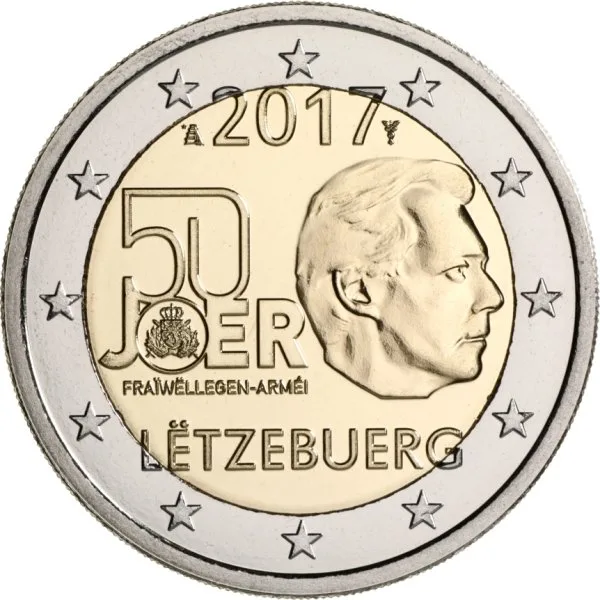
50 Years of Voluntary Military Service in Luxembourg
Commemorative coin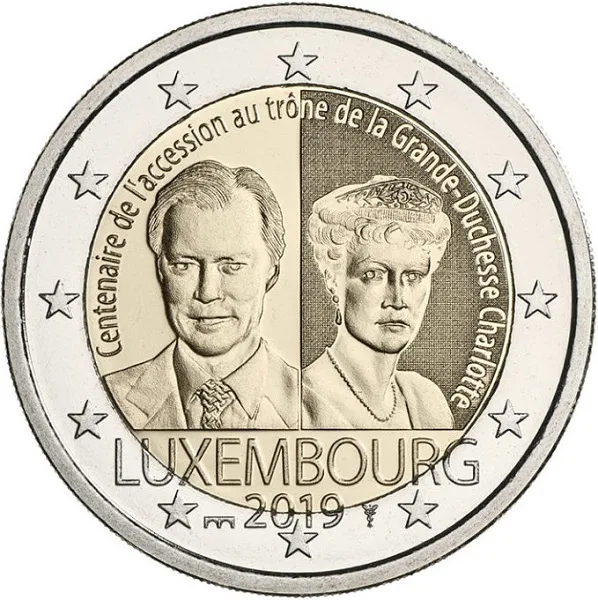
100th Anniversary of Grand Duchess Charlotte's Accession to the Throne
Commemorative coin