60 Years of Asterix
 + Add to collection In collection ★ Wanted
 At a glance
| Country | France |
|---|---|
| Year | 2019 |
| Issue date | 7 June 2019 |
| Coin type | Commemorative coin |
| Mintage | 310.000 (300.000 / 10.000) |
| Catalogue number | FR-19 G1 |
| Designer | Ateliers de Gravure, Monnaie de Paris |
| Rarity | €€€€€ what does this mean? |
| Edge lettering |  |
| Market value (approx.) | 13,5 € · guide price, uncirculated Unlock · for members |
Coin description
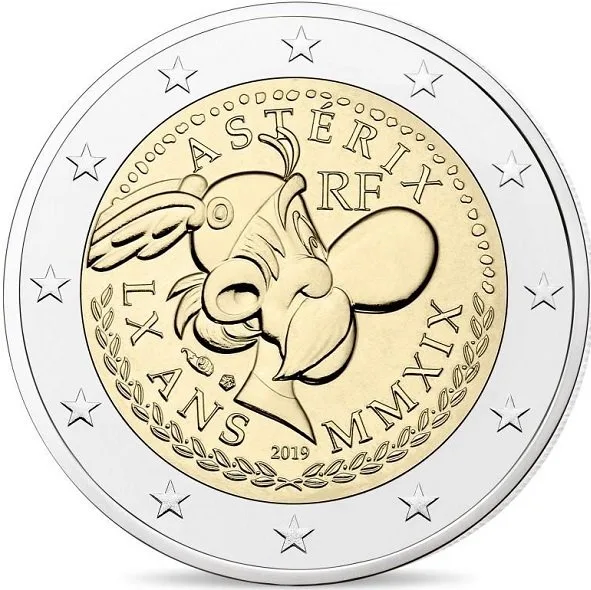
Asterix in profile, wearing his famous winged helmet, surrounded by laurel leaves and Roman inscriptions relating to his 60th anniversary. At the top the inscription "ASTERIX", below it the issuing country "RF" ("République Française"). The year of issue "2019" appears at the bottom together with the French Mintmark and the mintmaster's mark.
Further information on the topic
Few European comic characters have achieved a cultural reach comparable to Astérix. Since the first album in 1959, drawn by Albert Uderzo from a script by René Goscinny, the adventures of the fearless Gaul have appeared in more than 40 languages and sold over 380 million copies worldwide. The character strikes a nerve that goes far beyond children's reading: the clash between the small Gaulish village and the overwhelming Roman occupation contains a timeless comedy about power, bureaucracy and national quirks that remains a touchstone of popular culture in France to this day. Social satire, political caricature, and wordplay with Latin names and anachronistic references have all made Astérix a phenomenon taken seriously by literary scholars and schoolchildren alike.
Its origins lie with the publishing house Dargaud and the magazine Pilote, which Goscinny had co-founded. After his death in 1977, Uderzo carried the series on alone; since 2013 it has been in the hands of the writing duo Jean-Yves Ferri and Didier Conrad. France celebrated Astérix's 60th birthday in 2019 as a national cultural event - with special exhibitions, a reissue of early albums and public attention usually reserved for writers or statesmen. The comic has long been a fixture of the French educational canon and is used in schools as a source for everyday history and the satirical tradition. That France chose this anniversary as the occasion for a 2-euro commemorative coin shows how seriously the country treats its popular-culture icons alongside the classical arts.
Technical data
| Face value | 2 euro |
|---|---|
| Material | Bimetallic – outer ring: cupronickel; centre: three layers (nickel-brass / nickel / nickel-brass) |
| Weight | 8.5 g |
| Diameter | 25.75 mm |
| Thickness | 2.20 mm |